US sells more missiles to Persian Gulf Arab allies despite dwindling stockpile: Report
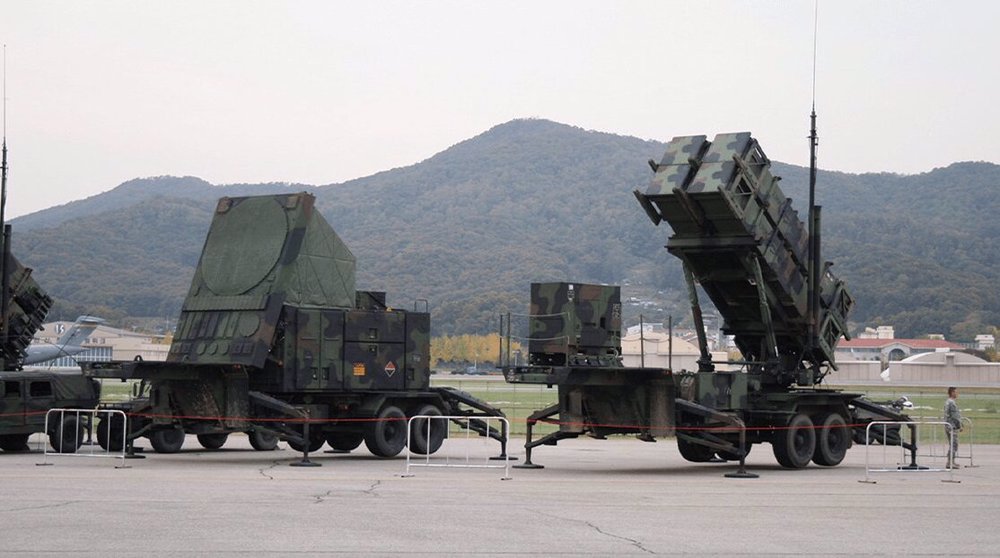
The administration of US President Donald Trump has reportedly approved sales of thousands of interceptor missiles and related services worth $17 billion to three Persian Gulf Arab countries, namely Kuwait, the UAE and Bahrain.
Citing US State Department and congressional officials, The New York Times reported that the exports had been authorized despite dwindling American stockpile caused by the recent war of aggression that the United States and the Israeli regime waged against Iran.
New exports are in addition to another package of sales valued at more than $8.6 billion and announced last week in news releases, the report said.
In total, according to the report, the State Department authorized about $25.7 billion in sales last Friday.
“This emergency action sends our partners a clear message we stand with them,” the State Department said in a statement to The New York Times after being asked about the sales.
A congressional official said the dollar values were $9.3 billion from Kuwait, $6.25 billion from the UAE and $1.625 billion from Bahrain.
Latest estimates show that the US military and Persian Gulf Arab countries used over 1,300 and about 600 Patriot missiles during the 40-day war on Iran, respectively.
US missile stockpiles severely depleted amid terrorist war on Iran: Reporthttps://t.co/j4oyW2Oh1p
— Press TV 🔻 (@PressTV) April 22, 2026
American companies produce more than 600 Patriot missiles per year. That means the United States and its Persian Gulf allies have burned through three years’ worth of such weapons.
According to a copy of the notification letter cited by The Times, each country's order includes two types of Patriot interceptor missiles. Based on a per-missile cost of approximately $4 million, the three orders amount to roughly 4,250 missiles.
That figure is separate from another major order announced last Friday. Qatar is purchasing $4 billion of interceptor missiles, equating to about 1,000 units. Combined production of this magnitude would take years to complete.
Patriot systems are manufactured by Raytheon, with Lockheed Martin also producing missiles for the platform.
The drawdown has raised alarms among some Pentagon officials who worry that US military readiness for conflicts elsewhere has been compromised.
The Pentagon has had to divert munitions from commands in Asia and Europe to West Asia, despite a broad belief in Washington that China — with the world's fastest-growing military — poses the greatest long-term security challenge to the United States.
The Trump administration has invoked emergency authorization three times to bypass congressional approval for West Asia arms sales.
“Again invoking emergency authorities, this time for over $25 billion in major weapons transfers, only highlights the administration’s failure to manage this war of choice,” Representative Gregory Meeks, the top Democrat on the House Foreign Affairs Committee, said in a statement.
“It did not do the necessary homework before going to war, and now it is rushing to resupply Persian Gulf partners while unnecessarily bypassing Congress, which stand as yet further examples of the administration’s own unpreparedness.”
Iran seeks reparations from five Arab states for enabling US-Israeli aggressionhttps://t.co/oVErqX8IfY
— Press TV 🔻 (@PressTV) April 14, 2026
The illegal US-Israeli aggression on Iran began on February 28 with airstrikes that assassinated senior Iranian officials and commanders.
The Persian Gulf littoral states allowed the aggressor regimes to use their soil and airspace to launch anti-Iran attacks.
UAE plane carrying Israelis lands in Saudi Arabia after pilots' brawl creates hijacking scare
Netanyahu begs UAE leader to publicly deny warning of Al-Aqsa Flood operation: Report

Netanyahu makes secret visit to Abu Dhabi amid deepening alliance: Report



Iraqis celebrate US troop withdrawal as country marks National Sovereignty Day
Iran’s Mirzazadeh defends Asian Games Greco-Roman 130kg gold in Nagoya
US losing response capability as Iran maintains control of Strait of Hormuz: IRGC
VIDEO | Iran-US conflict
VIDEO | Restricting Chinese firms is own goal against Europe's economy: Analyst
Pezeshkian: Iran’s strong maritime presence in Hormuz kept vital national lifelines moving
Iran Airbus A319 returns to service with in-house expertise
Iraq’s long, dark night ends: 23 years of American lies, occupation, abuse end in humiliating ouster



 PressTV NEWSLETTER
now
PressTV NEWSLETTER
now
 This makes it easy to access the Press TV website
