

More than 30 rights organizations have warned that French President Emmanuel Macron’s visit to Bahrain would embolden Manama to continue with its years-long crackdown on the dissent across the Persian Gulf island country.
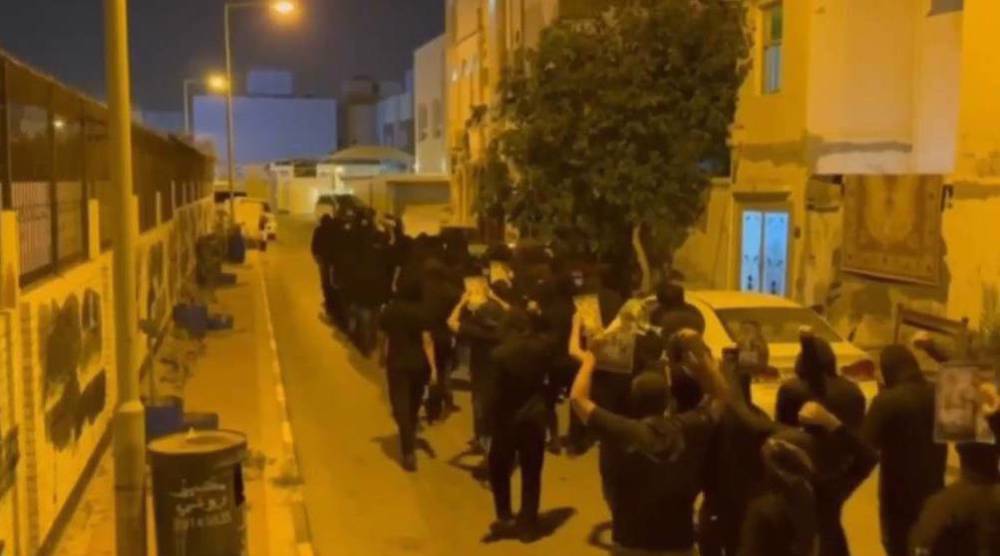
In a joint letter to Macron, 32 rights groups and organizations, including the Bahrain Institute for Rights and Democracy (BIRD), Human Rights Watch and the International Federation for Human Rights (FIDH), stressed that Manama is experiencing its most severe crackdown on dissent since a popular uprising began in mid-February 2011.
The signatories also warned the French president, who seeks to ink energy deals in some Persian Gulf countries, including Bahrain, that closer political and security cooperation could risk "emboldening the Bahraini authorities” in their crackdown on the dissent.
“France must not sacrifice human rights for lucrative [Persian] Gulf deals under the guise of regional security,” said Sayed Ahmed Alwadaei, advocacy director at BIRD.
“Bahrain must not be allowed to buy France's silence. Those responsible for serious human rights abuses must face consequences, not rewards from France,” he stressed.
Since the unprovoked war of aggression on Iran by a US-Israeli military coalition in late February, the tiny kingdom has responded to any expression of perceived sympathy for the Islamic Republic by detaining more than 700 people and stripping citizenship from 69 citizens, including 33 children, the youngest of whom was just 19 days old.
The ruling Al Khalifa regime has for years cracked down on its majority Shia population, as authorities havve been seeking to quell democratic protesters demanding that the regime relinquish power and allow a just system representing all Bahrainis to be established.
This is while King Hamad warmly welcomed Macron on Tuesday as the French leader’s visit to the small island country forms part of a Persian Gulf tour from October 19 to 21, encompassing Kuwait, the United Arab Emirates (UAE), Bahrain and Qatar.
Macron, whose authority at home lies in tatters due to massive rallies protesting the rise in the cost of living, has obtained, according to a statement by the Elysee Palace, commitments for around 100,000 tons of extra diesel per month from the UAE and 100,000 tons of extra diesel from Bahrain.
The statement added that with the additions of deliveries from Saudi Arabia, the European country has commitments for 295,000 tons per month, representing just over 10 percent of its consumption.
“At a time when students are protesting for better conditions in France, Macron is in Bahrain, where two EU prisoners of conscience are still imprisoned after 15 years,” said Maryam al-Khawaja, a Bahraini activist.
After the US waged a war on Iran and laid a siege on Iranian southern ports, Tehran blocked the flow of tankers through the strategic strait of Hurmuz. The closure led to a sharp increase in the cost of energy in societies across the globe, including France.
“The current crisis should remind President Macron that lasting energy security depends on respect for human rights and peace,” said Antoine Madelin, Fidh's advocacy director.
“France must look beyond immediate supplies and support the open, democratic societies on which a stable future depends,” he added.
According to Intelligence Online, Macron, who has fully withdrawn French troops from Iraq, is looking to announce the deployment of troops to Persian Gulf countries to allegedly protect their airspace from possible Iranian missiles and drones strikes.
Paris charges millions of dollars annually for its air defense teams, and according to the outlet, the UAE been receiving such support “for many months.”
 This makes it easy to access the Press TV website