

By Press TV Website Staff
There is little doubt that a common thread among candidates vying for the Israeli premiership is their hard-line stance toward the Islamic Republic of Iran and the Resistance Front. Although they may differ in domestic policy and political strategy, Iran and regional dynamics remain central to their broader agendas of Zionist expansionism.
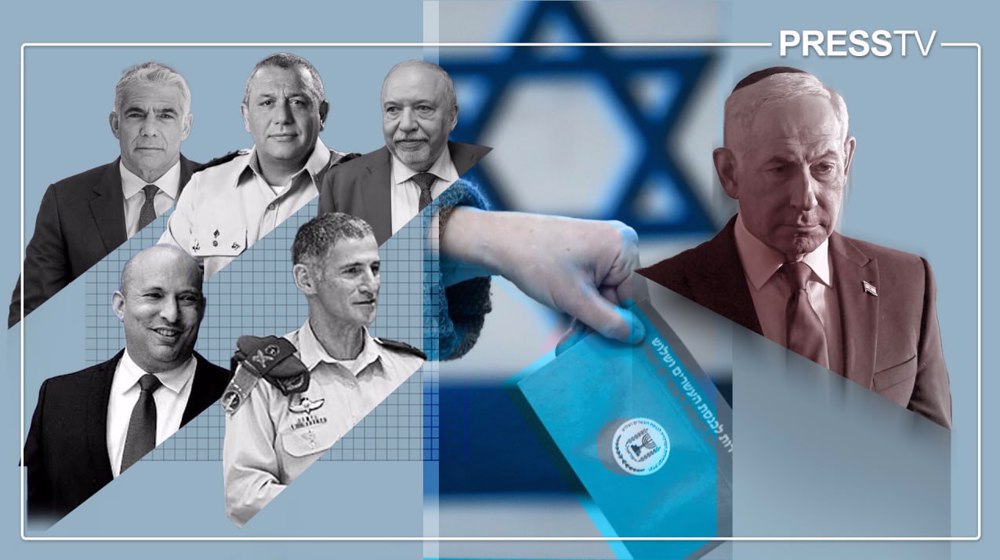
Against this backdrop, the name of former Israeli military chief Gadi Eisenkot has increasingly featured in political discussions as a key challenger to Benjamin Netanyahu. His public statements, policy positions, and record in military leadership offer important points of reference for assessing what his political prominence could mean for the regime.
Eisenkot, the 21st chief of staff of the Israeli army from 2015 to 2019, is the founder and leader of the "Yashar" party (meaning "right/straight").
In polling for the Israeli regime's premiership, Eisenkot has been leading Netanyahu. However, Israel's political structure is deeply polarized, and neither of the two main sides has the necessary 61-seat majority.
Who is Eisenkot?
Eisenkot was born on May 19, 1960, in the city of Tiberias in the northern occupied territories. He was the second of four children of Meir and Esther Eisenkot, who immigrated to the occupied territories from Morocco in the 1950s. His father was from Morocco and his mother from Casablanca. His parents later divorced, and his father remarried, having four more children from that marriage.
Regarding the origin of the surname "Eisenkot," two views are put forward. One is that the name is originally Ashkenazi, as Jewish families from Russia and Poland immigrated to Morocco in the 19th century and during World War II.
The refugees forgot their native language but retained their Ashkenazi surnames such as Goldberg, Wasserman, and Shapiro. Eisenkot is also from this category. Others believe "Ozenkot" is a Moroccan name meaning "deer" in the Berber language. According to this theory, an Israeli registry clerk changed the letter "v" to "y" at the time of the family's immigration, and "Ozenkot" became "Eisenkot."
Eisenkot spent his childhood and adolescence in the south of the occupied territories, where his father was active in the shipping industry. He studied marine sciences at Goldwater High School and then obtained his diploma at a boarding school.
Eisenkot holds a bachelor's degree in general history from Tel Aviv University and a master's degree in political science from the University of Haifa. He also completed a military studies course at the US Army War College in Pennsylvania.
On December 8, 2023, Gal Meir Eisenkot, Eisenkot's 25-year-old son, who was an officer in the Maglan unit, was killed in Jabalia in the northern Gaza Strip, just months after the regime launched its genocidal war on Gaza. Two of his nephews were also killed in the same war.
This personal loss turned the spotlight on Eisenkot in the occupied territories, while Netanyahu's sons did not directly participate in the war. This contrast has created enormous political capital for Eisenkot among settlers.
Entry into the army
Eisenkot joined the Golani Infantry Brigade in November 1978 and was stationed in Battalion 51. Before that, he briefly participated in the Israeli air force pilot course but was expelled after a month and sent to the Golani Brigade.
He completed the combat training course as a squad soldier and passed the company commander and officer course. During this course, he was wounded in the head after a machine gun bullet penetrated the armored personnel carrier he was driving.
After recovery, he returned as a platoon commander in Battalion 51. In the 1982 Lebanon War, Eisenkot took command of the first company of Battalion 51. He replaced a company commander who had been wounded in the Battle of Beaufort. He participated in the Israeli military aggression on Ain al-Tineh, Nabatieh, Jazine, and Beirut Airport.
In the Battle of Ain al-Tineh, he lost two close friends. A year after the war, Eisenkot was discharged from the army, but after three months returned to accept the offer of the Officers' School commander, replacing Eyal Birn, to serve as commander of a company of officer cadets.
In 1984-1985, he commanded the anti-tank company of the Golani Brigade and led his forces in complex operations in Lebanon. A month before the end of his mission, he was dismissed from his post due to a public dispute with the brigade commander, Tzvi Fogel, and refusal to order his company to return in the middle of a leave.
Eisenkot was then sent to the Command and Staff College. In 1986-1987, he served as brigade operations officer. After completing the battalion commanders' course, he was appointed commander of Battalion 13 (Gideon) and then deputy commander of the Golani Brigade. In 1991, he was appointed operations officer of the Northern Command. In 1992, he was promoted to the rank of colonel and took command of the Carmeli Reserve Brigade.
In 1994, he simultaneously took command of the Ephraim Brigade. In 1997, he succeeded Colonel Erz Gerstein and took command of the Golani Brigade, shortly after the fire disaster in Wadi Saluki in which battalion commanders were killed.
In subsequent years, Eisenkot commanded Division 366, serving as deputy operations chief of the General Staff, and commanded the Northern Command. He held the Northern Command directly after the Second Lebanon War (2006).
During his tenure as deputy operations chief and Northern Command commander, he became particularly notorious for introducing the "Dahiya Doctrine." This doctrine emphasizes the use of devastating and disproportionate firepower against civilian infrastructure as a tool for deterrence. The doctrine is named after the Dahiya neighborhood in southern Beirut, which was heavily bombed by the Israeli occupation forces in the 2006 war.
The doctrine has been described by rights campaigners as a blatant violation of international law. Eisenkot is known as one of the main architects of this doctrine.
He was appointed as the 21st Chief of Staff of the Israeli Army on February 16, 2015, succeeding Benny Gantz. His term continued until January 15, 2019. His successor was Aviv Kochavi. During his tenure, Yair Golan and then Aviv Kochavi were his deputies. The military affairs ministers during his time were Moshe Ya'alon, Lieberman, and Netanyahu.
His tenure included many notorious Israeli offensives: the so-called "Northern Shield" offensive in 2018-2019 against Hezbollah tunnels on the northern border; and the "House of Cards" offensive in May 2018 against civilian infrastructure in Syria after rockets were fired at the Golan Heights.
During his tenure as chief of staff, Eisenkot pursued the so-called "mowing the grass" strategy—an approach in which the army, through short, extensive, and continuous attacks, temporarily destroys enemy capabilities to create long periods of calm.
Eisenkot's entry into politics
After retiring from the army in 2019, Eisenkot entered the Knesset in the 2022 elections as a senior member of the alliance led by Benny Gantz. He held a high position on the party's list and was known as one of its key figures.
After the Operation Al-Aqsa Flood in October 2023, Eisenkot and four other alliance members—Gantz, Gideon Sa'ar, Chili Tropper, and Yifat Shasha-Biton—joined the emergency cabinet and served as ministers without portfolio. This cabinet was formed five days after the start of the genocidal war on Gaza. In 2024, he left the cabinet and accused Netanyahu of having no clear strategy for Gaza. Eisenkot was the most influential member in key decisions in the war cabinet.
The most important of these decisions was agreeing to a four-day ceasefire with Hamas in exchange for the release of 50 Israeli military captives. Eisenkot was the minister most willing to do anything to save them. Through his insistence, he eventually convinced other generals and the military affairs minister, and a total of 110 captives were released in that ceasefire.
Eisenkot founded his own party, "Yashar" on the eve of the October 2026 elections. This party presents itself as a centrist alternative to Netanyahu's regime.
The "Maariv" poll published on September 9-10 showed that "Yashar" would be the largest party in the Knesset with 25 seats, while Likud would come second with 19 seats. This was Likud's lowest level since May 2025. This poll was conducted with 4,329 respondents and had a maximum sampling error of 4%.
A Channel 12 survey published on Tuesday showed Netanyahu falling further behind Eisenkot, with 45% of respondents considering Eisenkot better suited as the new regime premier compared with 33% for Netanyahu.
On September 9, 2026, the "Yashar" party announced that it had signed an agreement with the party led by Yair Golan. Simultaneously, the "Bayachad" alliance led by Bennett and Lapid signed an agreement with "Israel Beiteinu" led by Lieberman. The purpose of these agreements is to prevent the wasting of votes and maximize opposition seats, a lesson learned from previous elections.
"We are determined to continue by any means possible to achieve victory, realize the people's will, and form a Zionist government and a government that replaces the October 7 government," the Yashar party stated in a statement.

Composition of Yashar's electoral list
Yashar's final list includes 40 names, composed as follows: Yoram Cohen, former Shin Bet chief (rank 2); Orit Farkash-Hacohen, former Knesset member; Adi Altschuler (rank 3), entrepreneur, proposed candidate for education minister (rank 4); Matan Kahana, retired colonel and former minister (rank 5); Chili Tropper, former minister (rank 6); Shaul Meridor, former director of the budget department of the finance ministry (rank 7); Shira Shapira, mother of Aner Shapira who was killed on October 7, 2023, at the Nova festival (rank 10); Elazar Stern, retired major general and former minister (rank 12); Dvora Sharifian Bachar, former Mossad and Shin Bet operative (rank 14); and Kamil Abu Rokon, a former regime official.
No bloc has the required 61-seat majority. This potential deadlock makes the position of small and Arab parties a determining factor. Lieberman and Bennett could act as "kingmakers," while Arab parties may refuse to support a regime led by Eisenkot or set conditions for it.
Eisenkot's political positions
Eisenkot announced in August 2026 that he opposes the establishment of a Palestinian state and called support for this option an "illusion." He has described Palestinians as bitter enemies of Jews over many decades.
In an interview in June 2026, he said: "I have never said two states for two peoples, because I understand the depth of this religious-national-social conflict, and anyone who talks about 'peace now' and two states does not understand the conflict. I very much believe in settlement construction in Judea and Samaria."
Eisenkot is known as a "military hawk" who believes in the use of indiscriminate force but also opposes "reckless adventures." He recently described Netanyahu's ceasefire agreement with Lebanon at Trump's request as "unreasonable surrender."
On the issue of Lebanon and the Hezbollah resistance movement, he has a position distinct from Netanyahu. He agrees with Netanyahu that the Americans should play a major role in managing the Lebanese army through military liaison officers. But he believes the French should also regain a significant share in these arrangements. Netanyahu has excluded France from any role due to the country's criticism of Israel's genocide in Gaza and Lebanon.
Regarding the security buffer zone in southern Lebanon, Eisenkot's view is not far from Netanyahu's. Netanyahu has shown he wants to maintain the entire current buffer zone, which in some places is more than 10 kilometers. Eisenkot, due to his military expertise, is pessimistic about the Lebanese army's performance, but under certain conditions, is willing to retreat to an 8-kilometer security zone.
He is deeply concerned about Hezbollah's presence in southern Lebanon, despite the Israeli army's deep incursion into the region. He hopes that US and French political and military support can pressure the Lebanese army to act against the Lebanese resistance.
On relations with the US and the West, Eisenkot has stated that one of his main goals is to restore Israel-US relations and convince Americans, both Democrats and Republicans, that Israel is an asset to America. He believes that Netanyahu's departure will end the isolation of the Israeli regime and end inflammatory statements by US government officials.
Political ambiguity
Eisenkot has not yet been able to draw a precise political vision for his prime ministership. The contradictory composition of the Yashar list, including high-ranking former military figures and Zionist right-wingers, may face divisions on key domestic and foreign policy issues.
Given the current deadlock in polls, several scenarios are proposed: an Eisenkot regime with implicit support from Arab parties from outside; or the cabinet supports Eisenkot or joins it with conditions. Eisenkot has not explicitly ruled out the possibility of an alliance with the Ra'am party.
In the final weeks before the elections, Eisenkot has exerted all his efforts to organize the anti-Netanyahu camp efficiently. His strategy is simple: instead of votes being scattered among dozens of small parties, the entire camp should focus on four main parties.
This division allows the parties to cooperate with each other and sign surplus agreements so that no vote is wasted. This decision by the Yashar party is a lesson learned from past elections, where the scattering and wasting of votes dealt a heavy blow to the anti-Netanyahu camp.

Eisenkot's military doctrine
Eisenkot's doctrine can be considered part of the Israeli army's overall strategy, shaped within the framework of the concept of "Campaign Between the Wars" (MABAM).
The basic logic of this approach is based on the assumption that a regime—an illegitimate entity—seeking to advance its goals through the campaign between the wars must simultaneously be prepared for the outbreak of war.
Therefore, the precondition for the successful implementation of this approach is possessing high military readiness and readiness to use force, while trying to prevent the outbreak of a comprehensive war.
At the regional level, this approach is also related to the goal of expanding the regime's regional expansionist project. One of the important elements of this strategy is maintaining Israel's "freedom of action." Changes in regional conditions lead to changes in Israel's operational space, and maintaining freedom of action for conducting aggressions is of high importance.
Dahiya Doctrine and Eisenkot
The Dahiya Doctrine is an Israeli military doctrine that calls for the use of massive and disproportionate force and the deliberate targeting of civilians and civilian infrastructure.
The Israeli army first used it during its indiscriminate attacks on Lebanon in the summer of 2006, which led to the killing of nearly 1,000 civilians, about a third of them children, and caused enormous damage to the country's civilian infrastructure, including power plants, sewage treatment plants, bridges, and port facilities, razing them to the ground.
This doctrine was formulated by Eisenkot when he was head of the Northern Command.
As he explained in 2008 regarding the future war against Lebanon: "What happened in the Dahiya neighborhood of Beirut in 2006 will happen in every village from which fire is directed at Israel... We will apply disproportionate force to it (the village) and cause great damage and destruction there. In our view, these are not civilian villages, but military bases. This is not a recommendation. This is a plan and it has been approved."
International law explicitly prohibits the use of disproportionate force and the targeting of civilians and civilian infrastructure, which are war crimes. As the International Committee of the Red Cross acknowledges, the application of the principle of proportionality to protect civilians and vital infrastructure in situations of armed conflict is very important.
Article 51 of the Fourth Geneva Convention prohibits attacks that "may be expected to cause incidental loss of civilian life, injury to civilians, damage to civilian objects, or a combination thereof, which would be excessive in relation to the concrete and direct military advantage anticipated."
The Israeli army has applied the Dahiya Doctrine, in addition to Lebanon, during repeated attacks on Palestinians in Gaza. The regime in December 2008 launched the so-called "Operation Cast Lead," a devastating three-week aggression that led to the killing of about 1,400 Palestinians, most of them civilians, including 300 children.
According to a UN investigation, this was a deliberately disproportionate attack designed to punish, humiliate, and terrorize the civilian population. Human rights bodies concluded that Israeli forces repeatedly violated the laws of war, including by conducting direct attacks on civilians and civilian buildings and attacks that targeted Palestinian militants and caused disproportionate civilian casualties.
In July 2014, Israel launched a deadlier and more destructive attack on Gaza under the name "Operation Protective Edge," killing more than 1,500 Palestinian civilians in 50 days, including more than 500 children, and targeting civilian infrastructure, including Gaza's only power plant, causing shortages of electricity, clean water, and the flow of raw sewage into the streets.
The Israeli army destroyed entire neighborhoods and razed tall residential buildings and shopping centers to the ground. UN Secretary-General Ban Ki-moon warned that the high number of civilian deaths "raises serious questions about proportionality." The UN High Commissioner for Human Rights expressed deep concern about Israeli war crimes.
 This makes it easy to access the Press TV website