New resolution and UNSC referral show IAEA continues to be weaponized by US, Europe against Iran
By Alireza Ahmadzadeh
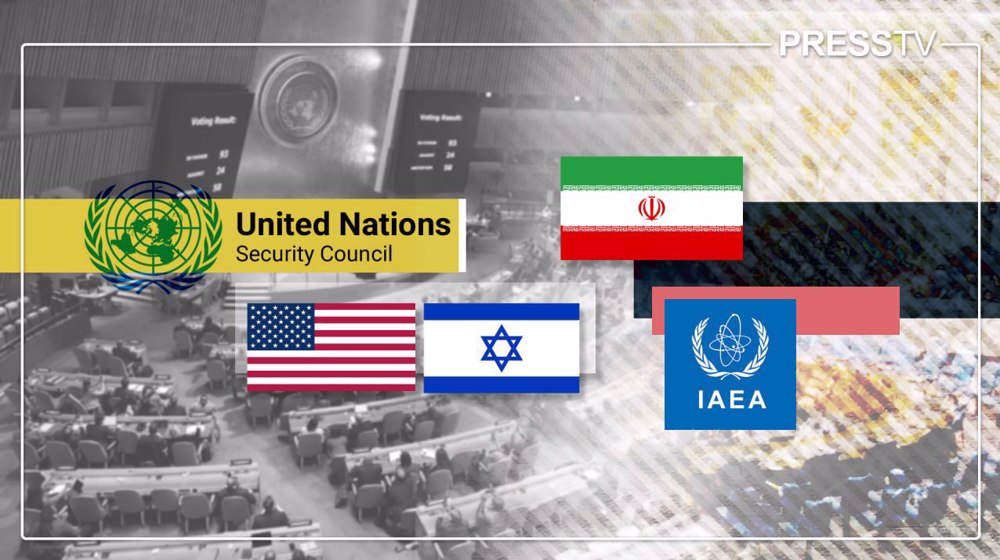
On Wednesday, the International Atomic Energy Agency (IAEA) Board of Governors, in yet another politically motivated move, voted to refer Iran to the UN Security Council over what it claims, without a shred of evidence, is nuclear “non-compliance.”
The resolution, which is the continuation of the resolution passed days before the Israeli regime launched its 12-day war of aggression against Iran last year, calls on Tehran to "urgently remedy" a violation that the Agency itself has never credibly established.
It demands inspector access to facilities that the very sponsors of the resolution, the United States and Israel, have bombed repeatedly over the past two years. And it pretends, with astonishing audacity and shamelessness, that none of this happened.
This is clearly not about safeguards. This is also not about non-proliferation. This is the final, unmasked stage in the weaponization of an international institution that was created to prevent exactly this kind of political abuse.
Diplomacy, then aggression, then silence
To understand what happened on Wednesday in Vienna, one must trace the pattern that has repeated with mechanical precision over the past two years in particular, and years before that in general.
The cycle began in the summer of 2025. On June 12, 2025, the IAEA Board passed a resolution against Iran. The very next day, Israel, with the patronage of the United States, launched a 12-day war of aggression, bombing Iran's safeguarded nuclear sites and forcing the IAEA to withdraw its inspectors.
Then came the catastrophic escalation in late February 2026. On February 28, the US and Israel jointly launched a full-scale war of aggression against Iran. The civilian toll was horrific, including a US strike on a primary school in Minab that killed over 160 schoolchildren, apart from the assassination of top political and military leaders and the Leader of the Islamic Revolution, Ayatollah Seyyed Ali Khamenei. The war was eventually halted by a ceasefire in early April.
Yet the diplomatic betrayal continued. On June 10, 2026, the IAEA Board adopted yet another US-sponsored resolution. Just one week later, on June 17, the Pakistan-brokered Islamabad Memorandum of Understanding (MoU) was signed. But merely three weeks after the ink dried, the United States violated the agreement, resumed its military aggression, and re-established its naval blockade.
Now, in September 2026, we are in the latest, most brutal iteration of this cycle. Just days before the IAEA vote, US missiles struck a wedding reception in southern Iran, leaving dozens of women and children killed or injured.
Through it all, the IAEA and the UN Security Council have maintained a deafening silence regarding these war crimes. And now, with the war still raging, Washington demands that Iran open its doors to inspectors while bombs are still falling.
It is a macabre ritual in which the word "diplomacy" is used as a cover for aggression, and the IAEA is used as a stage prop to lend the performance a veneer of legitimacy.
🎤 Conversation - Iran has good reason to bar IAEA inspectors from returning amid US aggression: Authorhttps://t.co/mzI5y3IX4l
— Press TV 🔻 (@PressTV) September 12, 2026
The legal absurdity
The most glaring flaw in the Western position, and in the IAEA Director General's report, is its complete detachment from physical reality.
The IAEA has not had access to key Iranian nuclear facilities since the US-Israeli aggression against Iran in June 2025 and rightly so. The sites cannot be opened for inspections while the aggressors continue to attack the country.
The UN agency's own report acknowledges that it "stopped conducting verification activities in Iran" and "decided to withdraw all of its inspectors from Iran for safety reasons."
Iran's ambassador to the IAEA, Reza Najafi, put the legal argument clearly. Under the Vienna Convention on the Law of Treaties, Articles 61 and 62, a party may suspend treaty obligations when performance becomes materially impossible due to unforeseen circumstances, or when a fundamental change of circumstances radically alters the basis of the agreement.
The destruction of the very facilities under inspection, and the continuation of active military aggression, constitutes precisely such circumstances.
No sovereign state on earth can be expected to provide safe access to nuclear facilities while they are under active military bombardment. The IAEA itself acknowledged this reality by withdrawing its inspectors.
And yet the IAEA Board now demands that Iran "remedy its non-compliance", as though the impossibility of performance was created by Tehran, rather than by the missiles that Washington and Tel Aviv fired at those sites.
As Najafi stated, "They cannot demand serious engagement while holding a hostile resolution over our heads. This aggressive approach destroys trust. It does not build confidence. It will not lead to diplomacy."
The evidentiary failure
Perhaps the most damning indictment of the resolution is its complete lack of evidentiary foundation.
Under Article XII.C of the IAEA Statute, a finding of non-compliance requires credible and verifiable evidence of a safeguards breach, specifically, the diversion of nuclear material from peaceful uses.
In 25 years of the most extensive, unprecedented inspections ever conducted in any country, the IAEA has never reported the diversion of even a single gram of nuclear material from Iran.
The Director General's report never stated that the UN agency verified the diversion of nuclear materials. The resolution demands that Iran "remedy" a so-called violation that the agency itself cannot establish. This is not a technical finding but a political presumption dressed in legal language.
Worse still, the resolution selectively ignores the IAEA's own 2015 "final assessment," which closed the file on all past and present issues related to Iran's nuclear program. The Board formally closed that file in December 2015. The resolution pretends this never happened. It pretends that the Joint Comprehensive Plan of Action never existed, that the US never unilaterally withdrew from it, and that the current crisis was not manufactured in Washington.
IAEA anti-Iran resolution illegal, political and product of US-Zionist pressure: SNSC secretaryhttps://t.co/KixJPxsI8C
— Press TV 🔻 (@PressTV) September 11, 2026
Crocodile tears over proliferation
There is a profound, sickening irony in Western delegations expressing "grave concern" about proliferation while refusing to utter a single word condemning the bombing of safeguarded nuclear facilities.
Let us be precise about what has happened. The United States and Israel, the two primary sponsors and beneficiaries of this resolution, have bombed nuclear facilities that were under IAEA safeguards. They have attacked sites that the UN nuclear agency was monitoring. They have destroyed the very infrastructure that the IAEA's verification regime was designed to protect.
And the response of the Western powers? Not a condemnation. Not a call for accountability. Not even a simple verbal statement expressing regret. Instead, they shed what Najafi aptly called "crocodile tears over proliferation" while hypocritically evading any acknowledgment of the unprecedented attacks that made verification impossible.
This is not a concern for non-proliferation. It is the weaponization of the very concept of non-proliferation, turning a legal and technical framework into a bludgeon to punish a nation that refuses to surrender.
The death of institutional independence
The IAEA was created in 1957 to promote the peaceful use of nuclear energy while preventing its diversion to weapons. Its credibility depends on one non-negotiable condition: that it operates independently, technically, and without political interference.
That independence is now dead. It was killed not by a single resolution, but by a sustained, deliberate campaign to transform the Agency into an instrument of regime-change policy.
The Director General's reports are no longer technical assessments. They are political documents, drafted to support predetermined conclusions. The Board of Governors no longer deliberates. It votes along bloc lines dictated by Washington. And the language of "non-compliance" and "proliferation concern" has been emptied of its legal meaning and repurposed as a euphemism for "a country we wish to punish."
Najafi's warning was stark and deserved: "The Board faces a critical choice today: to uphold the technical integrity of the IAEA or to allow it to become a mere political tool." The Board made its choice. It chose politics. It chose coercion. It chose to reward aggression and punish the victim.
🎤 Conversation - IAEA report in May 2025 became pretext for US-Israeli attacks against Iran: Ex-IAEA inspectorhttps://t.co/2XWhpbAvzH
— Press TV 🔻 (@PressTV) September 9, 2026
A collapsing regime
The consequences of this decision extend far beyond Iran. The non-proliferation regime rests on a grand bargain: states forgo nuclear weapons in exchange for access to peaceful nuclear technology and the protection of international law.
When a state fulfills its obligations, submits to inspections, and is still punished, bombed, sanctioned, blockaded, and referred to the Security Council, the grand bargain is broken.
Why would any nation accept safeguards if compliance brings no security? Why would any state trust international institutions if those institutions serve as accomplices to aggression? The answer, visible in the accelerating proliferation pressures across the Middle East and beyond, is that they will not.
Delusion of surrender
The ultimate objective behind this resolution is not non-proliferation. It is not compliance. It is not even diplomacy. It is to force Iran into surrender.
Two years of all-out military and economic aggression have failed to achieve that goal. Years of illegal sanctions, blockade, assassination, and mass killing have not broken Iran's will. And no resolution adopted in a Vienna conference room will accomplish what bombs and missiles could not.
But the cost of this delusion is not borne by Washington or Tel Aviv. It is borne by the IAEA's credibility, by the non-proliferation regime, by international law, and by the principle that international institutions exist to uphold justice, not to serve the ambitions of empires.
The IAEA has been hijacked. And unless its member states reclaim it, the institution that was built to prevent nuclear war will become a tool that facilitates one.
Alireza Ahmadzadeh is a Tehran-based international affairs analyst and PhD researcher.
(The views expressed in this article do not necessarily reflect those of Press TV.)
Pezeshkian: If Iran sought nukes, it would not have joined NPT
Russia’s Rosatom says Iran remains top priority in West Asia

Iran warns against politicized use of IAEA to justify military aggression



Stories Beyond Numbers: A pregnant woman killed alongside 8 family members in US-Israeli strike
Untold story of July 31: Hours after US strikes, Iran locked onto F-35 and destroyed MQ-9 Reaper
Saudi warplanes bombard areas recently liberated in Yemeni army’s advances
VIDEO | Press TV's news headlines
New resolution and UNSC referral show IAEA continues to be weaponized by US, Europe against Iran
VIDEO | BRICS should continue to defend basic intl. rules, oppose protectionism: CGTN anchor
Oman deal will not mean reopening of Hormuz Strait: Iran FM
Clashes erupt in Germany protests demanding Merz’s resignation





 PressTV NEWSLETTER
now
PressTV NEWSLETTER
now
 This makes it easy to access the Press TV website
