Martyred Leader’s massive Iraq funeral showed Iran-Iraq unity, dealt blow to US plots: Analyst
By Press TV Website Staff
The massive funeral processions held for martyred Leader of the Islamic Revolution Ayatollah Seyyed Ali Khamenei in Iraq demonstrated the depth of ties between Iran and Iraq while sending a political message to the United States and its allies, according to an Iraqi political analyst.
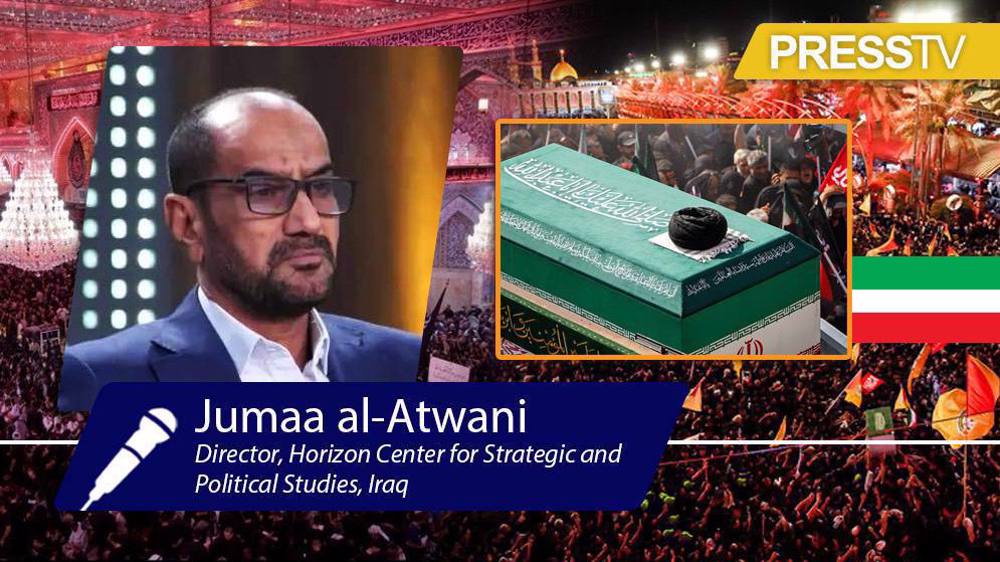
Speaking to the Press TV website, Jumaa al-Atwani, a senior political analyst and director of Iraq's Horizon Center for Political and Strategic Studies, pointed to the messages of historic funeral procession held in Iraq on Wednesday for the martyred Leader.
"The magnificent funeral of Imam Khamenei in Iraq and the participation of millions of Iraqi citizens not only showed the depth of unity and solidarity between the Iranian and Iraqi peoples, but also served as another missile and blow to the heart of global arrogance, led by the United States," he said.
The funeral ceremonies for the martyred Leader drew massive crowds across Iran and Iraq. Initial Iraqi media reports estimated that over ten million people took part in the processions in the holy cities of Najaf and Karbala, prompting a delay to the final stage of the funeral in the Iranian holy city of Mashhad.
Al-Atwani described the funeral in Iraq as an exceptional event that would remain etched in history, saying few political, religious, or revolutionary leaders anywhere in the world had received such a farewell.
According to the senior analyst, many followers of Shia Islam in Iraq regarded Ayatollah Khamenei as a top religious authority, the guardian of the Muslim community and, based on Shia jurisprudential principles, the deputy of Imam Mahdi (AJ).
'Largest in human history': Over 43 million join funeral ceremonies for Martyr Leader in Iran, Iraqhttps://t.co/TglBxpLCDY
— Press TV 🔻 (@PressTV) July 10, 2026
For that reason, he said, the ceremonies went beyond a memorial service and represented a continuation of Imam Hussein's (AS) movement, particularly as it coincided with the month of Muharram.
The analyst said Ayatollah Khamenei was viewed as "a martyr on the path of freedom, Islam, independence, resistance against oppression and support for the world's oppressed."
He noted that the historic turnout in Iraq conveyed two messages: that attempts by the United States and the "global arrogance" to weaken the close ideological and religious bonds between Iran and Iraq had failed, and that the Axis of Resistance was more united than ever.
Al-Atwani also pointed to the large number of young Iraqis lining the streets of Najaf and Karbala during the funeral procession, saying their participation reflected political, religious, and ideological awareness shaped by decades of religious education.
He added that the strong attachment many young people felt toward Ayatollah Khamenei was also the result of the martyred Leader's longstanding emphasis on the importance of youth and their role in building the future and defending the Islamic community.
Reflecting on his life and legacy, al-Atwani said he had dedicated himself to Islam with steadfastness, loyalty and patience, maintaining faith that “Islam would ultimately prevail over the world's arrogant powers.”
More videos from the moment Iran's martyred Leader's coffin entered the Imam Hussein Shrine, receiving an emotional welcome from Iraqi mourners.
— PressTV Extra (@PresstvExtra) July 8, 2026
Follow: https://t.co/7Dg3b41hTx pic.twitter.com/cJkA3GMIFJ
He said the martyred Leader demonstrated a strong spirit of struggle from an early age by opposing the monarchy in Iran before assuming leadership following the demise of Ayatollah Khomeini—the founder of the Islamic Revolution—and guiding the Islamic Republic and the Axis of Resistance for more than 37 years.
Al-Atwani further noted that Martyr Ayatollah Khamenei had provided firm leadership to the Axis of Resistance over recent decades and that his speeches consistently transcended national, ethnic and sectarian boundaries.
According to the analyst, the martyred Leader's views inspired Palestinians as well as followers of Shia Islam in Bahrain, Iraq, Iran and Yemen, while also resonating with oppressed people and supporters of liberation movements elsewhere.
He said Ayatollah Khamenei's personal qualities helped explain why millions of Iraqis traveled from different provinces to attend the funeral and sought to reach his coffin during the procession.
"The funeral of Imam Khamenei in Iraq was a popular and ideological victory. This magnificent funeral astonished the entire world," al-Atwani said.
This massive turnout showed the extent of the Iraqi people's hatred toward the United States and the global arrogance, he said, adding, this was also evident during the recent US-Israeli war of aggression against the Islamic Republic of Iran, which he said aimed to bring down Iran's political system, when Iraqi citizens held large-scale rallies in support of the Iranian people and government while chanting slogans against the “criminal” United States.
He added that the people of Iraq and Iran, together with those in the countries of the Axis of Resistance, constitute an army that will stand against global arrogance after Ayatollah Khamenei's martyrdom and continue along his path.
Iran is the last bastion of true anti-imperial resistance, owes no one an explanation: Writer
Focus on youth and training camps key to building future generations: Weightlifting chief
During Mosaddegh's time, US pursued the same policy toward Iran as today: Filmmaker



Bolivia’s former president hails Iran as ‘model of sovereign resistance against US empire’
Iran’s trade partners won’t listen to US ‘big talk’: Qalibaf
Iran’s top security official says US must change its behavior
Israel denies Swedish MEPs entry to occupied lands over criticism of Gaza genocide
Israeli court extends detention of Palestinian doctor despite heart catheterization
VIDEO | Iran court orders $37 million in US oil funds for Butterfly Patients
VIDEO | Press TV's news headlines
Iran pursues implementation of MOU; US bad faith prevented regional stability: Qalibaf


 PressTV NEWSLETTER
now
PressTV NEWSLETTER
now
 This makes it easy to access the Press TV website
