Iran is the last bastion of true anti-imperial resistance, owes no one an explanation: Writer
By Press TV Website Staff
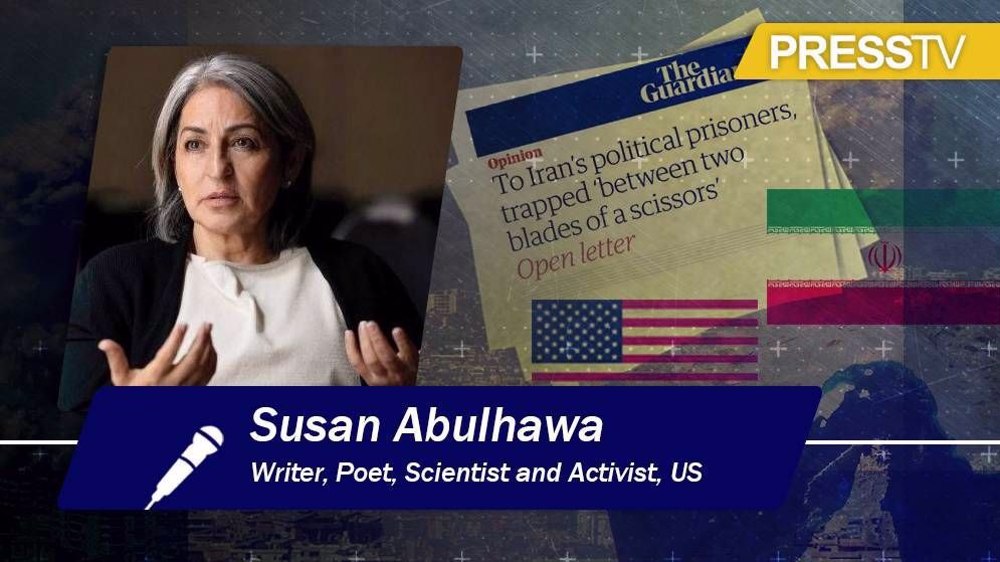
Palestinian-American writer and activist Susan Abulhawa says the Islamic Republic of Iran is “the last bastion of true anti-imperial resistance,” rejecting the open letter published in The Guardian critical of Iran.
In an interview with the Press TV website, Abulhawa denounced the letter and its signatories for creating false equivalences and downplaying the scale of the US-Israeli aggression against Iran.
The letter published in The Guardian on Thursday and signed by a group of noted intellectuals and activists has been widely criticized for placing Iran’s political prisoners, Israel’s detention of innocent Palestinians and the brutal US immigration detention system within a single framework of “carceral states,” while calling for opposition to both imperialism and what it describes as “hollow anti-imperialism.”
For Abulhawa, the letter’s framing fundamentally misrepresents the reality facing the Islamic Republic.
At the moment, she said, when the country is under sustained US-Israeli aggression, criticism of Iran’s domestic political system cannot be detached from the vastly unequal forces confronting the country or from decades of unilateral and illegal sanctions, “regime change” campaigns, covert operations, assassinations and other forms of Western and Israeli interventionist policies.
Abulhawa took particular issue with the letter’s description of Iranian political prisoners as being caught “between two blades of a scissors,” noting that the metaphor obscures a profound asymmetry between Iran and the powers waging war against it.
She also rejected a false equivalence between Iran’s prisons, Israel’s detention of Palestinians and the US immigration detention system, saying that the three involve fundamentally different political, legal and historical circumstances.
And she also questioned the letter’s use of the phrase “hollow anti-imperialism,” asking why Iran’s resistance to Western pressure and its insistence on sovereignty should be characterized in such terms.
In Abulhawa’s view, Iran’s struggle cannot be understood through a framework that places an anti-imperialist state under military attack on the same political and moral footing as the imperial powers attacking it.
‘Two blades of the same scissors?’
Abulhawa said she is struggling to reconcile her instinctive reaction to the letter with the respect she holds for many of its signatories, whom she described as individuals who have “dedicated their lives to Black liberation and anti-colonial struggles.”
“Prominent intellectuals in the imperial core are using their voice at this hour primarily to criticize a government under active bombardment. While I believe that no government is beyond reproach or criticism, I have a lot of questions and cautions about this open letter,” she told the Press TV website.
A central concern for Abulhawa is the letter’s description of Iranian political prisoners as being trapped “between two blades of a scissors” — the Islamic Republic on one side and the United States and the Israeli regime on the other.
She rejected the implication that the two sides could be understood as equivalent, saying that the comparison fails to account for the vastly different levels of political, military and economic power involved.
✍️ Analysis - Why expelling US military and dismantling their assets are key to regional peace and stability
— Press TV 🔻 (@PressTV) August 18, 2026
By Press TV Strategic Analysis Desk
https://t.co/5pBq74bPyp
“The overall framing is of two equally opposing sides—two blades of the same scissors,” Abulhawa said. “This is a wholly unfair representation of what is in reality a profound asymmetry of power.”
On one side, she said, stands “a country that has been subjected to crippling, decades-long economic sanctions, now fighting an existential anti-imperial struggle kinetically.”
On the other, she pointed to “a nuclear, AI-powered empire, with its inexhaustible money, munitions, supply lines, coalitions, surveillance, and near-total grip on international political, legal, information, and economic infrastructure.”
Abulhawa noted that the letter appears to minimize the severity of the war on Iran, which legal experts have unanimously described as illegal.
“What the letter describes as ‘current, indiscriminate waves of US-Israeli military assaults’ undersells what’s actually happening in the ‘six months into a war,’” she told the Press TV website.
She then pointed to a series of attacks and assassinations that demonstrate the scale and history of the confrontation, including “the unprovoked Tomahawk missile and B-2 bomber attacks targeting [Shajareh Tayyebeh] Elementary School in [Minab, southern Hormozgan province], which killed 180 children and teachers.”
She also cited attacks that led to the martyrdom of the Leader of the Islamic Revolution, Ayatollah Seyyed Ali Khamenei, and his family, as well as more than a third of the country’s political, military and scientific leadership.
Abulhawa further pointed to attacks on “civilian infrastructure, including water systems, farmlands, electric grids and power plants, as well as [the Dena destroyer,] an unarmed Iranian navy ship carrying young cadets returning from a peacetime maritime exercise in international waters.”
She noted that these events must also be viewed against decades of attacks against Iran that had gone unanswered by Tehran.
She cited Israel’s repeated assassinations of Iranian scientists, the assassination of Major General Qassem Soleimani, strikes against Iranian military generals in Syria, the attack on Iran’s consulate in Damascus, and the assassination of Ismail Haniyeh, chief of the Gaza-based resistance movement Hamas, on Iranian soil.
She also referred to the 1988 US downing of Iran Air Flight 655, which killed 290 passengers and crew members, including 66 children, as well as “endless cyber-attacks, covert and overt naval sabotage and so much more.”
“All of it without response from Tehran,” she said.
‘A false equivalence’
The noted writer and poet said placing the prison systems of Iran, the US and the Israeli regime within a single “carceral” framework risks obscuring fundamentally different political, historical and legal circumstances.
“There are currently 2 million incarcerated people in the United States, the largest prison population anywhere on earth,” she said, citing estimates that 4-6 percent of those prisoners may be innocent.
“That’s 80,000-120,000, about two NFL stadiums full of innocent lives behind bars,” she added..
She also rejected a “false equivalence” between Iranian prisons and Israel’s detention of Palestinians and inhumane conditions inside Israeli prisons.
“I would also argue that comparing Iran’s prisons with Israel’s decades-long, systematic, colonial detention of indigenous Palestinians is another form of false equivalence,” she told the Press TV website.
“So is the comparison with America’s ICE detentions, separation of families and loss of children in the process who are most likely trafficked.”
✍️ Feature - 32-year-old Iranian scientist who was identified by DNA 10 days after martyrdom in US-Israeli attack
— Press TV 🔻 (@PressTV) August 19, 2026
By @HumairaAhad_83 https://t.co/T43XTFIzcz
Abulhawa highlighted that it was not fair to place Iran, which she characterized as a “revolutionary government” only a few decades removed from West-backed colonial rule and still subject to sanctions, in the same “carceral” category as “two settler colonial states.”
“One cannot ignore the enormous disparity of political, military, and historical circumstances,” she said.
She also emphasized the different legal relationships involved.
According to Abulhawa, people held in Iranian jails are “overwhelmingly Iranian citizens, prosecuted under the state’s own criminal and national security laws.”
Palestinians held in Israeli administrative detention, by contrast, are “non-citizen subjects of a military occupation, detained and re-detained indefinitely under military decrees without charge or trial.”
Those held in US immigration detention represent another category: “non-citizens held under civil immigration laws pending removal proceedings with access to immigration courts, however corrupt they may be.”
“These are three distinct legal relationships—1) a state and its own citizens; 2) a state and migrants crossing its borders; and 3) an occupying power and a stateless occupied indigenous population,” Abulhawa said.
In her view, the letter collapses these distinctions into a single concept of “carceral states everywhere,” producing a “rhetorical equivalence” that is not supported by the underlying political realities.
It treats “administrative detention,” “political imprisonment,” and “immigration detention” as though the political stakes were the same, she said, while overlooking the fundamentally different questions of sovereignty, citizenship and self-determination involved.
Security threats, foreign interference and prosecutions
Another concern raised by Abulhawa was the letter’s failure to identify who the prisoners are or why they were arrested.
She explained that without this information, the letter does not engage with what Iranian authorities describe as security threats, foreign interference, terrorism and espionage.
“The letter does not identify who the prisoners are or why they were arrested,” she said.
“In neglecting to do so, there is no engagement with the very real security threats, proven foreign interference, terrorism, and espionage, which Iranian authorities cite as reasons for some arrests and prosecutions.”
She noted that many of those who were arrested by Iranian authorities confessed to working with the Israeli spy agency Mossad.
She also referred to a recent case involving people imprisoned after “gruesomely disemboweling a young reciter of the Quran.”
Hujjat al-Islam Golpayegani, martyred Leader’s son-in-law and Zahra’s father:
— Press TV 🔻 (@PressTV) August 21, 2026
“The martyred children of Gaza and Minab stand as a testament to the righteousness of the Resistance Front and the Islamic cause.” pic.twitter.com/KOTDbYABcL
What does ‘hollow anti-imperialism’ mean?
The phrase “hollow anti-imperialism” used in the letter has been widely scrutinized. The letter says its signatories reject what it calls a “false binary of imperialism and hollow anti-imperialism.”
Abulhawa questioned both the wording and the political implications of the phrase
“The phrase that knocked me off balance was this: ‘...we reject the false binary of imperialism and hollow anti-imperialism,’” she said.
She noted that anti-imperialist writer Carlos Martinez had addressed the wording in a recent post, describing it as the “load-bearing phrase” of the letter.
“Indeed, it does so much heavy lifting,” Abulhawa said, questioning why the word “hollow” had been inserted. “It’s so clearly deliberate, but why?”
For Abulhawa, the term is especially difficult to reconcile with Iran’s insistence on sovereignty in the face of sustained Western pressure.
“How can Iran’s insistence on sovereignty and dignity be called ‘hollow,’ despite the grave and terrible cost to themselves?” she asked.
She noted that Iran could have chosen a less confrontational path and aligned itself with the dominant regional order.
“They could have taken the easy path a long time ago and bowed to empire, as some of their Arab neighbors have done,” she said.
Instead, she said, Iran has chosen “self-possession and loyalty to their ancestors and children.”
“That can be called many things, but hollow is not one of them,” Abulhawa said, pointing out that Iran should not be expected to justify its resistance to external powers.
“Iran owes no one an explanation,” she said.The Islamic Republic is the last bastion of true anti-imperial resistance, and the whole world is rooting for them.”
Focus on youth and training camps key to building future generations: Weightlifting chief
During Mosaddegh's time, US pursued the same policy toward Iran as today: Filmmaker
Iran’s new military appointments signal ‘offensive’ posture toward US, Israel: Analyst



Araghchi: Iran and China seeking to build fairer, more peaceful international order
US envoy Tom Barrack retracts comment that Syria’s Golan is occupied
A response to The Guardian’s open letter: Opposing the war on Iran means rejecting war propaganda
Iran is the last bastion of true anti-imperial resistance, owes no one an explanation: Writer
Israeli army conducts new incursion into Syria despite Mossad chief–HTS diplomat meeting
Israeli drone strike kills two Palestinians in displacement tent in central Gaza
Omani foreign minister to visit Iran to discuss Strait of Hormuz shipping
Yemeni forces down Saudi ScanEagle drone over Hajjah




 PressTV NEWSLETTER now
  This makes it easy to access the Press TV website