‘Act of state terrorism’: US attack on civilian reservoirs in south Iran cuts off drinking water to thousands
By Ivan Kesic
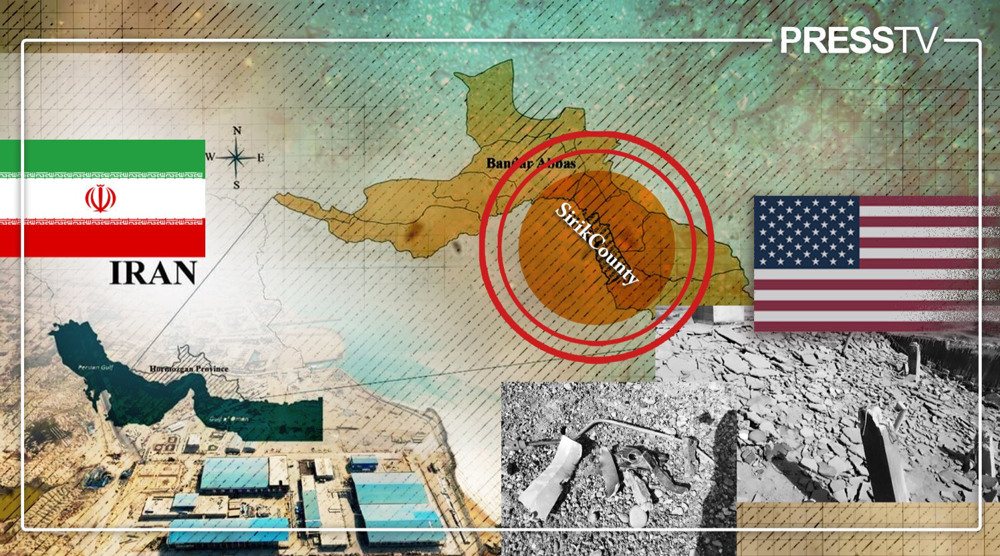
In a pre-dawn attack on June 9, 2026, the US military deliberately destroyed two water reservoirs in southern Iran’s Hormozgan province, cutting off drinking water to more than 20,000 residents as temperatures in the region soared to nearly 50 degrees Celsius.
The new American escalation against Iran came amid a fragile ceasefire in place since April 8, 2026, and only hours after a US Apache helicopter crashed in the Strait of Hormuz, an incident Washington linked to Iran, while Tehran categorically denied any involvement.
American warplanes struck multiple sites across the coastal province, including Jask, Sirik, and Qeshm Island, mainly targeting civilian areas and civilian infrastructure.
While the Pentagon claimed the strikes targeted Iranian air defense systems and radar installations, the on-the-ground damage presents a markedly different picture. In the Bemani District of Sirik County, two concrete water reservoirs were completely destroyed.
The larger reservoir, with a capacity of 2,000 cubic meters, and a smaller 500-cubic-meter facility were reduced to rubble under precision strikes. Their reinforced walls collapsed, support columns were shattered, and stored water spilled out overnight, leaving the surrounding area without a critical supply.
With seasonal rivers already dry and groundwater access severely limited, more than 20,000 residents now face the peak of summer without reliable access to safe drinking water, an act widely regarded under international humanitarian law as a war crime.
Attack on Bemani: what was destroyed
The targets of the American attack were two water reservoirs in the Bemani District of Sirik County, in the eastern part of Hormozgan province, along the coast of the Persian Gulf.
These were not military installations, nor were they situated near any strategic military assets. The larger reservoir measured 18.5 by 29 by 4 meters, giving it a total capacity of 2,000 cubic meters.
The smaller one measured 13 by 13 by 3 meters, with a capacity of 500 cubic meters.
Both structures were built of reinforced concrete, designed to withstand the harsh coastal environment and the immense weight of thousands of tons of water pressing against their walls.
Photographs and footage from the scene reveal the full extent of the devastation. The concrete walls of both reservoirs have been severely cracked, and in some places, completely breached.
The roof-supporting columns have collapsed, dragging large sections of the ceilings down with them. Water that had been stored for the dry summer months leaked out overnight, flowing down the hillside and into the dry riverbed below.
What remains is a scene of rubble, twisted rebar, and shattered concrete, a civilian water system deliberately and wantonly reduced to ruins.
The reservoirs were built on a hill approximately 15 meters above the surrounding area, a deliberate design choice that allows gravity to generate water pressure and push water through the distribution pipes without the need for constant pumping.
This gravity-fed system is essential in a region where electricity can be unreliable and fuel for generators is prohibitively expensive.
The reservoirs are supplied by the seasonal Chalak River, located 700 meters away, which brings water from the Gasmand Mountain during the winter and spring months when rainfall is more abundant.
During the summer and autumn, the river runs completely dry. This means that even if the reservoirs were rebuilt immediately, no water is available to fill them until the next rainy season.
On the smaller reservoir, a painted sign in Persian carries a message that now reads as both an epitaph and an indictment: "Water is the pulse of life. Let us not slow its rhythm through wastefulness."
The irony of destroying a structure bearing such words, while claiming to fight for humanitarian values, has not been lost on Iranian observers.

Human cost: 20,000 people left without water
The destruction of these two reservoirs has directly affected lives across the coastal town of Kuhestak, home to 4,000 inhabitants; the villages of Bemani with 1,000 residents; Palur with 500; and the surrounding district's total population of nearly 20,000.
These are not large cities with alternative water infrastructure. They are small communities in one of the hottest and most arid regions of Iran, where summer temperatures regularly exceed 45 degrees Celsius and have been reported as high as 50 degrees.
The water supplied by these reservoirs was not a luxury. It was the sole source of drinking water for these communities. The area lacks sufficient groundwater reserves to compensate for the loss, and the seasonal river that feeds the reservoirs runs dry for half the year.
Residents will now be forced to import water by tanker truck from other districts – districts that themselves have limited supplies due to the unforgiving climate.
The nearest structures to the reservoirs are the houses of the village of Bemani, situated along Road 91, approximately 400 meters to the east.
About 400 meters to the southeast lies an ice factory, essential for preserving fish and seafood, on which the economy of the fishing town of Kuhestak depends. The destruction of the reservoirs thus threatens not only drinking water supplies but also the very livelihood of the local population.
Abdolhamid Hamzehpour, CEO of the Hormozgan Provincial Water and Wastewater Company, stated that operational and crisis management teams are working to find alternative measures to provide sustainable water.
He announced that the estimated damage to water supply facilities stands at 140 billion Tomans. Yet he also acknowledged a grim reality – due to the massive scale of destruction, water supply to the 20,000 residents of these areas remains completely cut off, and efforts to find alternative solutions continue.

Iranian officials condemn the attack
Iranian officials have been unanimous in condemning the attack as a deliberate act of terrorism against civilian infrastructure.
Hamzehpour, speaking to local media, highlighted the glaring contradiction between America's claims of humanitarian concern and its actual conduct on the ground.
The criminal United States, he said, makes claims of humanitarianism and alleged aid, yet in practice – by deliberately targeting water reservoirs – has cut off people's access to the most basic and essential substance of all: water, at the height of summer heat.
The enemy has precisely targeted infrastructure linked to the daily livelihood and health of the people, he added. Depriving a large population of water in these weather conditions, he stressed, is a clear instance of a crime against humanity, carried out under the shadow of false claims of humanitarian aid.
Fatemeh Jarareh, the representative of Hormozgan Province in the parliament, condemned the attack in even stronger terms. The attacks on various areas of the province, she stated, and especially the destruction of the two concrete drinking water storage tanks in the Bemani District, demonstrate that the enemy does not hesitate to target even the most basic and essential needs of the civilian population.
Targeting the vital arteries of drinking water when the people of this region are enduring temperatures exceeding 45 degrees Celsius, she said, is not a military action but a clear crime against humanity and a flagrant violation of all international principles and treaties.
Jarareh also called on the international community to respond. The international community, human rights organizations, and international authorities, she warned, should not remain silent when faced with the targeting of civilian and vital infrastructure, because continuing this silence will pave the way for the repetition of such crimes.
Within the framework of her supervisory and legislative duties, she said, she will pursue the issue through relevant national and international authorities.
Aftermath of US airstrikes on potable water reservoirs in the Bemani district of Sirik County, Hormozgan
— PressTV Extra (@PresstvExtra) June 10, 2026
Follow: https://t.co/10Tn0f9DVO pic.twitter.com/al87ru9Die
Clear violation of the Geneva Conventions
Under international humanitarian law, the deliberate destruction of civilian water infrastructure constitutes a war crime.
This prohibition is neither ambiguous nor subject to interpretation. Article 54 of Additional Protocol I to the Geneva Conventions – to which the United States is a signatory – explicitly lists "drinking water installations and supplies" among protected objects.
The same article also prohibits the use of water supply destruction as a method of warfare, recognizing that depriving a civilian population of water is a form of collective punishment.
The 1949 Geneva Conventions, ratified by the United States, provide for the protection of civilian objects during armed conflict. The Fourth Geneva Convention specifically addresses the protection of civilian populations and prohibits the destruction of property not justified by military necessity. Water reservoirs serving exclusively civilian populations fall squarely within this protected category.
The International Committee of the Red Cross, in its customary international humanitarian law study, has identified Rule 154 as requiring military commanders to refuse orders that are manifestly unlawful. Destroying a civilian water reservoir in an area with no military targets and no military necessity is precisely such an order.
The attack on the Bemani reservoirs meets all three criteria for a war crime under international law: the targeting of a civilian object, the absence of military necessity, and the foreseeable harm to the civilian population.
The reservoirs are located in a rural area with no military installations nearby. The nearest military target of any kind is hundreds of kilometers away. The only structures in the vicinity are houses, an ice factory, and the village of Bemani itself.
The US authorities claim it was targeting air defense systems and radar installations, yet no such systems have been identified in the area, and the Pentagon has provided no evidence that any military targets existed near the reservoirs.
The timing of the attack compounds its criminality. Striking water infrastructure during the summer, when temperatures regularly exceed 45 degrees Celsius, demonstrates a deliberate awareness that the destruction will cause maximum suffering.
Dehydration in such heat can kill within hours, particularly among the elderly, children, and those with pre-existing health conditions.
The use of water deprivation as a method of warfare has been condemned by humanitarian organizations, including Oxfam and the International Committee of the Red Cross, as a form of collective punishment and a flagrant violation of the most fundamental principles of international law.

Precedent of targeting water
The attack on the Bemani reservoirs follows a pattern of American threats against Iranian water infrastructure dating back to the early weeks of the aggression.
In March 2026, President Donald Trump threatened to destroy all desalination plants in Iran.
Legal experts immediately warned that such strikes would violate international law. They stated that desalination plants are generally civilian objects and as such protected from attack, and that they also enjoy special protection as objects indispensable to the survival of the civilian population.
Destroying infrastructure needed by civilians, they noted, violates Article 54 of Additional Protocol I to the Geneva Conventions.
The White House refused to rule out targeting Iran's water supply. Press Secretary Karoline Leavitt stated that the US Armed Forces would always act within the confines of the law, but then added that Trump would move forward unabated.
Legal experts also noted that American criminal law prohibits the commission of war crimes, defining them as grave breaches of the Geneva Conventions. Any person who commits war crimes can be imprisoned for life or put to death if the crime results in the death of any victims.
Despite these prohibitions and the clear warnings, the attack on the Bemani reservoirs has now made real what was once only a threat.
Iran Army: US vessels ‘do not dare’ approach Iranian shores
Iran will respond ‘decisively’ to any enemy miscalculation: IRGC
Top security, military brass hail 200 nights of rallies as proof of Iran’s strength



VIDEO | Press TV's news headlines
Iran summons German ambassador over Berlin’s hostile positions, interventionist activities
Israeli occupation court extends detention of Press TV journalist Naqaa Hamed
Iran rejects Sweden’s allegations, orders Swedish diplomat to leave within 48 hours
UN fact-finding mission finds ‘reasonable grounds’ US committed war crimes in Iran
Al-Houthi: Saudi claims of Yemen targeting Mecca 'heinous lie', manifest slander
Iran dismisses Saudi claim that Yemen attempted to target Mecca
‘Organized, illegal, aggressive’: Press TV slams abduction of West Bank journalist by Israeli forces



 PressTV NEWSLETTER
now
PressTV NEWSLETTER
now
 This makes it easy to access the Press TV website
