'Flamingo Revolution': Albanians rally to save wetlands from Trump-Kushner family $4bn luxury project

By Ivan Kesic
As thousands of Albanian citizens enter their tenth consecutive day of protests under the banner “Albania Is Not for Sale,” the alliance between Prime Minister Edi Rama and the Trump-Kushner family stands exposed, threatening not only one of Europe’s last pristine wetlands but also Albania’s aspirations for European Union membership.
What began as a luxury yacht trip off the Albanian coast in 2021 has spiraled into one of the most damaging environmental and political scandals in modern European history.
Jared Kushner, son-in-law of US President Donald Trump, and his wife, Ivanka Trump, reportedly “captivated” by an uninhabited island they discovered while swimming, have partnered with Prime Minister Edi Rama to transform both Sazan Island and the protected Vjosa-Narta lagoon into a four-billion-dollar elite resort complex.
The project, granted “strategic investor” status by Rama’s government following controversial 2024 changes to Albania’s nature protection laws, has already seen heavy machinery digging up ancient sand dunes, barbed wire blocking public beaches, and private security guards violently assaulting peaceful protesters.
Now, with the European Commission warning that the development jeopardizes Albania’s EU accession, and the country’s anti-corruption prosecutor launching a criminal investigation, the so-called Flamingo Revolution has become a defining test of whether money and political connections can destroy nature and silence citizens with impunity.
Thousands rally in Albania’s capital, Tirana, to protest a planned island development project linked to Jared Kushner and Ivanka Trump.
— PressTV Extra (@PresstvExtra) June 8, 2026
Follow: https://t.co/7Dg3b41hTx pic.twitter.com/TaQhBcyl17
Sazan Island: From communist military fortress to Trump family playground
Sazan Island, a 5.7-square-kilometer uninhabited outpost off the coast of the southern city of Vlora, holds a dark but fascinating history.
During World War II, it served as a strategic military base, and in the 1950s, it became part of Albania’s defense network under its alliance with the Soviet Union.
Even after Albania broke with Moscow, the island remained a heavily fortified military outpost, dotted with thousands of concrete bunkers, underground tunnels, and unexploded ordnance scattered across its seabed and rocky shores.
For decades, Sazan was strictly off-limits to ordinary Albanians, a forbidden zone shrouded in secrecy.
That all changed when Kushner and Ivanka, sailing on a friend’s boat, decided to stop for a swim. The couple later described how they swam to the islands, hiked barefoot to the top, and were completely captivated by what they found.
That moment of barefoot discovery would set in motion a chain of events that has brought Albania to the brink of political crisis. The couple saw not a historical site requiring preservation but an opportunity to transform it into a private luxury destination.
Under the current plan, the island would be transformed into a 1,400-hectare private resort, complete with hotels, wellness centers, and high-end tourist facilities.
Kushner’s investment firm, backed by sovereign wealth funds from Saudi Arabia, the United Arab Emirates, and Qatar, is leading the development.
In late 2024, the Albanian government granted the project “strategic investor” status, a designation that provides fast-track administrative procedures and exemptions from standard environmental reviews.
The scale of the project has been described by Ivanka Trump as “almost daunting” in its size.
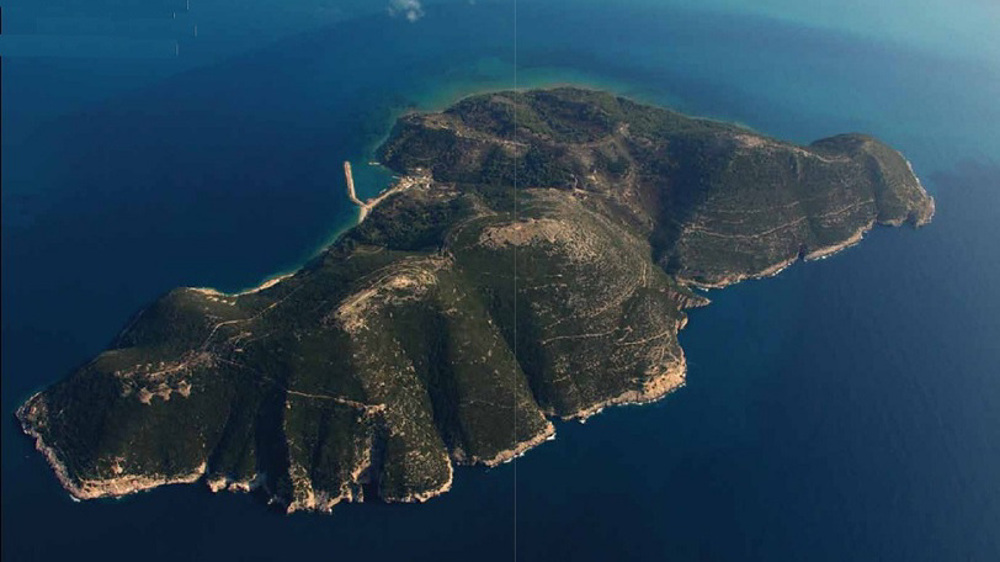
Environmental catastrophe: Destruction of Vjosa-Narta
While Sazan Island captures headlines, the more immediate and irreversible ecological damage is occurring on the mainland, at the Pishë Poro-Narta Protected Area within the Vjosa-Narta Protected Landscape.
This region is part of the delta of the Vjosa River, one of Europe’s last wild rivers, and it is an ecological treasure of global significance. It shelters more than 70 endangered species and over 200 bird species, including flamingos and the rare Dalmatian pelican.
It sits on the Adriatic Flyway, a critical migration corridor for millions of birds traveling between Africa and Europe each year.
The surrounding waters are among the last Mediterranean refuges for the Mediterranean monk seal, one of the world’s most endangered marine mammals, and provide key nesting grounds for the loggerhead sea turtle.
What has happened to this protected landscape since late April 2026 is a severe violation of environmental law.
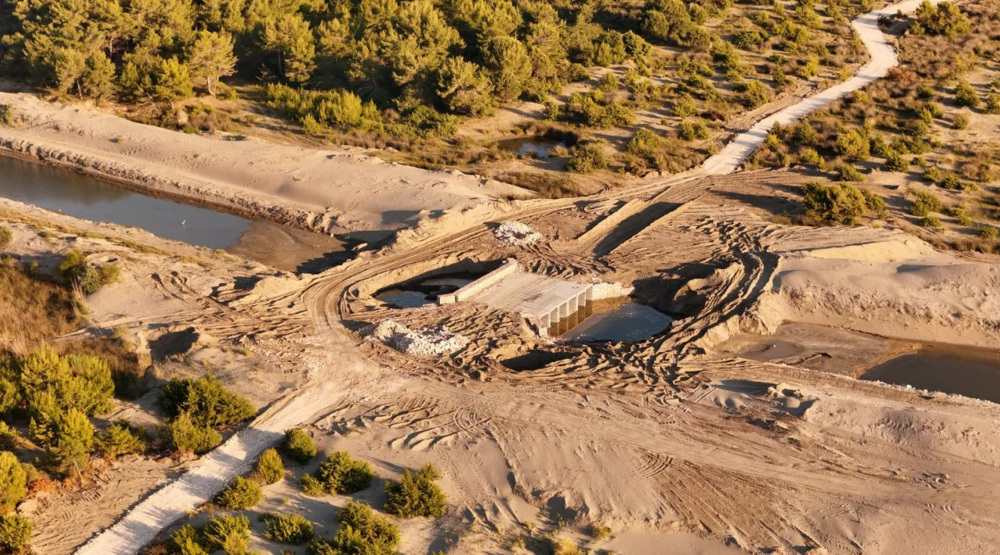
Heavy machinery has been observed tearing through the area without visible permits, without a completed environmental impact assessment, and with the Albanian government providing explanations that environmental groups have disputed.
Gravel has been dumped onto ancient sand dunes that are legally designated as Natural Monuments under Albanian law, damage that scientists say will take hundreds of years to repair.
Construction has also blocked one of the two openings connecting the Narta Lagoon to the sea, cutting off tidal exchange with immediate and cascading consequences for fish, birds, and the entire food chain. Each day the blockage continues, the damage deepens.
The environmental organization PPNEA, which has operated in Albania since 1991 and is BirdLife International’s partner in the country, has described the destruction as unprecedented in the history of Albania’s protected areas.
The group has documented that some ecological damage to the sand dunes is already irreversible.
When questioned in parliament, the government claimed that the opening had been closed to build a road for environmental surveying, a claim contradicted by the heavy machinery, barbed wire, and security presence observed at the site.
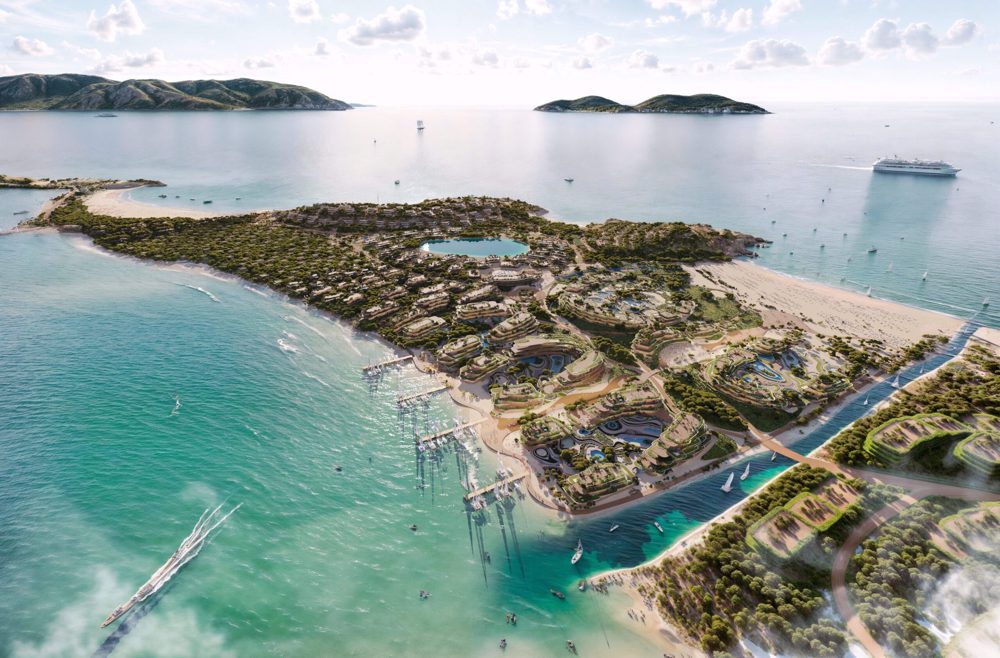
Kushner-Rama alliance and connections to the Israeli regime
At the center of this scandal stands Prime Minister Rama, who has governed Albania since 2013 and who has cultivated a close relationship with Kushner dating back to the first Trump administration.
When Kushner sailed off the Albanian coast in 2021, Rama boarded his boat for a meeting.
By 2024, the fruits of that relationship were evident: the Albanian government changed its laws specifically to accommodate luxury resort construction in protected areas, granted Kushner’s consortium strategic investor status, and approved the project without environmental review.
Rama has defended the project with increasingly combative rhetoric. He has dismissed protesters as being manipulated by foreign interests, claiming that social media bots are fueling the demonstrations and that "antisemitic narratives are being promoted by enemies of the Israeli regime and Albania."
He has also suggested that the project would not have attracted international attention if not for the involvement of Kushner, implying that the criticism is politically motivated.
When the European Commission raised concerns, Rama dismissed the warnings, insisting that the environmental impact is still being studied and that no final construction permits have been approved for the ambitious project.
The prime minister’s connections to the Israeli regime are also notable. In 2025, Rama boasted about receiving an invitation to participate in a Gaza reconstruction plan board, presenting it as evidence of his personal relationship with the Trump administration.
Rama has used such connections to manufacture the illusion of influence in Washington and Tel Aviv, even as the United States State Department has placed Albania on visa restriction lists due to concerns about corruption and the absence of the rule of law.

Pattern of predatory real estate: Ivanka and Jared’s controversies
The Albania project is not an isolated venture for the Kushner-Trump family. It follows a pattern of using political connections to secure lucrative real estate deals in vulnerable countries, often at the expense of local communities and environmental protections.
Only months before the Albanian controversy erupted, Kushner was forced to withdraw from a similar luxury development in Serbia after the country’s prosecutor for organized crime charged four individuals, including a government minister, with abuse of office and falsification of documents to help pave the way for the project.
The Serbian deal, which also involved strategic investor designation and changes to local laws, collapsed under the weight of criminal investigations. Kushner withdrew from the project, leaving behind a trail of corruption charges and public outrage.
Now, the same pattern is repeating in Albania. The country’s Special Anti-Corruption Prosecution Office has opened a criminal investigation into the changes to the protected area’s status and the land ownership transfers that made the Kushner project possible.
The investigation reportedly extends beyond environmental concerns to possible abuses of office and fraud.
Meanwhile, Ivanka Trump has described the project in glowing terms, speaking of architecture that would “almost rise from” the beautiful land and insisting that “community” is at the heart of the development.
For Albanians who have seen their beaches fenced off and their dunes bulldozed, such assurances ring hollow.
Flamingo Revolution: Protests, violence, and democratic demands
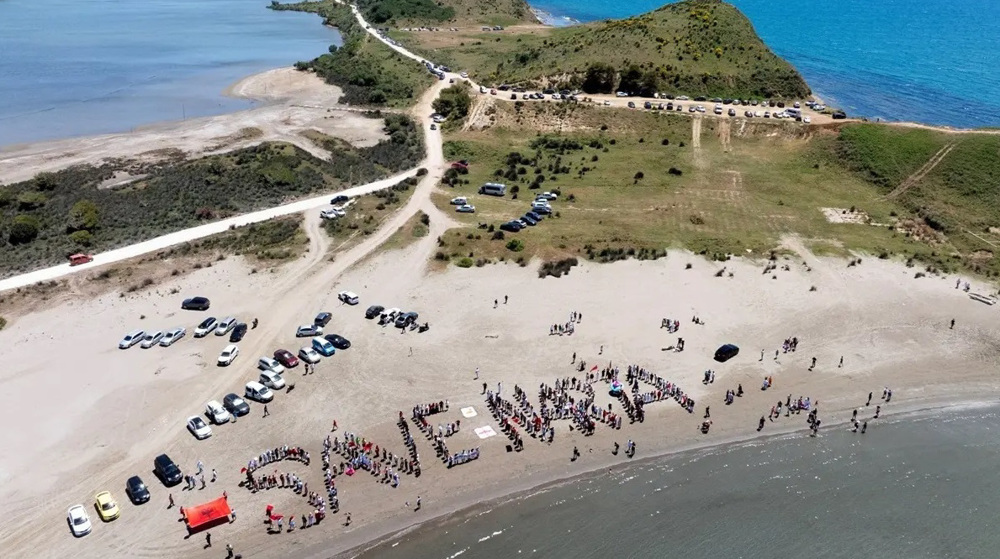
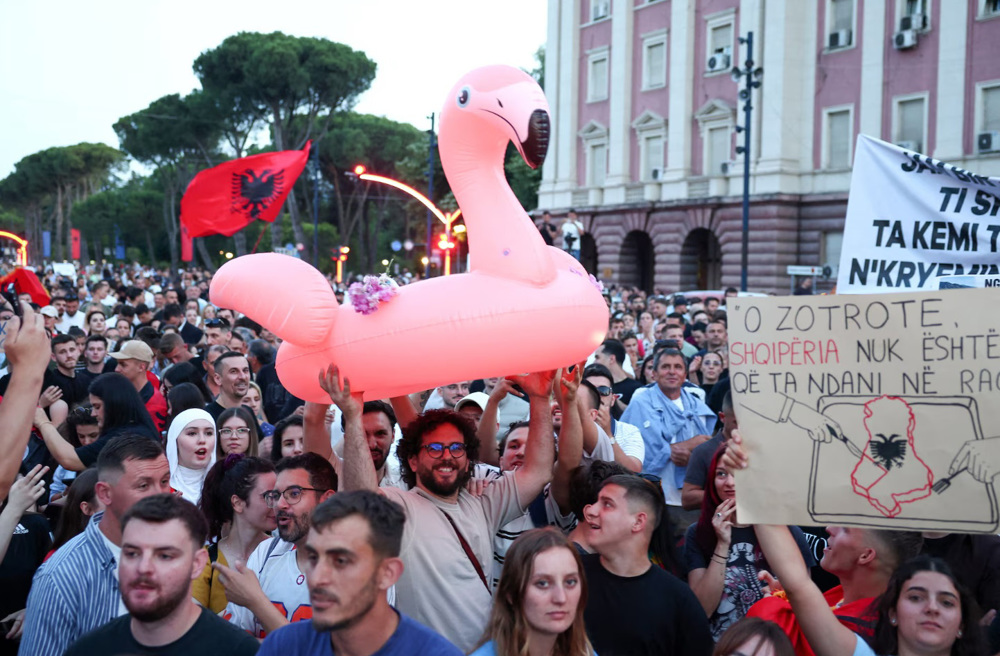
What began in late May 2026 as a small gathering in the fishing village of Zvërnec has swelled into a nationwide uprising. Protests continue with thousands of citizens marching through the capital, Tirana, under the slogan “Albania Is Not for Sale.”
The movement has been dubbed the "Flamingo Revolution," after the pink flamingos whose habitat is under threat. Demonstrators carry pink flamingo-shaped balloons, wear pink clothing, and wave flags in which the black double-headed eagle of Albania has been replaced by a pink two-headed flamingo.
The protests have spread beyond Albania’s borders, with the Albanian diaspora organizing solidarity demonstrations in New York, London, Brussels, Milan, and Berlin.
Chants of “Ivanka, go home,” “Cancel the project,” and demands for the prime minister’s resignation have filled the streets, reflecting broader anger at the political elite that has dominated Albania for three decades.
The government’s response to peaceful protests has been violent and aggressive. When citizens attempted to access Zvërnec Beach, they were met by private security guards who had erected barbed wire fences.
Viral footage showed a guard punching and dragging a protester away from the fenced-off beach. Another incident showed a Greek citizen injured in the violence, sparking a diplomatic protest from Athens.
Albanian police later confirmed they had arrested a security guard on charges of unlawful deprivation of liberty and intentional minor injury, and suspended several police officers for their role in the incident.
Rather than apologizing or restraining the developers, Prime Minister Rama has insisted that the project will proceed regardless of protests. He has offered to meet with a delegation of protesters to discuss solutions, but the protesters have rejected the offer and are now demanding his resignation.
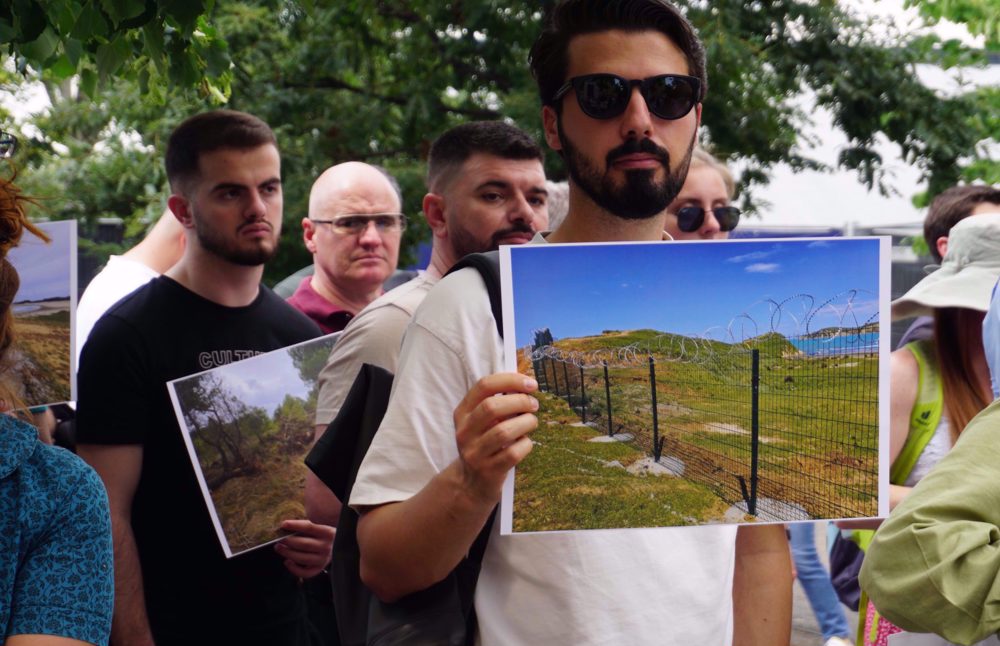
People’s demands: Nature, justice, and the rule of law
The protesters’ demands extend far beyond canceling one luxury resort. They represent a broad rejection of the corruption, clientelism, and disregard for democratic norms that have characterized the Rama era.
Protesters have stated that they are not against foreign investment, nor against any particular individual or nationality, but they are against the destruction of their nature and their land for economic gain.
For years, experts have noted that the best coastal lands in Albania have ended up in the hands of oligarchs through opaque deals, while ordinary Albanians are left with nothing but low-wage service jobs in the luxury resorts built on their stolen heritage.
The Kushner-Trump family project is seen as the culmination of this pattern, the most egregious example yet of a prime minister selling the nation’s natural heritage to the highest and most influential political bidder.
The protesters have also focused on the legal changes that made this project possible.
In February 2024, Rama’s government amended Albania’s Law on Protected Areas to allow structures of excellence with five stars or more and related hospitality activities within zones that had previously been strictly protected.
Environmental lawyers have described this as one of the most aggressive legislative attacks on environmental protection seen in Europe in recent years.
The law has no basis in European Union standards, and Brussels has repeatedly warned Albania that it must repeal these changes to advance its membership bid.
The protesters also demand that the criminal investigation proceed without political interference. They want to know who changed the land ownership status of the Zvërnec beachfront, who approved the strategic investor designation, and whether any improper payments were made.
EU warning: Chapter 27 and the future of Albanian accession
The European Commission has now made clear that the Rama government’s actions could cost Albania its European Union membership.
A Commission spokesperson warned that Albania must refrain from actions that could undermine the fulfillment of closing benchmarks for Chapter 27 on Environment and Climate Change.
The Commission emphasized that Albania is expected to align fully with the European Union’s Birds and Habitats Directives, which strictly protect areas like Vjosa-Narta.
The Commission has urged Albania to repeal the changes to the Law on Protected Areas and terminate the Strategic Investments law, which gives favored projects fast-track treatment that risks bypassing European Union environmental safeguards.
The Commission also noted that the ongoing anti-corruption investigation reportedly extends beyond environmental concerns, indicating that European officials are paying close attention to the corruption dimensions of the case.
Albania, alongside Montenegro, is considered a frontrunner for European Union accession, with Prime Minister Rama himself setting a target of joining by 2030.
However, if Brussels concludes that Albania is not serious about environmental protection or the rule of law, that timeline will be pushed back indefinitely or canceled altogether.
The Commission’s warnings are not about the involvement of any particular individual; they are about the destruction of protected habitats, the violent repression of peaceful protesters, and the systematic dismantling of environmental laws.
Unfolding consequences
The situation in Albania continues to deteriorate. The anti-corruption prosecution office has frozen the bank accounts of the landholding company tied to the project, and the criminal investigation is widening.
The European Commission is monitoring the case closely, and the Albanian diaspora is mobilizing international pressure. The prime minister faces the most serious challenge to his authority in over a decade, and the protesters show no signs of backing down.
The damage to the environment, however, may already be done. Conservation groups have documented irreversible harm to the sand dunes and the lagoon ecosystem.
Even if the project is halted today, the blocked tidal connection and the dumped gravel will take years or centuries to repair. The flamingos, the pelicans, the monk seals, and the sea turtles do not have the luxury of waiting for Albanian politics to resolve itself.
The Trump-Kushner family has made billions of dollars by exploiting political connections and bending rules to their advantage.
Edi Rama has made a career of presenting himself as a modernizer while governing through clientelism and authoritarian methods. But in the spring of 2026, on the shores of the Adriatic, the people of Albania had chosen to resist.

Trump bars CNN, MS NOW and Politico from White House as they question his pro-war policies
US leaves UN Human Rights Council after probe finds possible American war crimes in Iran
Yemen dismisses Mecca drone allegation, says kiswa donors to Epstein target sanctities



Iran FM: Our first task in New York is to defend the just cause of the Iranian people
US lawmaker admits American people footing bill for Trump’s failed aggression against Iran
VIDEO | Trump's America is dying for Israel
US visa ban on Iranian president’s media team is bid to hide the truth: FM spokesman
VIDEO | Iran fully prepared to respond to new aggression
US aggression, economic warfare amount to crimes against humanity: Iran's UN envoy
Protests erupt in US as ICE agent shoots Venezuelan driver
US pressure fuels cooperation among Muslim states: Pezeshkian


 PressTV NEWSLETTER
now
PressTV NEWSLETTER
now
 This makes it easy to access the Press TV website
