Trump's anti-Iran threats ‘psychological’ tactic to win at talks what war could not: Analyst
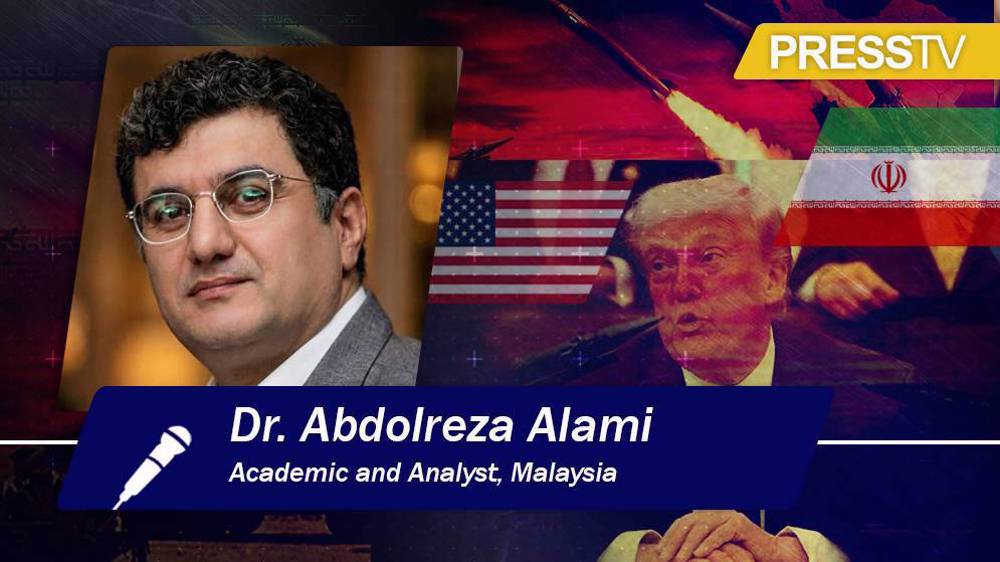
By Press TV Website Staff
US President Donald Trump’s relentless military threats against Iran are a "psychological pressure" tactic – an attempt to extract political concessions that 40 days of unprovoked aggression failed to secure, says an analyst.
Speaking to the Press TV website, Abdolreza Alami, senior lecturer at University Technology Mara in Malaysia, highlighted the failure of the US-Israeli war coalition in their recent unprovoked military aggression against the Islamic Republic of Iran.
“If forty days of direct military engagement failed to produce Iran's strategic retreat, then the sustained psychological pressure of renewed strike threats may achieve at the negotiating table what force could not deliver on the battlefield,” he said.
Trump's parallel posture — threatening military aggression while engaging in indirect talks — should not be read as a contradiction, Alami said, calling it a “textbook application of coercive diplomacy” following the war of aggression and the subsequent ceasefire.
The US-Israeli aggression, which began on February 28 with the assassination of the Leader of the Islamic Revolution, Ayatollah Seyyed Ali Khamenei, and several high-ranking commanders and went on for 40 days, failed to achieve its declared objectives, Alami noted.
“Iran's nuclear capabilities were not dismantled, its regional deterrence posture was not broken, and the fundamental balance of power in West Asia was not structurally altered,” he said in a conversation with the Press TV website.
✍️ Analysis - Big defeat to big lies: Trump peddles Iran 'discord' fiction to mask US military, strategic failure
— Press TV 🔻 (@PressTV) April 23, 2026
By Press TV Strategic Analysishttps://t.co/WQZGoNLjmx pic.twitter.com/rEX09k5Fhi
Iran responded with 100 waves of counterattacks spread over 40 days, targeting American and Israeli military and strategic assets across the region.
A Pakistani-mediated ceasefire was brokered on April 8, but subsequent talks in Islamabad ended with no tangible results. Tehran cited Washington's excessive demands and has made clear that any return to negotiations depends on lifting the illegal US naval blockade.
Alami pointed to a critical structural constraint in Trump's strategy of issuing threats. Over four decades of illegal and crippling sanctions, external pressure, and military threats, Iran has internalized this environment as a permanent condition of its security landscape, not as an exceptional crisis, he noted.
“Consequently, external coercion rarely weakens Tehran's negotiating position; more often, it reinforces the resistance discourse within Iran's political establishment, particularly among factions that interpret any agreement reached under duress as strategic capitulation,” the Malaysia-based analyst explained.
There is also an institutional dimension, according to Alami, who added that US policy toward Iran is neither unified nor fully centralized.
Within Washington's decision-making architecture, currents closely aligned with the Israeli priorities remain structurally opposed to any durable de-escalation with Tehran, he said.
“From Iran's perspective, Israel derives strategic benefit from the perpetuation of a crisis environment — because a genuine Iran-US rapprochement would inevitably reduce Israel's centrality in the region's security architecture,” Alami remarked.
He also pointed to the pressure on Trump to announce victory before the American public, especially with the November midterms looming and ratings dwindling.
“For Trump, constructing a victory narrative is not merely a public relations exercise — it is a political survival imperative,” he told the Press TV website.
This comes as the failed war has led to a record low disapproval rate for Trump, as the US public is growing more discontent with the increasing economic costs of the aggression.
A recent poll shows most Americans disapprove of the war with Iran, blame the administration for rising gas prices, and give Trump a low 36% approval.
— Press TV 🔻 (@PressTV) May 12, 2026
Follow: https://t.co/mLGcUTS2ei pic.twitter.com/ovpeyymKXg
Trump’s failure in war, the analyst hastened to add, has created a “narrative gap” which is the distance between actual outcomes and the image that must be presented to the American domestic audience.
“That gap generates a form of compensatory narrative pressure: even a modest agreement, if framed skillfully, can be marketed as a decisive political triumph — one that brought Iran to the table, contained the crisis, and restored American deterrence credibility,” he said.
The two countries are now exchanging draft proposals through Pakistan. But Tehran has highlighted deep mistrust regarding Washington's willingness to honor its commitments.
Divergent definitions of threat and internal Arab bloc divisions obstruct any durable settlement, he said.
“The United States seeks a 'narratable victory'; Iran seeks agreement without capitulation; and certain regional actors — Israel most structurally — retain a stake in maintaining tension. This combination makes the current moment simultaneously a diplomatic opening and a high-risk zone for strategic miscalculation,” added the analyst.
Iran is the last bastion of true anti-imperial resistance, owes no one an explanation: Writer
Focus on youth and training camps key to building future generations: Weightlifting chief
During Mosaddegh's time, US pursued the same policy toward Iran as today: Filmmaker



Iran calls on states to condemn US ‘unilateral coercive measures’
Series of ship accidents, supply failures, and falling troop morale stretch US Navy to its limits
VIDEO | From deal to ordeal: The US and Iran
VIDEO | West Asia under fire
125 countries bound to arrest Netanyahu as ICC warrant looms over Israeli PM: Report
Who is liable for reparations, Iran or US?
Iran’s giant solar leap: A 5,000-megawatt project in Isfahan
VIDEO | Yemeni women mark birth anniversary of Prophet Mohammad (PBUH)


 PressTV NEWSLETTER
now
PressTV NEWSLETTER
now
 This makes it easy to access the Press TV website
