
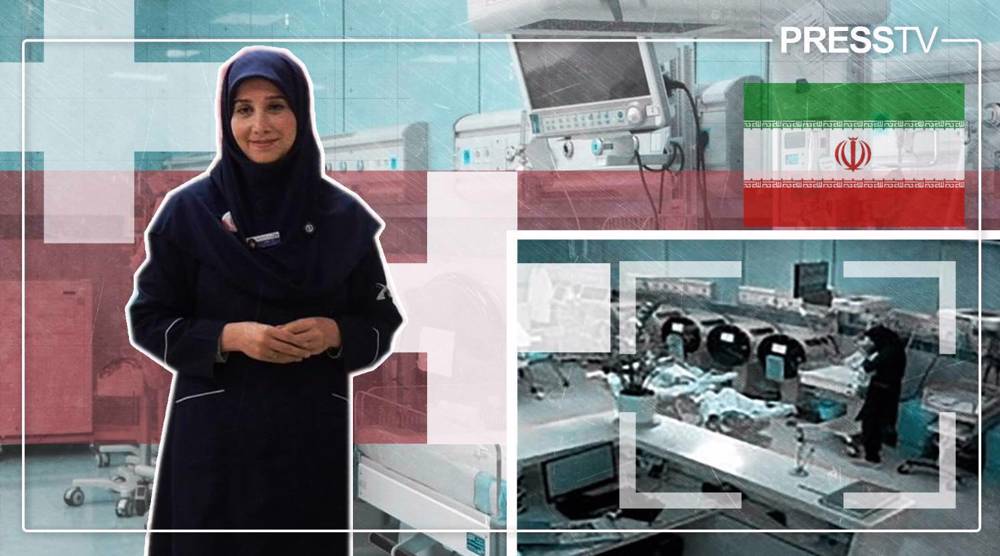
By Mina Mosallanejad
At 11:40 on the morning of March 1, as the shockwave from the US-Israeli bombing tore through a military compound near Tehran's Khatam al-Anbia Hospital, glass exploded inward like shrapnel, ceilings crashed down in clouds of dust, and terrified patients fled screaming through smoke-filled corridors.
On the fifth floor, in the neonatal ward, three newborns – barely hours old – lay still in their bassinets, unaware that the world outside had just broken open.
Neda Salimi did not run for herself. All she thought at that moment was the safety of newborns.
The neonatal nurse, sitting beside the infants and writing reports only moments before the blast, heard the explosion – and moved in less than three seconds – not toward the exit door, but toward the smallest heartbeat in the room.
“There was no time to think,” she told Press TV Website. “In those moments, only one thought existed in my mind: we had to get the babies somewhere safe.”
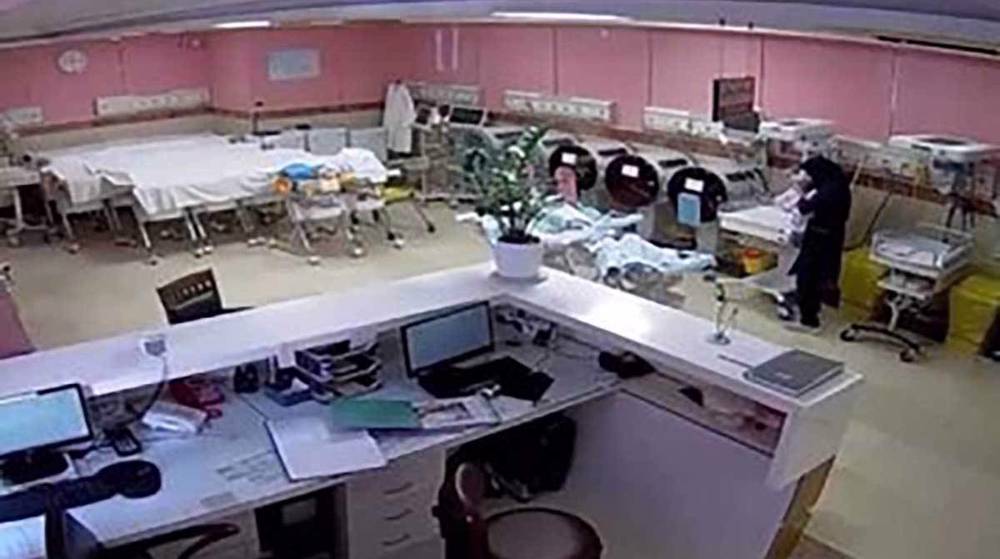
Security camera footage – later viewed millions of times through social media platforms worldwide – captured only seven seconds of what happened next.
In the grainy video, Salimi lifts all three newborns into her arms, cradling them firmly and fondly, and rushes out of the room as chunks of debris rain down around her.
Those seven seconds became one of the defining scenes of the Ramadan war – an unprovoked US-Israeli war of aggression that tore through civilian neighborhoods, hospitals, research centers and schools across the country.
It was a war where newborn children were carried through smoke and shattered glass by exhausted nurses while the merchants of death in Washington and Tel Aviv spoke the language of war from a safe distance.
The harrowing footage turned Salimi into a national symbol of admiration overnight. But what the cameras did not show was the chaos after she disappeared into the hallway.
As she reached the corridor –lungs burning, ears still ringing – she handed two of the infants to colleagues who were also evacuating patients, their faces pale with the same terror.
She kept the third baby pressed against her chest, one hand supporting its tiny head, while the staff rushed toward the shelter beneath the hospital.
"We tried to keep the babies in our arms the entire time so they wouldn't be hurt," she recalled in a conversation with the Press TV website, her voice steady despite the painful memory.
"The shelter was full of fear, confusion, and people trying to help each other."
"The parents thought their children were under the rubble"
— Press TV 🔻 (@PressTV) April 21, 2026
Interview with the Iranian nurse whose video rescuing infants after the US–Israeli bombing of a hospital went viral.
Follow https://t.co/B3zXG73Jym https://t.co/jp5EMheEjA pic.twitter.com/XwiqerJbmU
The three babies – two boys and one girl – had been born less than an hour earlier. Their mothers were still recovering from surgery when the explosions began. In the panic, many believed their children had died. For those minutes, in the smoke and darkness, hope had become the rarest thing in the room.
"When we finally found the mothers among the crowd and returned the babies to them, it was the most beautiful moment," Salimi recalled, her voice softening. "That day, we witnessed three reunions. For a few moments, we forgot there was a war."
She still becomes emotional remembering that day. The babies were crying from the noise and terror – so were the nurses and everyone around.
"We cried because the families were crying. Then we cried again because they were happy."
Salimi is 36 years old, from Kermanshah, and in the final semester of a PhD in nursing at Iran University of Medical Sciences. She has spent nearly 12 years as a nurse, including a decade in pediatric and neonatal care. She is also the mother of a six-year-old boy.
She believes motherhood shaped her reaction that day, though not in the sentimental way people often imagine.
"Yes, I am a mother, and of course that feeling exists inside me," she stated. "But when you work with newborns every day, you become attached to them, irrespective of whether you have children or not. You feel responsible for them. Maybe motherhood simply makes that responsibility deeper."
In neonatal intensive care units, nurses spend their days and nights caring for patients who cannot speak, cannot explain pain, and cannot ask for help. Their language is weaker than words: a faint cry, a sudden drop in oxygen levels, an irregular heartbeat flickering across a monitor, she noted.
"NICU nursing requires both a strong spirit and a very soft heart," Salimi explained. "One moment, you may witness an unsuccessful resuscitation. Ten minutes later, you have to smile and teach another mother how to breastfeed her child. You switch instantly between grief and hope."
It is a profession built on emotional whiplash. Nurses celebrate life while standing only inches from death.
Salimi described watching premature infants spend months attached to tubes and machines before finally growing strong enough to drink milk in their mother's arms. She calls those moments miracles.
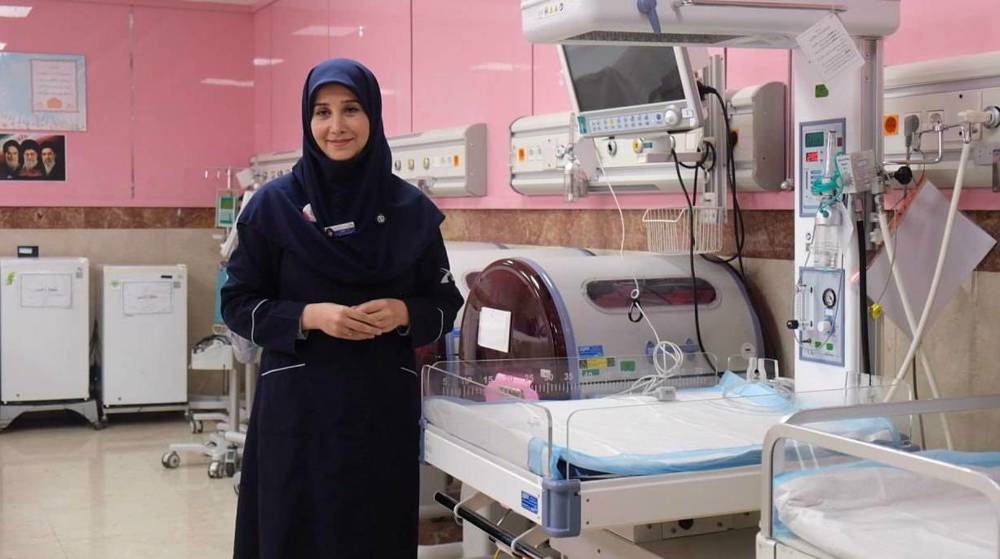
"The day a baby is discharged feels like winning a championship," she said.
But there are also losses that never fully leave.
"The death of a newborn or child you cared for is one of the heaviest griefs a nurse can carry," she told the Press TV website. "A bed that held life only hours earlier suddenly becomes empty—a silence that weighs more than any sound."
There are other wounds too, she explained: parents asking through tears whether their child will survive; the pain of inserting needles into veins "as thin as thread," performing procedures that hurt infants even while knowing they are necessary.
For nurses in wartime, those ordinary stresses collide with a larger terror. During the US-Israeli aggression against Iran, medical workers repeatedly found themselves treating civilians under bombardment while hospitals near military sites absorbed shockwaves from nearby attacks – the ground trembling, ceilings cracking, the next strike always a question mark.
At Khatam al-Anbia Hospital, this was not the first time staff had worked under fire. During the earlier twelve-day war in June 2025, Salimi said she had already evacuated another newborn during missile strikes while a colleague carried an infant – still attached to medical equipment, tubes trailing behind – toward shelter.
The March bombardment, however, was heavier.
Outside the hospital stood a column of black smoke rising from the explosion. Inside, shattered glass covered the floors like a frozen storm, crunching underfoot as nurses guided patients toward safety – through darkness, through dust, through the prayers trapped in their throats.
Security footage from the reception area showed medical staff running through corridors as ceilings partially collapsed around them, dust filling their lungs.
The war's architects speak in the language of strategy and military targets. But for civilians, the reality arrived as shockwaves through maternity wards.
At the moment of the attack, six newborns were in the ward, though only three remained in bassinets; the others had already been discharged – tiny lives already home, unaware of what they had narrowly missed.
Two of the infants Salimi carried had monitoring lines attached, though they were not critically ill.
"They were not premature," she explained. "The devices were only monitoring their oxygen and heartbeat while we waited for the mothers to return from surgery."
In the shelter beneath the hospital, Salimi remembers praying.
"I asked God to give us a few more minutes of life," she recalled, "just enough to return the babies to their mothers. After that, if He wanted to take our lives, He could."
The video spread rapidly across social media channels inside Iran, becoming viral internationally. Salimi herself first discovered it accidentally.
"I saw the clip online and turned to my husband and said, 'That's me. Where did they get this footage?'"
Her husband cried watching it.
Soon, their home was filled with neighbors knocking on the door, many embracing her in tears. Her phone rang constantly until the battery died. Calls flooded the hospital as strangers asked to speak to the nurse who had carried three newborns through the explosions, as if she were a character in a story, not a woman still trying to process what she had lived.
Despite the sudden, extraordinary attention, Salimi insists the rescue was not an individual act.
"All my colleagues stood together bravely that day," she asserted. "It wasn't only me.
Still, public recognition changed her life. People now stop her in the streets to thank her or tell her they are proud of healthcare workers. The admiration, she said, feels meaningful, but also heavy.
"I feel a greater responsibility on my shoulders now."
She remains in contact with the families of the three infants she rescued on that day. After their discharge, hospital staff continued following up about feeding and neonatal care. As far as she knows, all three children are healthy.
"That is my greatest happiness," she said. A quiet victory. Three small heartbeats are still going.
The pressures on nurses, meanwhile, continue long after headlines fade. Salimi described overwhelming workloads, staff shortages, long shifts, economic strain, and the psychological trauma left behind by war – the kind that does not show up on any monitor.
"Many nurses are carrying the emotional effects of these experiences," she remarked. "But they continue because they know people's lives depend on them."
At least 18 Iranian healthcare staff martyred in recent American Israeli attacks
— Press TV 🔻 (@PressTV) March 19, 2026
According to Mohammad Raeeszadeh, the head of Iran's Medical Organization, more than 18 healthcare staff members were martyred in American Israeli attacks on medical centers across Iran. pic.twitter.com/Q1VWK9jLl4
Iranian nurses, she told the Press TV website, proved themselves during the COVID-19 pandemic, the twelve-day war, and the Ramadan war. What they ask for now is not applause, but practical change: better working conditions, stronger professional support, and enough resources to continue saving lives without losing their own along the way.
Yet even after everything she has witnessed, Salimi still speaks about nursing less as a career than as a moral commitment.
"A successful nurse needs more than knowledge and skill," she said. "They need a heart full of kindness and humanity."
For her, nursing is not simply clinical work or a profession. It is the ability to bring hope into moments where people feel abandoned by the world around them, when the bombs are falling and no one is coming to save you.
That philosophy becomes more striking in wartime, when hospitals themselves cease to feel safe and civilians become collateral beneath geopolitical calculations made thousands of miles away, in conference rooms where the names of neighborhoods are never spoken.
Wars launched in conference rooms by Washington and Tel Aviv through the rhetoric of "precision strikes" rarely show their aftermath honestly.
The aftermath is not a map or a military briefing. It is a neonatal ward trembling from nearby missiles. It is mothers emerging from surgery, believing their newborn children may already be dead. It is a nurse running through broken glass, carrying three babies against her chest – not as a superhero, but as a human being who refused to look away.
Salimi says she sometimes thinks about the future – about the day those children might grow up and learn what happened during the first hour of their lives.
"If they see me one day," she said, "I want them to know that life is a miracle that needs kindness, effort, and faith."
Then she pauses and smiles softly – the kind of smile that has seen too much and still chooses gentleness.
"I hope they become strong and compassionate people," she added. "That would mean everything was worth it."
 This makes it easy to access the Press TV website