
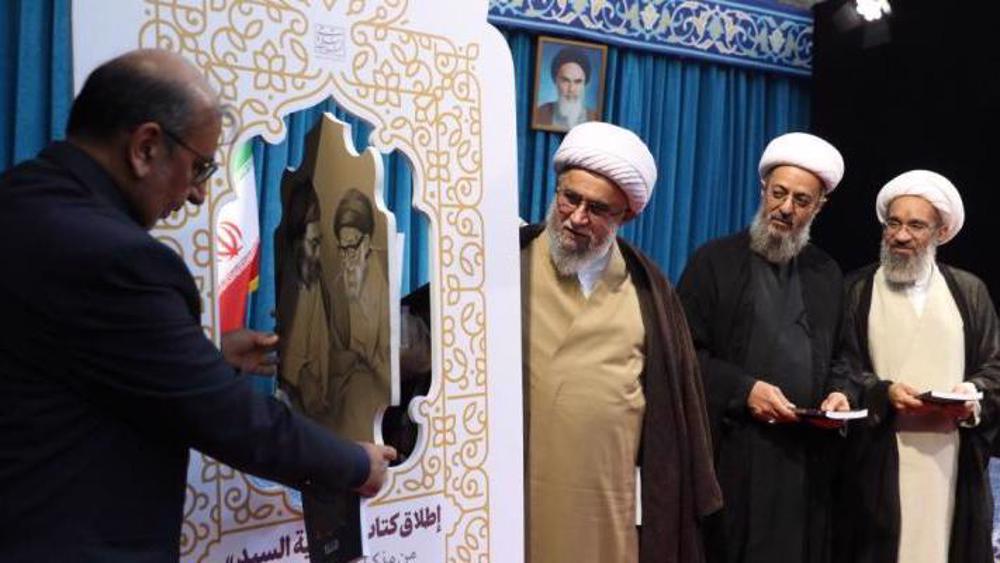
In a solemn ceremony held Thursday evening at the martyrdom site of the late Leader of the Islamic Revolution, Imam Seyyed Ali Khamenei, the Arabic translation of the acclaimed work "Agha's Narrative" was unveiled.
The event drew Arab scholars, cultural figures, and clerics residing in Iran, who gathered to commemorate the figure widely regarded as a pillar of contemporary Islamic leadership.
"Hikayat al-Sayyed" traces the formative years of the martyred Leader of the Islamic Revolution, offering readers an intimate portrait of his family relationships, spiritual upbringing, and the moral-intellectual environment that shaped his worldview.
The book aims to answer a question many in the Arabic-speaking world want to know: how did this exceptional figure attain such profound scholarly, spiritual, and political stature.
According to the organizers, the translation opens up a treasure trove of ethical and educational values that define the martyred Leader's legacy, making them accessible to a broader regional audience.
Dr. Mohammad Akhgari, head of the international affairs department at the Office for the Preservation and Publication of the Works of Ayatollah Khamenei, addressed the gathering and spoke at length about the book's contents.
"Today, in a place where memory has become intertwined with martyrdom, we stand with reverence before a personality who touched hearts through his knowledge and sincerity. This book is a truthful window into a man who exercised profound educational influence upon the Leader of the Islamic Revolution," he said.
He said 'Hikayat al-Sayyed' is not merely the story of the life of a great scholar, but a “truthful window” into the personality of a man who exercised a “profound educational and intellectual influence” upon the Leader of the Islamic Revolution.
Imam Khamenei a competent man who returned Ummah to Islam: Sheikh Qassimhttps://t.co/FjQGxfwPkv
— PressTV Extra (@PresstvExtra) May 15, 2026
“Through the memories of a righteous son — the martyred Leader, Grand Ayatollah Sayyid Ali Hosseini Khamenei — the book presents a vivid and authentic image of that great father and opens before readers a treasury of moral, spiritual, and educational values.”
A televised message from the top Bahraini cleric, Ayatollah Sheikh Isa Qassim, described the martyred Leader as "an outstanding revolutionary figure distinguished by vigilance, unwavering determination, and exceptional strategic capability."
He added that the Imam's entire being "was immersed in the principles of that great, dignified, and divine Revolution."
Kuwaiti scholar Ayatollah Sheikh Hussein al-Maatouq emphasized that the book reveals "an important dimension" of the Leader's personality.
"We stand before a personality who represents the practical embodiment of the Prophet's saying: 'The scholars are the heirs of the prophets,'" he said.
The ceremony was marked by visible emotion. Arabic-speaking attendees were invited to write personal messages to the martyred Leader, and many were observed with tearful eyes as recordings of his Arabic speeches echoed through Keshvar Dost Street.
Hezbollah's representative in the holy city of Qom, Hujjat al-Islam Sheikh Moein Daghigh, in his remarks, said “all the tyrants of the earth united to assassinate him, believing they could destroy the civilization of Islam, but failed."
The event concluded with poetry recitations by Sayyid Morteza Heydari Al Kathir, an Arab poet from Khuzestan, dedicated to the martyred Leader's memory.
 This makes it easy to access the Press TV website