#IR47: From fear to awe – How Western media covered Imam Khomeini’s triumphant return in 1979

By Ivan Kesic
On February 1, 1979, as Air France Flight 4721 descended through the dawn sky toward Tehran, the eyes of the world’s media were fixed not just on an airplane, but on the culmination of a revolutionary story that would irrevocably alter Iran and redefine the global political landscape.
The homecoming of Imam Ruhollah Khomeini to Iran on 12 Bahman 1357 (February 1, 1979) was a seismic event that commanded unprecedented global media attention.
For the international press corps, it represented the dramatic final act in the collapse of a pivotal Western ally in the Persian Gulf region, the Pahlavi monarchy.
Their coverage revealed a complex struggle to interpret a phenomenon that defied easy categorization: a mass revolution fused with profound religious identity, led by a charismatic, ascetic cleric in exile.
Western media outlets initially propagated fear and distortion, framing the Imam as a "fanatical relic" and the revolution as a "Soviet ploy." Yet, as millions of Iranians poured into the streets in a breathtaking, self-organized welcome, the narrative was forced to shift.
The world media’s gaze revealed a dual nature – shifting from preconceived attempts to undermine the revolution’s legitimacy toward reluctant, awestruck acknowledgments of its popular sovereignty and the unique leadership of Imam Khomeini, whose steadfast vision guided a nation to its historic destiny.
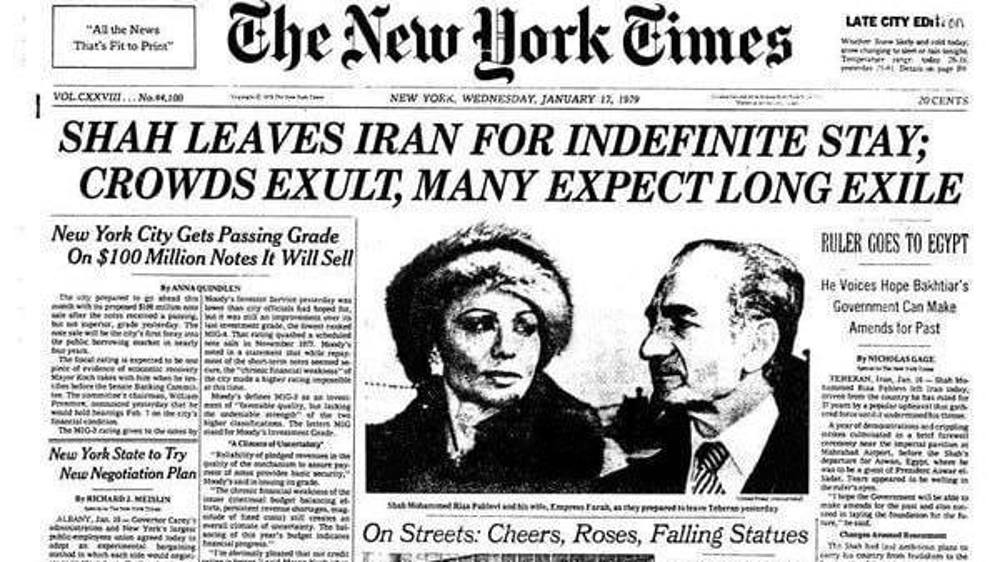
Preconceived narrative: Fear, distortion, and "red menace"
In the months leading to the Islamic Revolution in 1979, Western analysts and media outlets grappled with an inconvenient truth: the undeniable centrality of Imam Khomeini’s enigmatic personality and leadership to the rapidly growing movement.
This realization prompted a dual approach in media coverage, one aimed at shaping perception to forestall the revolution’s stupendous success that rippled across the region.
Unable to ignore the reality of his unifying appeal, major American and European media groups embarked on a campaign to distort his image and the nature of the emerging Islamic government.
The New York Times, the Wall Street Journal, and notably the Washington Post selectively highlighted excerpts from the Imam’s writings that emphasized his uncompromising Islamic principles, presenting them not as a coherent ideology of liberation but as evidence of "regressive fanaticism."
This media activity was complemented by diplomatic efforts to discredit the popular movement. Political figures like Henry Precht, the Iran desk officer at the US State Department at the time, publicly labeled the Imam’s words as "misleading" to distort the narrative.
The overarching goal was to cultivate a wave of Islamophobia, painting a picture of a "hard-hearted, stubborn, and deeply angry" leader whose rule would allegedly turn back the clock centuries.
When simplistic religious scare tactics proved insufficient, some media circles floated an alternative, equally flawed analysis: that the revolution was a Cold War contrivance, a proxy victory for the Soviet Union.
This theory crumbled under its own illogic, unable to explain why a Soviet-backed uprising would sideline the Iranian communist Tudeh Party in favor of a distinctly Islamic framework.
These early reports were less about journalism and more about psychological operation, an attempt to immerse global audiences in a "superficial and false awareness" that served entrenched geopolitical interests.
Calculus of return: A flight against all odds
The Imam’s decision to return to Iran while the remnants of the Shah’s regime and a US-backed interim government in Tehran still clung to power was itself a story of profound defiance that captivated the international press and reluctant journalists.
Media reports from Paris detailed the immense logistical and security challenges. After the appointed "Revolutionary Flight" with Homa Airlines was thwarted by the Bakhtiar government’s closure of airports, Imam Khomeini’s entourage in Neauphle-le-Château negotiated with several European carriers, all of which refused the perceived risk.
Only Air France, after securing guarantees from French political officials and the revolutionary forces in Iran, agreed to charter the fateful Boeing 747, with the flight’s rental and insurance famously covered by a devoted follower of the Iranian leader.
Foreign correspondents noted the extraordinary precautions, including the plane carrying double its usual fuel load to enable a return to Paris if denied landing—a detail that underscored the palpable tension that existed at the time.
The scene at Charles de Gaulle Airport on the night of January 31 was etched in media dispatches; a French taxi driver, witnessing the police-lined motorcade and global press spotlight, told an Iranian journalist, "Your Ayatollah has shaken the world."
Onboard, reporters chronicled the surreal atmosphere: a flight that served no alcohol, the Imam resting peacefully under his cloak, and the collective anxiety that the aircraft was uninsurable for this mission.
Their reports conveyed a keen awareness that they were witnesses to a potentially perilous historic pivot, with one journalist noting that safely touching down in Tehran would be "the greatest success of their careers."
Peter Jennings, a Canadian-American journalist who anchored a prime-time show on ABC World News, famously asked Imam: “What do you feel (about returning home?” Imam answered: “Nothing!” He asked again, and the answer was the same.
That one-word answer reflected his extraordinary strength of character, as commentators later noted.
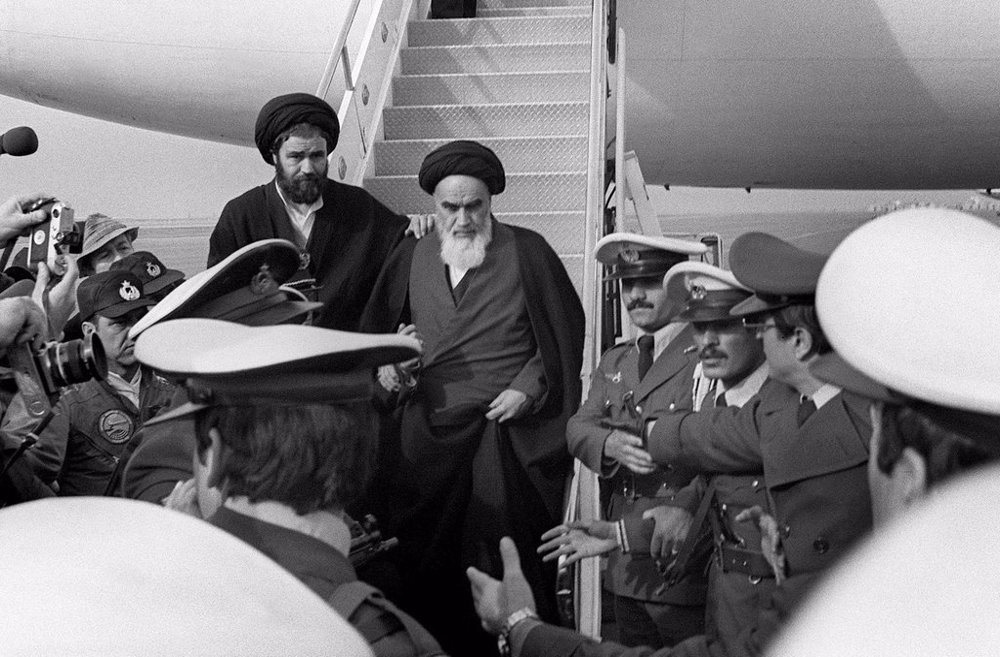
Unfolding spectacle: Reluctant admiration for a people’s welcome
As Flight 4721 entered Iranian airspace and circled low over Tehran, the mainstream Western media’s preconceived narratives began to confront an irrefutable visual reality.
What unfolded below was a human phenomenon of such scale and spontaneity that it forced a recalibration of reporting.
Foreign journalists, descending the aircraft stairs behind Imam Khomeini, found themselves not just reporting on a historic arrival, but immersed in what global news agencies would soon call "the biggest reception of the century."
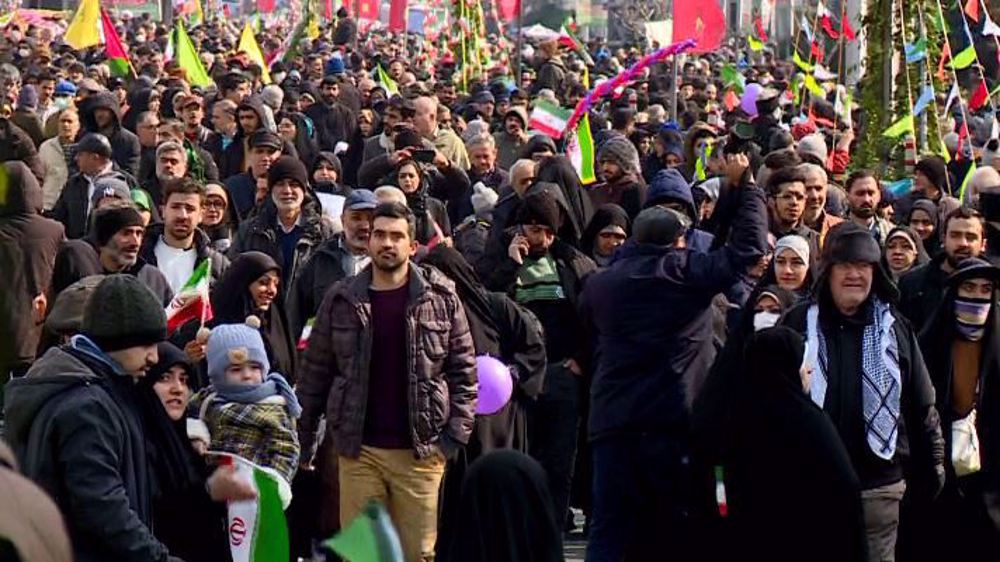
The sheer numerical magnitude became an immediate focal point. While outlets like BBC’s Radio London offered characteristically conservative estimates, agencies such as United Press International and Germany’s Radio Cologne reported numbers between 4.5 and 6 million people—a human river stretching an estimated 33 kilometers from Mehrabad Airport to the Behesht-e Zahra cemetery.
The Kayhan newspaper’s description of "33 kilometers of flowers on the path of the new spring" captured the poetic dimension that foreign reports struggled to convey.
More impactful than the numbers, however, was the nature of the event. Journalists from major Western outlets were compelled to note a unique and disarming fact: this multimillion-person mobilization occurred without any visible police or security direction.
In their dispatches, they admitted that in any comparable Western event, such a crowd would have inevitably led to fatalities from crushing, yet here, "no one was killed."
This detail became a testament to what foreign correspondents termed the people’s "social growth and political maturity," an organic, peaceful power that dismantled stereotypes of a populace in need of authoritarian control.
The Imam’s own rejection of elaborate state reception plans, insisting he would return "as a student" and move among the people even at risk of being "crushed under their feet and hands," further cemented an image of a leader intrinsically connected to his nation’s will, a stark contrast to the isolated monarch he had toppled.
Speech that defined an era: Behesht-e Zahra and the clarion call
The global media’s gaze followed the Imam’s procession to Behesht-e Zahra, the cemetery for martyrs of the revolution, where his first major address on Iranian soil would be delivered.
This speech was dissected in international reports not merely for its content but as the definitive political manifesto of the new era. Correspondents relayed the Imam’s declaration of the Bakhtiar government as illegal and his promise to "strike at this government."
They transmitted his historic appointment of a provisional government based on popular mandate, a move that formally transferred revolutionary legitimacy from the exiled leadership to an executive body on the ground.
The media framed his unwavering demand for the complete eradication of the West-backed puppet monarchy as the final word on any compromise.
In doing so, they highlighted how the speech methodically dismantled the last hopes of the old regime and its foreign backers for a negotiated settlement that would preserve the Pahlavi framework in some diminished form.
The setting itself was deeply symbolic, and foreign reports did not miss its significance: the leader speaking amidst the graves of those who fell for the revolution, linking past sacrifice with future sovereignty of a nation.
This speech, broadcast and reprinted worldwide, transformed Imam Khomeini from a symbolic opposition figure into the de facto head of state in the eyes of the global community, signaling that the transfer of power was not a future possibility but a present reality.
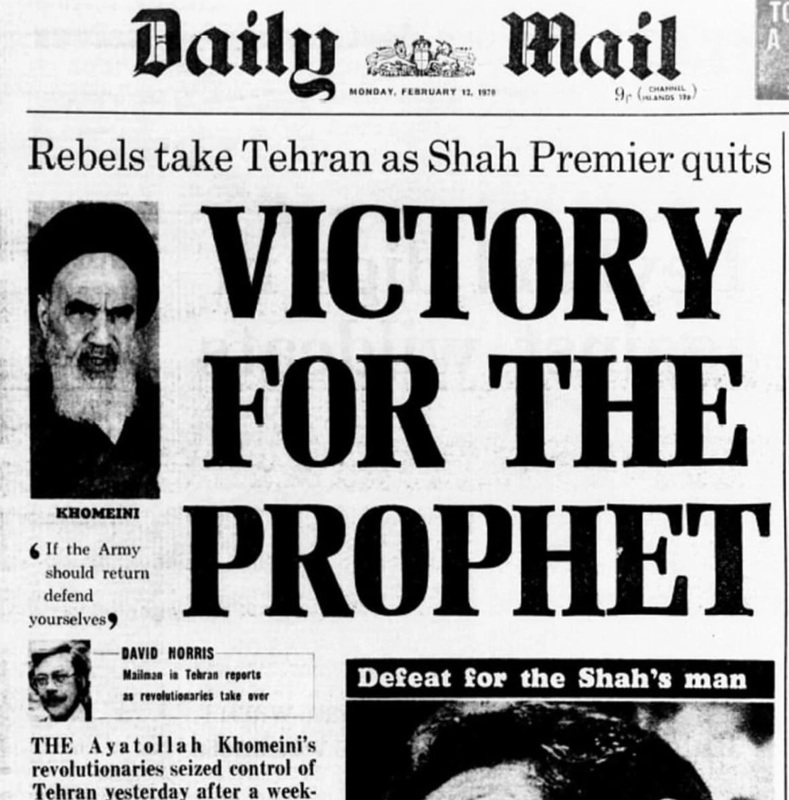
Regional tremors: How the Arab world reacted
The shockwaves of the Imam’s historic return were immediately felt across the wider region, and world media served as the conduit for these anxious regional reactions.
This was framed not as a nationalist issue but as a deeper, ideologically transformative one. Similarly, reports from Egypt captured President Anwar Sadat’s "deep alarm."
Sadat, the Shah’s close friend and his first host after fleeing Iran, was reported by AFP news agency to have held secret meetings vehemently opposing the "politicization of Islam," warning potential Egyptian "Ayatollahs" against exploiting religion.
The Lebanese press reported that Imam Khomeini had refused to receive an Egyptian religious delegation sent to persuade him to accept a constitutional monarchy, demonstrating his uncompromising stance.
From the opposite flank, the media noted celebrations in Libya and statements from the Palestine Liberation Organization foreseeing the revolution’s impact spreading beyond Iran’s borders.
These reports collectively painted a picture of a regional order beginning to quake, with established autocracies recognizing the Imam’s return as a potent challenge to their own legitimacy.
Wishful thinking as policy: Israeli regime's orientalist dismissal
The Israeli regime’s reaction to the Islamic Revolution and the return of Imam Khomeini was characterized by a profound and critical failure of comprehension, framed through a lens of orientalist dismissal and geopolitical anxiety.
Reuters quoted an unnamed Israeli regime official expressing profound alarm, stating that the regime was preparing to abandon Iran as an economic partner.
The official identified a "real danger" of the "Middle East and a significant part of Africa" being destabilized by the rise of "religious pan-Islamism," directly attributing a new trend of Arab youths turning to traditional dress and religious leaders to the events in Iran.
Israeli narratives hastily constructed a portrait of Iran as a society rejecting modernity, a “dark utopia” resurrecting “primeval reactionary forces” that had uprooted the Shah’s “benevolent modernizing project.”
This framing, articulated by figures like Uri Lubrani, the regime's last ambassador to Pahlavi Iran, dismissed the revolution as a “remarkable lesson in the immense power of irrationality,” portraying it as a paradoxical anachronism devoid of logic.
Unable to reconcile the revolution’s popular sovereignty and religious identity with their own secular worldview, Israeli officials and media retreated into wishful thinking and overt hostility.
Headlines in the Israeli press betrayed this posture, with op-eds proclaiming “Iran Disintegrates,” “Chaos Reigns in Iran,” and “Khomeini—The Beginning of the End?”
This rhetoric was not only not analytical but actively hopeful for the new republic’s immediate collapse, reflecting a deeper inability to engage with the authentic historical agency of the Iranian people.
The regime’s response thus became an exercise in denial, an attempt to “wish away” a profound civilizational and political shift that challenged its regional calculus and exposed the limitations of its understanding.
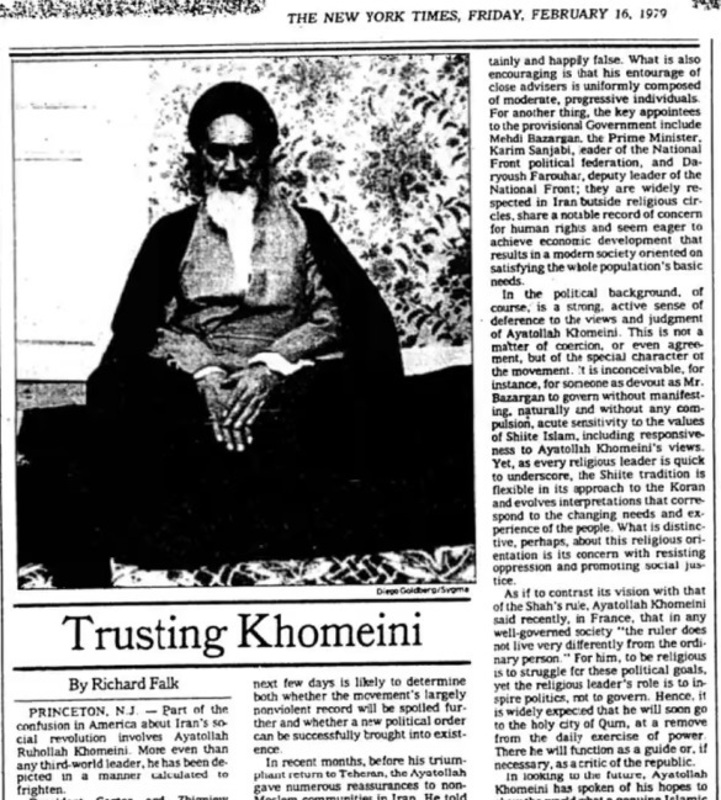
Conflicted witness: Scholarly defense and evolving portrayals
Amidst the torrent of negative framing, strands of a more nuanced understanding emerged in the global media landscape, often from academic voices.
A pivotal moment was the publication of Professor Richard Falk’s article "Trusting Khomeini" in the New York Times just days after the revolution’s victory.
Falk, a scholar of international law at Princeton University, directly challenged the prevailing media caricature. He argued against interpreting the Imam’s views as mere "religious fanaticism" and noted the flexibility within Shi’a Islamic jurisprudence.
He suggested that the popular people-centric revolution sought a distinct, "nonviolent" model of Islamic governance focused on social justice, different from other Muslim states.
While not uncritical, such interventions provided a counter-narrative that compelled readers to look beyond sensational headlines.
Furthermore, earlier interviews with the Imam, such as one granted to Lucien George of Le Monde in Najaf, had already offered Western audiences a more complex portrait.
George described a "firm, ascetic and pious leader" whose power derived not from material wealth but from "authority over the thoughts of the Iranian people," an authority that had grown in exile.
These pieces, though fewer in number, signaled that within the global conversation, there was a struggle to comprehend the intellectual and spiritual dimensions of the movement, acknowledging Imam Khomeini as a revolutionary thinker who had crafted a potent and "irreconcilable" discourse that mobilized a nation.
Aftermath and admission: When reality forced a reckoning
In the immediate days following the return, global media coverage became a real-time chronicle of the old order’s disintegration, validating the Imam’s position.
Reports flowed in of Iranian embassies worldwide being occupied by students declaring them representatives of the "Islamic Republic," of continued military defections, and of the crumbling authority of the Bakhtiar cabinet.
The forced acknowledgment of Imam Khomeini’s uncontested leadership became a recurring theme. The Associated Press described him as the "absolute guide of Iran," a man of "determined and steely face" who "never compromised."
This language, while often still laden with Western unease, represented a shift from portrayal as a "fanatic" to recognition as an indomitable political force.
The sheer success of the popular mobilization and the rapid collapse of the alternative government left little room for the earlier dismissive narratives.
The media had to report on the phenomenon as a successful revolution, not potential chaos. The ultimate admission was embedded in the scale and peace of the welcome itself—a civic miracle that no foreign analyst had predicted and no hostile government could discredit.
The world’s press, in its totality, became the unwilling archivist of a truth it had initially resisted: that Imam Khomeini’s return was not an invasion of ideology but a homecoming to a nation that had already, in its heart and in its streets, chosen its path.
The revolution was televised, and its authenticity proved to be its most powerful rebuttal to all distortion.
A year after his death, New York Times journalist Philip Shenon visited the tomb of Imam Khomeini and made an interesting observation for his Western readers.
“Even from the grave, Ayatollah Khomeini — so reviled and feared in the West, still so beloved by millions of the faithful here — is continuing to command influence in the nation that he led as its supreme spiritual leader for nearly 10 years," he wrote.
Media reports on Qatar-mediated talks ‘baseless speculation’: Baghaei
Media reports of Iran showing nuclear flexibility false; US trapped in Hormuz Strait: Source
Iraqis hold nationwide rallies against suspension of Iranian flights



Iran warns regional states of Israel’s malicious intents following reports of Netanyahu UAE visit
Army spox: Saudi Arabia launches over 30 airstrikes across Yemen in 24 hours
VIDEO | News Review: Israel settlement expansion
Israel violates Gaza ceasefire over 5,100 times, kills 1,421 Palestinians: Gaza Media Office
VIDEO | Russia holds events under title of Iran’s Culture Week
Republicans distancing themselves from Trump ahead of US midterms
Pezeshkian: Expanding Iran-Azerbaijan rail, air links key to strengthening ties
Iranian engineering students hold lectures at US-bombed B1 mega-bridge


 PressTV NEWSLETTER
now
PressTV NEWSLETTER
now
 This makes it easy to access the Press TV website
