By Mohammad Molaei
On October 4, 1957, the Soviet Union launched Sputnik 1, a 58-centimeter aluminum sphere, into orbit around Earth. In doing so, it opened an era in which human beings would, for the first time in history, cross beyond the shore of the sky itself and begin the long work of making space a domain of human activity.
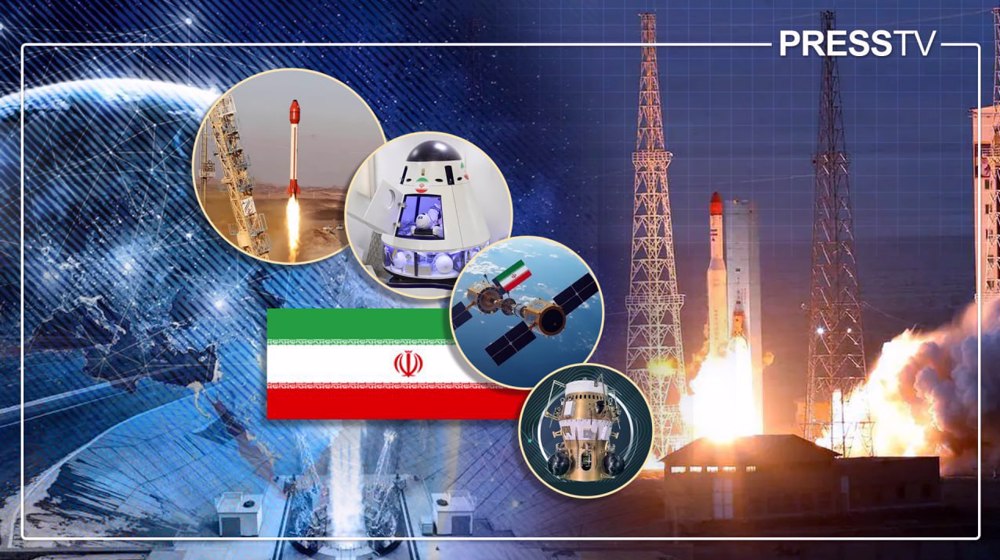
World Space Week, observed annually from October 4 to 10 in commemoration of that launch and, a decade later, the signing of the Outer Space Treaty, offers an occasion to trace that arc – from a single radio-beeping sphere in 1957 to a field in which, today, Iran counts itself among a small group of nations capable of designing, building, and independently launching its own satellites.
The first man beyond the sky
Less than four years after Sputnik's launch, the Soviet Union achieved a milestone that no unmanned payload could match: on April 12, 1961, cosmonaut Yuri Gagarin became the first human being to travel into orbit, completing a single 108-minute circuit of Earth aboard Vostok 1 before returning safely to the planet.
The significance of Gagarin's flight extended far beyond the technical achievement of keeping a human being alive in the vacuum of space.
For the first time, it demonstrated that the boundary separating Earth from the cosmos was not an absolute limit on human presence, but an engineering problem that could be solved. And it did so under the flag of a nation that, within living memory, had been a largely agrarian society devastated by war.
Gagarin's flight transformed the abstract possibility of human spaceflight into demonstrated fact. In doing so, it reset the terms against which every subsequent spacefaring power would be measured.
A race decided by desperation and improvisation
Gagarin's flight, coming on the heels of Sputnik, placed the United States in a position of profound technological humiliation. Washington had been outpaced by Moscow at nearly every major milestone of the early space age – first satellite, first animal in orbit, first human in orbit – and American planners understood that competing with the Soviet space program on its own terms, incrementally matching each Soviet first one step behind, was a contest the United States was structurally positioned to keep losing.
The American response drew on a resource acquired in the closing days of the Second World War: German rocket scientists recruited from the defeated Nazi regime, chief among them Wernher von Braun, who had developed the V-2 ballistic missile for Hitler's Germany and was brought to the US under the classified postwar program known as Operation Paperclip.
Von Braun and his colleagues became an important part of the technical foundation of the American rocket program. Under this German-American leadership, the United States made the decisive strategic choice of the space race: rather than continuing to chase the Soviet Union through a series of incremental firsts, Washington would leapfrog the competition by committing to land a human being on the Moon – a technical undertaking of such scale and complexity that it would force the United States to develop capabilities far beyond those required for orbital flight and, in effect, change the terms of the contest.
That bet culminated on July 20, 1969, when Apollo 11 astronaut Neil Armstrong stepped onto the lunar surface and spoke the words that would become the defining phrase of the space age: "That's one small step for man, one giant leap for mankind."
The Moon landing closed the first chapter of the space race. But the underlying lesson of how it was won – that a competitor unable to match a rival step for step can instead change the terms of the competition entirely – would echo far beyond the Cold War and far beyond the two nations that fought it.
A field still closed to most of the world
More than six decades after Sputnik, the ability to operate independently in space remains far more exclusive than satellite ownership alone might suggest. More than 80 countries operate satellites of one kind or another, but most of them commissioned their spacecraft from foreign manufacturers or rely on foreign launch providers to reach orbit.
The far narrower circle consists of the countries that have demonstrated the ability to design, build, and launch satellites into orbit using their own indigenous capabilities.
Iran joined that circle in 2009, alongside countries including the United States, Russia, China, Japan, India, France, the United Kingdom, North Korea, and Israel. Of those nations, only three – the United States, Russia, and China – have independently conducted crewed orbital missions.
That distinction matters because satellite ownership and space-launch sovereignty are not the same achievement. A nation can purchase a satellite from a foreign manufacturer and pay another country to launch it, but it remains dependent on foreign providers for access to orbit.
A nation capable of designing, building, and launching its own spacecraft possesses something more consequential: an independent pathway to space.
Omid: Iran enters the circle
Iran crossed that threshold on February 2, 2009, coinciding, fittingly, with the 30th anniversary of the Islamic Revolution. On that day, it launched its first domestically built satellite, Omid ("Hope"), aboard the indigenous Safir carrier rocket, becoming the ninth country to place an independently developed satellite into orbit using its own launch vehicle.
Iran's achievement followed the Soviet Union in 1957, the United States in 1958, France in 1965, Japan and China in 1970, the United Kingdom in 1971, and India in 1980.
Geoffrey Forden of the Massachusetts Institute of Technology described the achievement at the time as a "technological tour de force," underscoring the significance of Iran's entry into an exclusive group of countries capable of reaching orbit despite international opposition and extensive sanctions intended, among other things, to restrict its access to advanced aerospace technology.
Rasad-1: Iran's first eye in orbit
Iran's second satellite, Rasad-1 ("Observation"), launched aboard a Safir carrier on June 15, 2011, becoming the country's first domestically built imaging satellite and successfully transmitting photographic data to ground stations.
According to specifications released by the Iranian Space Agency, Rasad-1 incorporated many of the core subsystems required for an operational satellite platform, including power-management systems, solar cells, attitude control, a payload, GPS, onboard data and command management, receiver and transmitter systems, a ranging transmitter, and thermal-control systems.
Its attitude-control system used a passive gravity-gradient method based on a deployable boom.
As Iran's first step toward an indigenous Earth-observation capability, Rasad-1's camera offered a resolution of approximately 150 meters – a modest capability by modern imaging standards, but an important milestone in the development of Iran's domestic satellite technology.
Navid and Fajr: Building toward maneuverability
Iran's third satellite, Navid ("Promise"), was launched from the Semnan Space Center at approximately 3:30 a.m. local time on February 3, 2012. It was followed by Fajr ("Dawn"), launched aboard an upgraded Safir-1B carrier on February 2, 2015.
Fajr represented a further step toward greater spacecraft autonomy. It was designed with an orbital-transfer capability, allowing it to adjust its orbit from an elliptical path of roughly 250 to 450 kilometers to a circular orbit at approximately 450 kilometers.
The maneuver was enabled by a cold-gas propulsion system and was intended to extend the satellite's operational lifetime to roughly 18 months.
Payam-1: A near miss
Not every Iranian launch reached orbit successfully. Payam-1, launched aboard the Simorgh carrier rocket in January 2019, failed to achieve the velocity required to enter a stable orbit. Iranian officials said the satellite fell short of the required velocity by approximately 150 meters per second before ultimately re-entering and falling into the Indian Ocean.
The narrow margin was a reminder of the unforgiving precision demanded by orbital mechanics – and of the technological gap that can separate a successful launch from failure. It also demonstrated how Iran's ambitions were increasingly moving beyond simply placing small satellites in orbit toward developing larger and more capable launch vehicles and spacecraft.
The Noor constellation: Iran's military satellites take shape
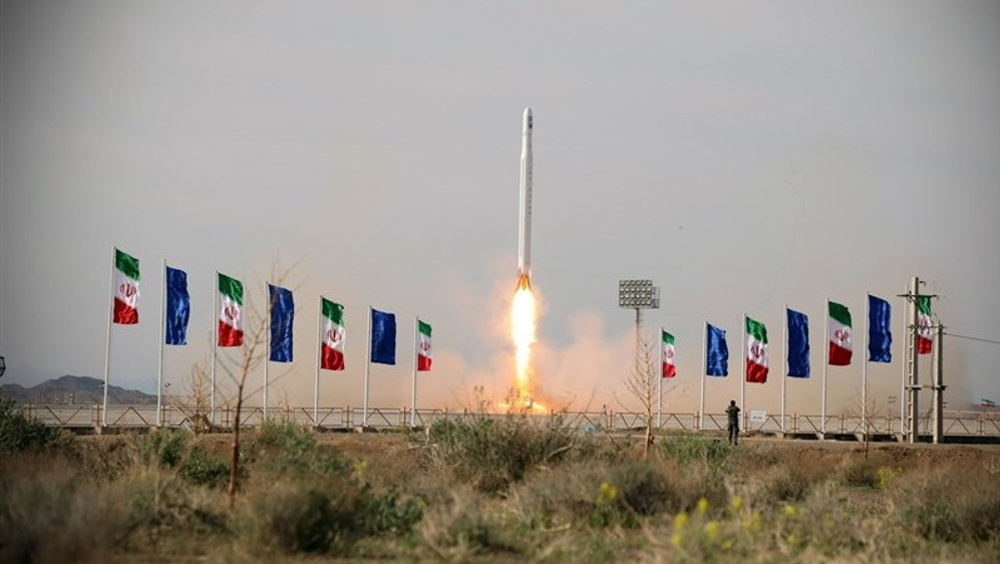
On April 22, 2020, the IRGC's Aerospace Force successfully placed Iran's first military satellite, Noor-1, into an orbit roughly 425 kilometers above Earth using the indigenous Qased carrier rocket, launched from Iran's central desert.
The reaction from Washington offered its own measure of the launch's significance. Then-US Secretary of State Mike Pompeo condemned the launch within hours, claiming it demonstrated that Iran's space program was "neither peaceful nor entirely civilian" and calling for Iran to be "held accountable" under UN Security Council Resolution 2231.
The unusually sharp and immediate diplomatic reaction underscored how seriously Washington regarded the scientific capability Iran had demonstrated.
Iran followed with Noor-2, launched aboard the Qased into an orbit of approximately 500 kilometers and equipped with an imaging payload. Noor-3 followed on September 27, 2023, entering a roughly 450-kilometer orbit with an imaging mission and an announced ground resolution of approximately five meters. The progression represented a substantial improvement in Iran's indigenous military-imaging capability within a single generation of satellites.
Khayyam: Iran's sharpest eye
On August 9, 2022, at 10:31 a.m. Tehran time, Iran's most capable Earth-observation satellite, Khayyam, was launched aboard a Russian Soyuz rocket from the Baikonur Cosmodrome in Kazakhstan.
Khayyam is designed for high-resolution remote sensing, with an advertised ground resolution of approximately one meter – by far the sharpest imaging capability publicly associated with Iran's satellite fleet. Weighing roughly 600 kilograms and operating at an altitude of approximately 500 kilometers, the satellite completes an orbit of Earth roughly every 90 minutes.
The satellite was named in honor of Omar Khayyam, the Iranian mathematician and astronomer whose work on calendrical reform produced the exceptionally accurate Jalali calendar nearly a millennium ago.
As a remote-sensing platform, Khayyam has been associated with six principal application areas: agriculture, environmental monitoring, natural-disaster response, urban change detection, water-resource monitoring, and mineral exploration. Its significance, however, extends beyond those civilian applications. High-resolution Earth observation provides a state with a persistent means of monitoring changes on the ground without relying entirely on foreign imagery providers.
Soraya and the Qaem-100: A breakthrough in solid-fuel propulsion
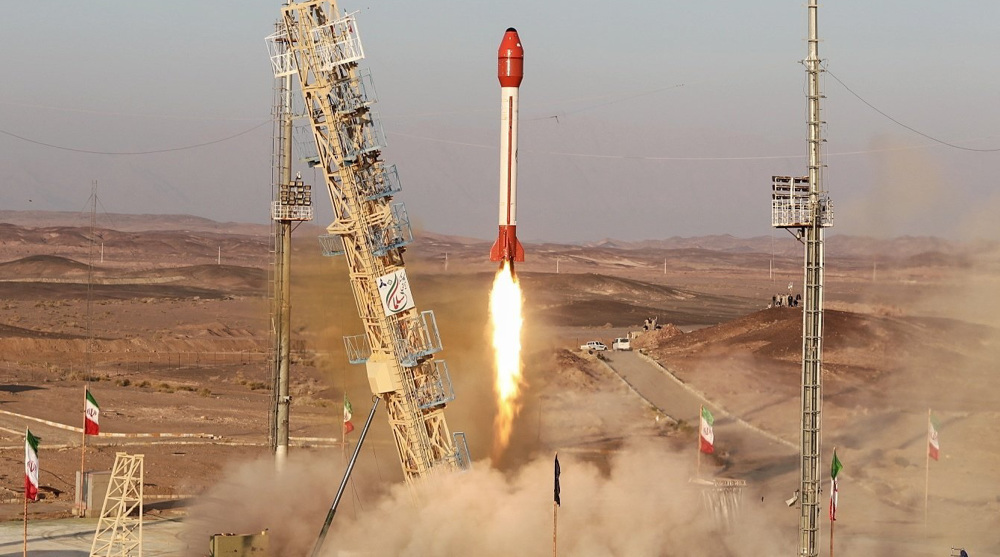
On January 20, 2024, Iran launched the Soraya satellite aboard the IRGC's Qaem-100 carrier rocket. The Qaem-100 is a multistage launch vehicle based primarily on solid-fuel propulsion, a choice that offers important advantages in storage, readiness, and operational simplicity compared with conventional liquid-fuel systems.
One of the most significant features demonstrated by the Qaem-100 was the ability to terminate thrust from its solid-fuel upper stage after achieving the desired velocity. Conventional solid-fuel motors are substantially less flexible than liquid-fuel engines because their propellant cannot simply be throttled in the same manner once combustion begins.
The ability to control the termination of thrust therefore represents an important advance in Iran's solid-propellant launch technology, particularly for achieving more precise orbital insertion.
The achievement mattered for a reason extending beyond the Soraya mission itself: increasingly precise control over a launch vehicle's final velocity translates directly into greater flexibility in placing satellites into their intended orbits.
Chamran-1: Proving orbital maneuvering
The Ministry of Defense's research satellite Chamran-1, designed and built by Iran Electronics Industries' space division in cooperation with the Aerospace Research Institute and private knowledge-based companies, launched aboard the Qaem-100 on September 14, 2024, successfully reaching an orbit approximately 550 kilometers above Earth.
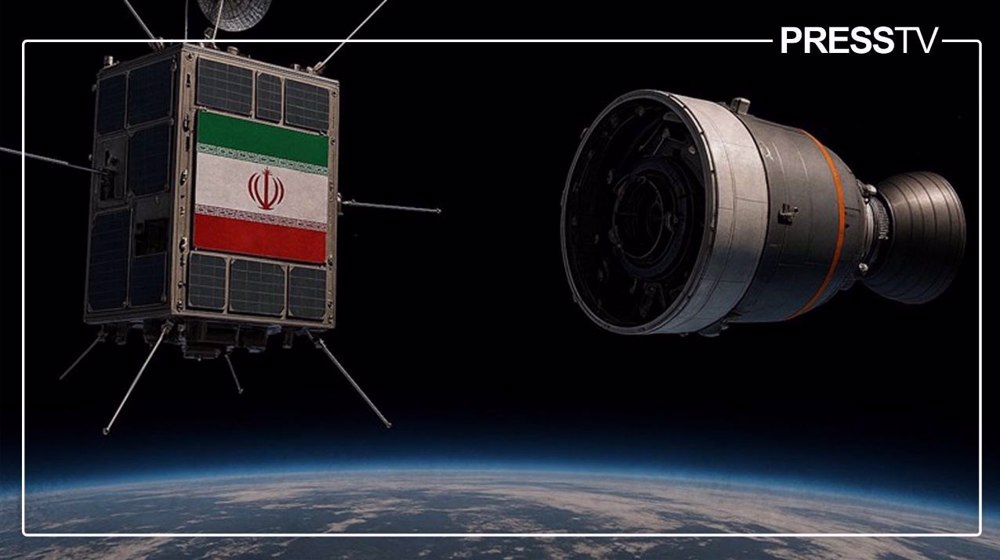
Chamran-1's primary mission was to demonstrate orbital-maneuvering technology – the ability of a spacecraft to actively modify its orbit – alongside secondary objectives involving a cold-gas propulsion system and the evaluation of navigation and attitude-control technologies.
By the second half of November 2024, Iranian officials reported that Chamran-1 had completed a sequence of orbital maneuvers, including lowering and raising its altitude and conducting a rendezvous maneuver with the upper-stage remnants of its own carrier rocket.
Such capabilities are significant because controlled proximity operations are a prerequisite for more sophisticated activities in space, including satellite inspection, rendezvous, and, potentially, future servicing missions.
Jam-e Jam 1: Iran's first geostationary broadcast satellite
On February 12, 2026, the Islamic Republic of Iran Broadcasting organization's first geostationary communications satellite, Jam-e Jam 1, also designated Iran DBS, was launched from the Baikonur Cosmodrome in Kazakhstan aboard a Russian Proton-M rocket.
The mission represented Iran's entry into a substantially more demanding class of space infrastructure: geostationary communications satellites.
Jam-e Jam 1 is intended to occupy an orbital position at approximately 34 degrees east longitude after completing the necessary orbital-transfer maneuvers. Its principal purpose is to provide broadcast and communications infrastructure for Iran's state broadcasting system.
Unlike conventional direct-to-home television satellites, Jam-e Jam 1 is intended primarily as professional broadcast infrastructure, with its signals designed for reception by ground stations and specialized equipment rather than ordinary household satellite receivers.
The satellite was launched alongside the Russian meteorological satellite Elektro-L No. 5, using the Proton-M launch system and its DM-03 upper stage.
Why space matters – and why it matters most in a crisis
The case for why a nation should bear the enormous cost of developing an indigenous space program is, at its foundation, a case about strategic independence.
A country that cannot build or launch its own satellites remains dependent on foreign manufacturers, launch providers, and satellite operators for access to capabilities that can become critical national infrastructure. That dependence becomes particularly consequential when the country in question is the target of illegal and crippling sanctions and unprovoked wars.
Iran's space program, developed over more than two decades under extensive international sanctions and technology restrictions, is therefore significant not merely because of the individual satellites it has placed in orbit, but because of the technological ecosystem it represents. Iran has progressively developed domestic capabilities in satellite manufacturing, launch vehicles, remote sensing, communications, propulsion, guidance, and orbital operations, areas in which access to foreign technology has frequently been restricted.
The security dimension of this capability is equally important. A high-resolution Earth-observation satellite can provide persistent surveillance of military installations, transportation networks, infrastructure, and changes in force deployment without requiring physical access to the territory being observed. Khayyam's approximately one-meter-class imaging capability provides a level of situational awareness that is strategically valuable.
The same principle applies to communications and navigation. Modern military operations depend on resilient positioning, navigation, timing, and communications infrastructure. But it is important to distinguish between satellite imagery and satellite navigation.
Measured against that backdrop – a space program developed from a relatively modest starting point, under sustained international sanctions and deliberate restrictions on access to advanced technology – Iran's progression from Omid's modest 2009 debut to the Noor satellites, Khayyam's meter-class Earth observation, the Qaem-100's increasingly sophisticated launch technology, and Chamran-1's orbital maneuvering represents a significant trajectory in the development of an indigenous space capability.
 This makes it easy to access the Press TV website