
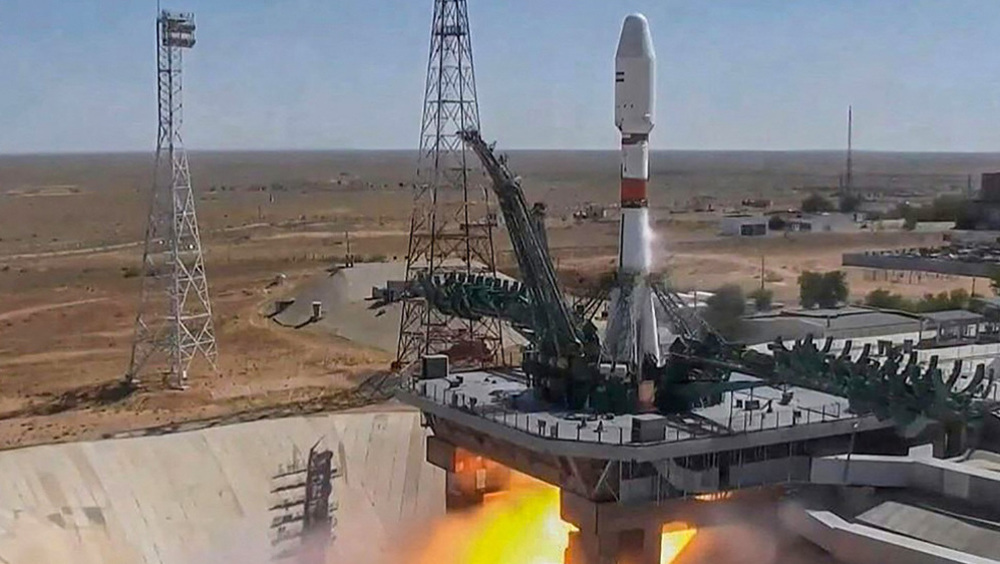
The head of the Iranian Space Agency (ISA) says the strategic vision of the martyred Leader of the Islamic Revolution Ayatollah Seyyed Ali Khamenei laid the foundation for the long-term development of the country's space industry.
Speaking during a televised interview on Wednesday, Hassan Salarieh said the martyred Leader consistently supported the country's space program, describing space technology as one of the advanced and strategic fields that contribute to national strength.
According to the official, the Leader's influence on the development of the nation’s space industry can be understood in three principal areas, namely strategic guidance, formulation of national policies, and strategic oversight of technological progress.
✍️ Viewpoint - How Iran’s martyred Leader became an enduring symbol of sovereignty, justice, and resistance
— Press TV 🔻 (@PressTV) July 8, 2026
By @soupalestina https://t.co/lVcl4Cb3TG
Salarieh said the first area of influence was the Leader's continuous strategic guidance and advocacy for advanced technologies.
He said that whenever the Leader laid emphasis on the development of sectors such as space technology, nanotechnology, and biotechnology, his guidance would effectively establish a strategic direction for researchers, engineers, and specialists, while generating fresh momentum for scientific progress.
According to Salarieh, the encouragement also extended beyond the scientific community, prompting policymakers, legislators, and funding institutions to regard themselves as responsible for advancing those priorities and creating greater coordination among different sectors.
The second area, Salarieh said, encompassed incorporation of the Leader's vision into the country's broader strategic framework.
He said the Leader's guidance was reflected not only in public statements, but also in the Islamic Republic's general policies, documents covering the country’s grand strategy, and its successive five-year national development plans.
The third area, according to Salarieh, involved the Leader's direct oversight of technological development.
He said major achievements in the space sector were regularly presented to the Leader by the Ministry of Information and Communications Technology through executive summaries and detailed reports.
The Leader, he added, would provide strategic feedback, including private endorsements and directives that helped shape the future course of Iran's space industry.
Highlighting the Leader's detailed understanding of space technology, Salarieh said one example was Ayatollah Khamenei’s inquiries about Iran's plans to gain access to and conduct operations in geostationary Earth orbit (GEO), approximately 36,000 kilometers above Earth.
He said those questions demonstrated that the Leader's vision extended beyond short-term achievements in low Earth orbit (LEO) and instead focused on the long-term development of communications and telecommunications satellites.
While describing launches into low Earth orbit as still a major accomplishment, Salarieh said the Leader's attention to geostationary orbit reflected his understanding of its strategic importance and its central role in developing the space economy.
From nuclear energy to space exploration: Iran is totally different from what it was before the Islamic Revolution#IR47
— Press TV 🔻 (@PressTV) February 9, 2026
Follow https://t.co/B3zXG74hnU pic.twitter.com/zlVsdIKVbL
Space projects moving ahead faster than before
Addressing the impact of the most recent bout of unprovoked American-Israeli aggression against the country, Salarieh said some facilities related to nation’s space industry sustained damage after being targeted by adversaries.
He said the enemies seek to obstruct the country's progress because the space industry is among its leading enabling technologies, with advances in the sector contributing to scientific and technological development across numerous fields.
According to Salarieh, however, attacks on physical infrastructure cannot stop a knowledge-based industry built on the expertise of Iranian specialists.
He said scientific knowledge and technological capability cannot be destroyed, noting that damaged buildings and equipment can be rebuilt or replaced, including with more advanced facilities.
Salarieh said Iran's space projects are currently being implemented at a faster pace than before, with scientists and specialists working with increased determination and motivation.
He also said those working in the space sector now bear greater responsibility towards the country’s progress following the Leader's martyrdom, making it imperative to pursue the nation’s space program with stronger resolve.
The official concluded his remarks by vowing commitment to accelerating the development of Iran's space industry at an even faster pace “in fulfillment of our pledge of allegiance” to the martyred Leader’s son and successor, Ayatollah Seyyed Mojtaba Khamenei.
“By relying on the capabilities of Iranian scientists and elites, we will strive to elevate this industry to new heights of achievement and further strengthen the position of the Islamic Republic in the field of space."
 This makes it easy to access the Press TV website