Austria's hijab ban tells Muslim girls their religious visibility is political problem: Activist
By M. Salimi
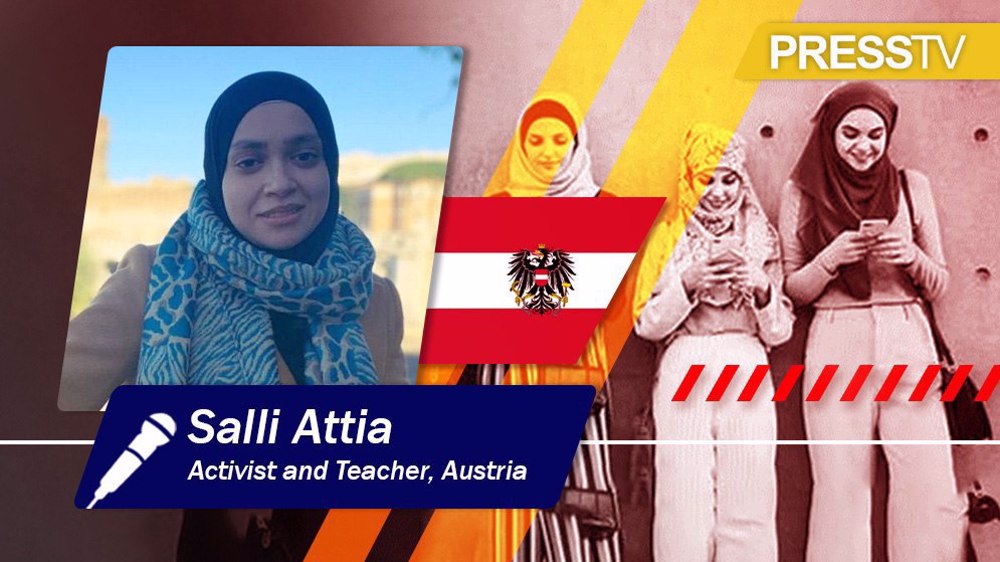
Austria's controversial law banning headscarves for girls under 14 is not a measure to protect children but a form of "state-legitimized racism" that forces Muslim girls to choose between their education and their identity, says an Austrian activist.
Sali Attia, spokesperson for the campaign against the hijab ban in Vienna schools, spoke about the illegal ban that violates fundamental rights.
Speaking to the Press TV website, Attia, a teacher, activist and founder of Teachers for Palestine, noted that the legislation, which took effect on September 1, creates a profound contradiction at the heart of Austrian education by turning teachers into enforcers and singling out the religious practice of one group of girls while claiming state neutrality.
"The law begins by excluding and disciplining the very girls it claims to protect," Attia said. "It sends a message to Muslim girls: Your religious visibility is a political problem."
She described the ban as part of a broader pattern of anti-Muslim policies in Austria, warning that the political consensus behind the law, supported by the governing ÖVP, SPÖ and NEOS, as well as the far-right FPÖ, shows how far restrictions on Muslim religious visibility have moved into the political mainstream.
A contradiction at the heart of the law
From her perspective as a teacher, Attia said the contradiction is obvious: the government says it wants to protect girls, but the law begins by excluding and disciplining the very girls it claims to protect.
"If a girl is genuinely being pressured by her family to wear a headscarf, then she needs trust, counselling, child protection and adults at school whom she can turn to," she explained.
"Simply forcing her to remove the headscarf at the school door does not solve what is happening at home. And for a girl who wears it willingly, the state is telling her that her own understanding of her identity and religion does not count."
The law explicitly prohibits girls under the age of 14 from wearing a headscarf that covers the head "according to Islamic traditions."
Attia finds this especially troubling because school should be the place where children experience belonging.
"Instead, some Muslim girls now enter school knowing that something connected to their religious identity is prohibited," she said. "Protection should mean strengthening children. It should not mean excluding them."
Constitutional questions remain unresolved
Attia pointed to an important precedent. In 2020, Austria's Constitutional Court struck down the previous headscarf ban in primary schools, finding that it violated the principle of equality in conjunction with freedom of thought, conscience and religion and stressed the requirement of religious and ideological neutrality of the state.
"That is why we see serious constitutional questions again," she said. "The new law does not establish a general rule covering religious symbols. It explicitly refers to a headscarf covering the head 'according to Islamic traditions.'"
Five pupils and their parents already attempted to challenge the new law. In June 2026, the Constitutional Court rejected those applications as inadmissible because the law had not yet entered into force.
Crucially, the Court therefore did not decide whether the law itself is constitutional. Now that the law has been in force since September 1, the constitutional questions can arise in a different procedural context.
"For me, the fundamental issue remains: Can the state single out the religious practice of one group of girls and call that neutrality?" Attia noted.
Teachers turned into enforcers
One of the aspects that affects Attia most personally as a teacher is the requirement to instruct students to remove their headscarves and report violations, with parents facing fines of up to €800.
"My job is to build relationships with my students. They should be able to come to me when they have problems, including problems with their parents, religion, identity or pressure from their community," she said.
Now teachers and school leaders are placed within an enforcement process concerning the headscarf. The statutory procedure begins with conversations involving the pupil and parents and can escalate through the education authority and child and youth welfare system. Ultimately, parents can face fines of between €150 and €800.
"That changes the relationship between teacher and student," Attia said. "Imagine a twelve-year-old Muslim girl entering my classroom. Instead of asking first, 'How are you? What do you need in order to learn?', the system can require us to focus on what she is wearing."
For many educators who oppose the ban, this creates a serious conflict with their understanding of education. "We became teachers to educate, support and protect children – not to police Muslim girls' clothing," she stated.
The self-determination paradox
Attia described the government's framing of the ban as protecting girls' self-determination as "perhaps the biggest contradiction."
"The legislation itself says that the ban is intended, among other things, to promote girls' 'self-determination', equality and visibility," she noted.
For Attia, genuine empowerment means giving girls education, knowledge, confidence and a safe environment in which they can develop their own beliefs.
When the campaign uses strong language such as "state-legitimized racism," Attia said it is pointing to what it sees as a structural problem: Muslims are repeatedly discussed politically as a problem that needs to be managed, restricted or integrated.
"The wording of this law matters. It does not simply establish a neutral dress code. It specifically prohibits a head covering worn 'according to Islamic traditions,'" she said.
And the political debate did not necessarily stop with children. During the parliamentary process, the FPÖ proposed extending restrictions to teachers and school staff; that proposal was rejected by the other parliamentary parties.
"As a Muslim woman who wears a headscarf and teaches in an Austrian school, this debate is therefore not abstract to me," Attia said. "It sends a message to Muslim girls: Your religious visibility is a political problem. And Muslim women hear another question behind it: If the headscarf of a 13-year-old is unacceptable today, whose headscarf will be debated tomorrow?"
This affects how people experience belonging. "Integration cannot work if people are constantly told that they belong only on the condition that they make parts of themselves invisible," she warned.
What the numbers don't tell us
The government interprets the current numbers as evidence that the law is working. As of September 18, around 80 cases had reached Austria's education directorates; 55 were in Vienna. There had also already been a first case referred for an administrative penalty in Lower Austria.
"But numbers alone do not tell us what happened to all the other girls," Attia cautioned. "If thousands of girls previously wore a headscarf and now only a relatively small number of cases reach the authorities, we need to ask: What happened to the others? Did they freely change their minds? Did they remove it because they feared consequences for their parents? Did families adapt reluctantly? Are girls covering differently? How do they feel about going to school now?"
She stressed that compliance with a law does not automatically prove acceptance of that law. "As a teacher, I am much more interested in what these measures do to trust, belonging and participation in school. Those effects cannot be measured simply by counting reported violations."
Voices of the affected
As the founder of Teachers for Palestine and a spokesperson for the campaign, Attia has been in contact with affected families. The most difficult part, she said, is listening to young girls realize that adults are debating whether the way they understand their religion and identity is acceptable.
"What stays with me is not one dramatic story but the fundamental question these girls are being forced to confront at such a young age: Why do I have to choose between something that is important to me and simply going to school like everyone else?"
She asked what it means for a girl to see older classmates, her mother, her sister, or even a teacher like her, wearing a headscarf, while being told: You are not allowed to do this because you are not yet fourteen. "What are we teaching her about herself?"
Attia urged caution about claiming that every girl chooses independently. "Children are influenced by their families, communities, friends, social media and society—all children are. But Muslim girls should not automatically be treated as if they have no agency simply because their choices are religious. We need to listen to them before claiming to speak for them."
A political consensus against Muslim visibility
The legislation was supported in parliament by the governing ÖVP, SPÖ and NEOS as well as the FPÖ; the Greens voted against it.
"For me, as someone affected by this debate, that shows how far restrictions specifically concerning Muslim religious visibility have moved into the political mainstream," Attia said. "My concern is what this means for Muslim children growing up in Austria."
She argued that integration cannot be a one-way process in which Muslims are constantly required to prove that they belong.
"A successful pluralistic society also has to make room for citizens whose religion remains visible. A Muslim girl should not have to become less visibly Muslim in order to be considered more Austrian."
Lessons from France
Attia drew an important legal distinction between France and Austria.
France's 2004 law prohibits conspicuous religious signs or clothing in public schools more generally and French jurisprudence has applied the rule not only to Islamic headscarves but also, for example, to Sikh turbans and other conspicuous religious symbols.
"The Austrian provision, by contrast, explicitly refers to a headscarf covering the head 'according to Islamic traditions.' So I would be cautious about presenting France as a direct precedent for Austria," she said.
The broader lesson she takes from France is that bans do not make questions of religious identity disappear.
"Twenty years after the 2004 law, France is still dealing with disputes over religious clothing in schools, including the more recent controversy over abayas. In 2024, France's Conseil d'État upheld the prohibition on abaya-type clothing in public schools. That demonstrates something important: regulating clothing does not end the social and political debate about religion. It can simply shift the boundary of what clothing becomes controversial."
A school where no girl has to choose
The school strike on October 9, 2026 at 12:00 at Platz der Menschenrechte in Vienna is publicly announced as a protest against the headscarf ban and against racism, sexism and militarization in schools.
But for Attia, the discussion has to go beyond one piece of clothing.
"I want an education system in which every child feels that school belongs to them. That means investing in teachers, school social work and psychological support. It means smaller classes and enough resources for schools. It means serious protection against discrimination. It means strengthening children who experience coercion at home rather than collectively treating Muslim girls as victims. And above all, it means listening to the girls themselves."

BRICS paving way for alternative world order, not a war machine against West: Analyst
Iran’s strategic location, energy resources position it as a key player in BRICS alliance: Analyst
Yemeni military advance along Red Sea alters balance of power amid Saudi siege, aggression: Analyst



Martyr Soleimani’s portrait confronts Gaza butcher as world walks out on Netanyahu at UN
VIDEO | Press TV's news headlines
VIDEO | Pakistan executes precision strikes on 10 Afghan sites following drone incursion
VIDEO | Education in Yemen: Years of Saudi-led aggression failed to stop learning
Minab’s school bell rings through grief as 168 empty desks stand as silent witnesses
Europe was part of the infrastructure of US aggression against Iran: Deputy FM
VIDEO | The pain of not being able to provide
VIDEO | US ill intentions further exposed


 PressTV NEWSLETTER
now
PressTV NEWSLETTER
now
 This makes it easy to access the Press TV website
