
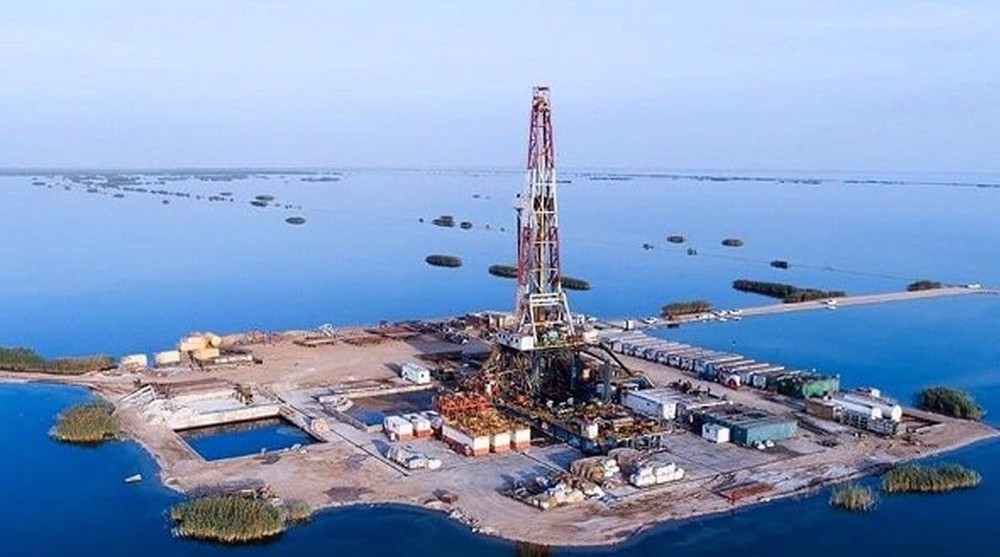
In western Karoun, near the Iraqi border, Azadegan has become a test of Iran’s engineering, financial and technological capabilities and its ability to execute a major oil project under intense external pressure.
One of Iran’s largest oil reserves and among the world’s major petroleum deposits, it remained for years awaiting full-scale development because of a combination of external pressures and internal challenges that slowed its progress.
Today, the integrated development plan for Azadegan, aimed at raising production from around 205,000 barrels per day to 550,000 barrels per day, has become one of Iran’s most important energy projects.
The project serves as a measure of whether Iran’s oil industry has succeeded in filling the vacuum left by departing foreign companies through its own engineering, technological, financial and managerial capabilities.
From the beginning, Azadegan was regarded as one of Iran’s most attractive oil investment opportunities, drawing attention from major international energy companies.
Japan’s Inpex signed an agreement in 2004 to assess and develop it, with plans to invest billions of dollars and gradually increase production capacity through its technical expertise and financial resources.
At the time, the development strategy envisioned raising output to 150,000 barrels per day in the first phase and eventually reaching 260,000 barrels per day in later stages.
Inpex gradually reduced its involvement and eventually withdrew from the project, a decision shaped by concerns over the consequences of American sanctions and the restrictions they imposed on financial and commercial cooperation with Iran.
Following Inpex’s exit, Chinese companies entered parts of the development process, but those partnerships also faced difficulties, eventually pushing Azadegan toward greater reliance on Iranian companies.
Over time, the National Iranian Oil Company and domestic contractors assumed a larger role in advancing the project and overcoming the challenges created by foreign withdrawal.
What initially emerged as a necessity created by sanctions and external pressure eventually became a major test of the country’s industrial strength and its ability to execute complex energy projects independently.
Developing a giant oil field requires an integrated industrial system capable of managing every stage of development.
Major global oil companies typically bring that system with them, combining engineering design, reservoir management, equipment supply chains, drilling technology, financing and decades of experience executing complex projects.
When those companies left Azadegan, Iran’s real challenge was building an entire ecosystem capable of performing the wide range of tasks previously handled by international partners.
Over recent years, Iranian companies have become increasingly active across this chain. Equipment that once relied heavily on foreign suppliers is now increasingly designed, manufactured or maintained inside the country.
Domestic engineering firms, drilling contractors, equipment manufacturers and knowledge-based companies have gradually expanded their role in developing the field and supporting its production objectives.
Technologies related to downhole pumps, wellhead equipment, drilling materials and production systems represent areas where Iran has reduced dependence on external suppliers and strengthen its domestic industrial base.
The critical achievement for Iran, however, has been developing the ability to manage and execute major projects despite restrictions on access to certain foreign technologies and services.

Azadegan has demonstrated that sanctions, while increasing development costs and creating significant obstacles, have also accelerated efforts to build industrial capacities that previously received less attention.
Another major dimension of Azadegan’s development is its financing model.
A project requiring around $10 billion in investment cannot be carried out through the resources of a single contractor and demands a broader financial structure capable of supporting a world-scale energy project.
At a time when international companies and foreign financial institutions have largely avoided participation in Iranian energy projects due to US sanctions, mobilizing domestic financial resources has become a strategic necessity.
The National Development Fund and major Iranian banks are helping create a new financing model for strategic projects, mobilizing domestic capital to offset restricted foreign investment and underpin the development of one of Iran’s largest oil fields.
The significance of Azadegan becomes even clearer when considering its status as a shared field with Iraq.
In shared reservoirs, time is a decisive economic factor, as the country that develops faster and extracts more efficiently can secure a greater share of the field’s economic value.
Across the border, Iraq’s Majnoon field is being developed with American participation, making the race to extract shared resources more than a commercial contest for higher profits.
The competition is unfolding within a broader geopolitical environment shaped by decades of political pressure, economic sanctions and efforts by Washington to constrain Iran’s energy capabilities.
American policy toward Iran’s oil sector has focused on limiting export capacity, discouraging foreign investment and raising the cost of cooperation with Tehran.
At the same time, the expanding role of Western and American-linked companies in parts of Iraq’s energy sector has added another dimension to the regional energy competition.
Washington has sought to maintain and expand its influence over Iraq’s economic and energy structures, making the development of shared fields a matter that extends beyond ordinary financial calculations.
Under such circumstances, accelerating Azadegan’s development is about preserving Iran’s position in a strategically vital energy region and ensuring delays do not erode its stake in shared resources.
The target of reaching 550,000 barrels per day requires far more than drilling additional wells. The reservoir must be managed scientifically and efficiently to ensure long-term production sustainability and maximize recovery from the field.
For this reason, technology remains at the center of Azadegan’s development strategy.
Artificial lift systems, electric submersible pumps, advanced drilling methods and detailed reservoir studies are essential tools for increasing recovery rates while reducing production costs.
One of the defining differences between modern oil projects and those of previous decades is that success is no longer measured solely by initial production levels.
A successful field is one that can maintain stable output over many years and convert the maximum possible share of its underground resources into economic value.
Azadegan provides Iran’s oil industry with an opportunity to deepen its experience in managing a large and complex reservoir through greater reliance on domestic knowledge and technical expertise.
For decades, Iran’s energy sector relied on foreign companies for technology, financing and project-management expertise, but changing circumstances have compelled the industry to develop and strengthen a greater share of those capabilities within the country.
Azadegan stands as a product of that transformation, shifting from a project once reliant on foreign participation into a major test of Iran’s ability to deploy its own engineering, technological and industrial capabilities.
As development advances, Azadegan is set to establish a new model for Iran’s energy sector, bringing together Iranian engineering, domestic financing, indigenous technology and local project-management expertise.
 This makes it easy to access the Press TV website