
By Ivan Kesic
The development of a domestically produced nanocatalyst for TU5 engines marks a significant industrial achievement for Iran, demonstrating how nanotechnology can reduce reliance on precious metals while cutting production costs by an estimated $500,000 per batch.
The accomplishment has placed the country among a select group of countries capable of designing and manufacturing advanced automotive emissions-control systems, marking a significant milestone for Iran’s automotive and nanotechnology industries.
Sanat Afrin Mahan, a knowledge-based company based in Baharestan Industrial Park in Kamalshahr, successfully designed and produced a specialized catalyst that addresses two critical challenges simultaneously: reducing reliance on expensive and strategically scarce precious metals while maintaining or improving the emissions-control performance required for modern vehicles.
Developed specifically for Peugeot vehicles and subsequently coordinated with Iran Khodro, the catalyst employs a nanostructured perovskite powder to meet its performance objectives.
According to Ehsan Rajabi, the company’s research and development specialist, each production batch of approximately 1,500 catalysts generates estimated savings of $500,000 through reduced precious-metal consumption, underscoring the economic significance of the technological achievement.
The project successfully passed technical evaluations at Iran Khodro’s specialized centers and received the necessary certifications for production use, marking a significant step toward localizing advanced automotive technologies and reducing Iran’s dependence on imported components and materials.

Technical challenge of automotive emissions control
The catalytic converter is far more than a simple exhaust filter; it is a highly engineered chemical reactor operating under extreme conditions that would challenge any industrial catalyst.
A modern gasoline three-way catalyst must simultaneously oxidize carbon monoxide and unburned hydrocarbons while reducing nitrogen oxides, all within a constantly changing exhaust environment.
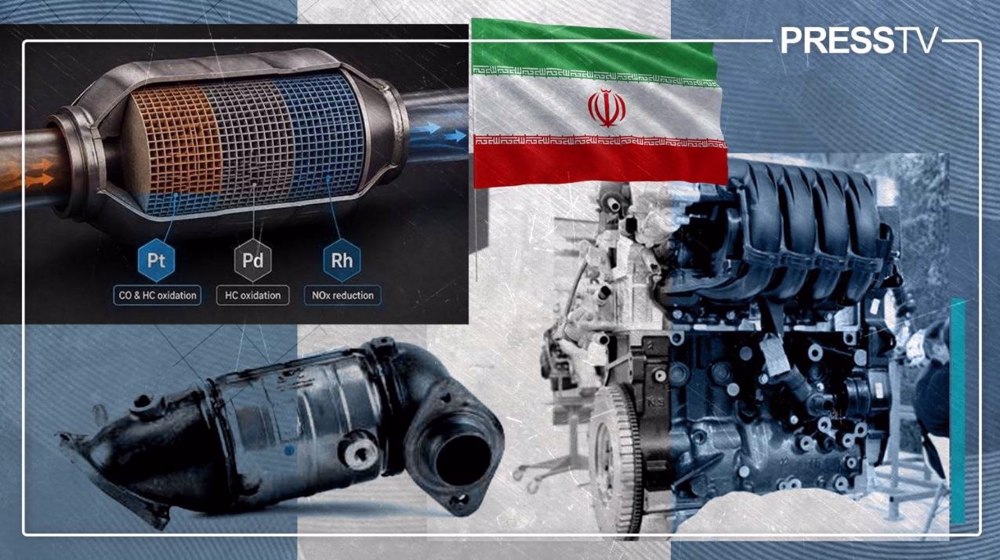
These reactions take place within a porous ceramic honeycomb coated with a high-surface-area catalytic washcoat, a complex mixture of materials designed to maximize the catalyst's effectiveness.
Platinum-group metals, principally platinum, palladium, and rhodium, provide much of the catalytic activity necessary for these transformations.
The precious metals are dispersed as extremely small particles over the washcoat so that a very large fraction of their atoms are exposed to the exhaust gases, maximizing the catalytic surface area available for reactions.
This is precisely where nanotechnology becomes relevant to emissions control. A catalytic converter does not require a large mass of platinum, palladium, or rhodium; what matters is the maximum possible number of accessible active sites for a given quantity of metal.
Reducing the size of the active particles and distributing them more uniformly can dramatically increase the effective catalytic surface area, allowing more effective performance with less material. Iranian manufacturers had already recognized this principle in earlier developments.
Iran Delco, for example, received national NanoMark for a gasoline-vehicle catalytic converter incorporating nanoparticles of precious metals, with the company describing a system in which oxide layers coat the ceramic substrate and the precious-metal nanoparticles are distributed over the surface.
The new TU5 project takes this principle further by attempting to reduce dependence on the precious metals themselves through advanced materials engineering.
Nanocatalyst approach: Reducing precious metal dependence
The key material in the TU5 nanocatalyst is nano-perovskite powder, a class of crystalline oxides with a general structure that makes them exceptionally interesting for heterogeneous catalysis.
Perovskites offer remarkable chemical flexibility, allowing researchers to tune oxidation states, oxygen vacancies, electronic structure, and oxygen mobility by substituting different elements into the crystal structure.
These properties are particularly relevant to exhaust catalysis, where the catalyst repeatedly experiences alternating oxygen-rich and fuel-rich conditions as the engine's air-fuel ratio varies during normal operation.
The Iranian formulation appears to use the perovskite as an active catalytic component capable of carrying part of the chemical workload traditionally assigned to precious metals.
This is technologically important because the precious metals are not merely expensive; their supply is strategically concentrated, and their prices can fluctuate dramatically, creating significant economic and strategic vulnerabilities for any country dependent on imports.

Platinum, palladium, and rhodium have become indispensable components of automotive emission-control systems worldwide.
The engineering challenge is not simply to demonstrate catalytic activity in a laboratory reactor; the material must survive thousands of thermal cycles, exposure to water vapor and combustion products, fluctuating oxygen concentrations, contaminants such as sulfur, and temperatures that can become extremely high during catalyst operation.
It must also resist sintering, the agglomeration of nanoparticles into larger particles that reduces active surface area, which is one of the central problems in automotive catalysis.
The $500,000 saving is primarily the economic consequence of reducing precious metal loading, rather than as evidence that precious metals have been eliminated from the converter. The technology is described as reducing the use of precious metals without impairing performance.
For a commercial gasoline three-way catalyst, even a small amount of rhodium can be highly valuable because of its exceptional nitrogen oxide reduction properties, while palladium and platinum contribute strongly to oxidation reactions.
The most realistic interpretation is that the Iranian formulation substitutes part of the precious-metal function with nanostructured oxide chemistry and improves the utilization of the remaining precious metal content through advanced dispersion techniques.
Strategic context: Overcoming supply challenges
The development of this nanocatalyst must be understood within the broader context of Iran's efforts to reduce dependence on imported strategic materials. Access to platinum-group metals has been complicated by international restrictions, procurement difficulties, and foreign-exchange costs.
The researchers involved in the TU5 project explicitly identified difficulties in obtaining precious metals as one of the motivations for redesigning the catalyst.
Their approach therefore addresses two problems simultaneously: the environmental requirement for effective exhaust treatment and the industrial requirement for a more secure domestic supply chain.
The economic impact of this achievement is substantial when considered across production volumes.
If one batch contains approximately 1,500 catalysts and saves $500,000, the implied average saving is about $333 per converter, a significant amount for a mass-produced automotive component that provides a useful indication of how heavily the cost of precious metals can influence catalyst economics.
The figure is a reported estimate rather than an independently audited cost calculation, so it should not be interpreted as a universal saving applicable to every converter or production volume.
Nevertheless, if the formulation and production figures are accurate, the potential industrial effect is considerable, particularly given the scale of Iran's domestic vehicle production.
The TU5 engine platform makes the project particularly relevant to Iran's automotive industry. The engine family has been used extensively in Iranian-produced passenger cars, meaning that a catalyst optimized for this engine potentially has a large addressable domestic market.
The reports indicate that the new catalyst was developed specifically for Peugeot cars and subsequently coordinated with Iran Khodro, the country's largest automaker.
The fact that the component reportedly underwent technical evaluation by the automaker is more significant than a laboratory demonstration; automotive catalysts must satisfy durability, emissions, mechanical, thermal, and production-quality requirements before they can become viable mass-produced components.

Iran Delco and Sanat Afrin Mahan: Two pillars of domestic catalyst manufacturing
The Iranian automotive catalyst industry has evolved through the efforts of two distinct companies, each contributing to the country's technological self-sufficiency.
Iran Delco, based in Shamsabad Industrial City near Tehran, has a long history of catalyst formulation and localization, having originally acquired technology from Germany and subsequently localizing the formulation after foreign cooperation was terminated.
According to Alireza Majidian, the company's sales and marketing manager, Iran Delco had developed formulations allowing precious metals to be partially replaced by cheaper elements while maintaining performance.
The company has the capability to design catalytic converters for essentially any vehicle or engine and has been supplying domestic automakers while exporting some products to Turkey and Azerbaijan.
Sanat Afrin Mahan, the company responsible for the 2026 TU5 nanocatalyst, operates from its facility in Kamalshahr's Baharestan Industrial Park.
The company was founded in 2006 as an automotive catalytic converter manufacturer and has since developed its capabilities through sustained investment in research and development.
Sanat Afrin Mahan established its R&D unit in 2019 and achieved Euro 5 catalyst technology in 2021, the same year it received knowledge-based company status.
The company's annual production capacity is approximately 2.4 million automotive catalytic converters annually, and its product catalogue includes a TU5 catalytic box specifically for Peugeot and Rana vehicles, demonstrating that the 2026 project builds on established commercial capabilities.
Global context: Select group of manufacturers
Automotive emissions catalysts are dominated by a small number of global suppliers, with companies such as BASF, Umicore, and Johnson Matthey possessing decades of expertise in catalyst formulation, precious metal management, washcoat technology, aging studies, and emissions certification.
BASF describes itself as holding a top-three market position across its strategic environmental-catalyst businesses and lists companies including Johnson Matthey and Umicore among its principal competitors. These companies represent the technological standard against which any new entrant must measure itself.
Iran's achievement in developing a domestically produced nanocatalyst for the TU5 engine should not be understood as inventing catalytic converters. It has manufactured automotive catalysts domestically for years.
The more significant achievement is the optimization of the catalytic formulation to reduce dependence on imported strategic materials while retaining the required emissions control performance.
This places Iran among a select group of countries capable of not just manufacturing but designing and engineering advanced automotive emissions control systems, a capability that has strategic as well as commercial significance.
The broader technological significance of this development lies in materials efficiency. Instead of asking how to obtain more platinum, palladium, and rhodium, the nanocatalyst approach asks how to obtain more catalytic function from every gram of those metals.
This is a central direction of modern catalyst engineering worldwide. Nanoparticle dispersion, strong metal-support interactions, oxygen-storage materials, redox-active oxides, and carefully engineered interfaces can all increase the effectiveness of a limited quantity of precious metal.
The same principle is being pursued internationally; research into modern three-way catalysts investigates optimized ceria-zirconia supports and alloying strategies precisely because these can improve precious metal utilization and stability.

Path forward: Commercialization at scale
The next test for the TU5 nanocatalyst is commercialization at scale. A credible automotive catalyst must demonstrate not merely excellent initial conversion efficiency, but durability after prolonged high-temperature aging, resistance to poisoning, stable precious metal dispersion, consistent batch-to-batch manufacturing, and compliance with the applicable emissions standard throughout its service life.
The catalyst has successfully passed initial tests and received the necessary certifications, but long-term field operation will provide the ultimate validation of its performance and durability.
If the Iranian catalyst can meet these requirements in large-scale production, its significance would extend well beyond the TU5 or Peugeot cars.
It could provide a domestic technological platform for other gasoline engines and potentially reduce Iran's dependence on imported precious metals and proprietary catalyst formulations.
The estimated $500,000 saving is only the most visible part of the achievement. The deeper accomplishment is the development of a locally engineered nanostructured exhaust-catalysis technology capable of replacing some of the functionality, and therefore some of the cost and strategic dependence, traditionally supplied by platinum-group metals.
The company's integrated management system policy reflects a commitment to continuous improvement and environmental responsibility.
Sanat Afrin Mahan's stated goals include optimizing the consumption of natural resources and energy, protecting the environment by preventing water, soil, and air pollution, and reducing the consumption of precious metals to achieve customer-desired prices.
These objectives align with the broader national goals of technology localization and economic self-sufficiency, making the nanocatalyst project a significant industrial achievement that extends well beyond its immediate technical and economic benefits.
 This makes it easy to access the Press TV website