
By Press TV Website Staff
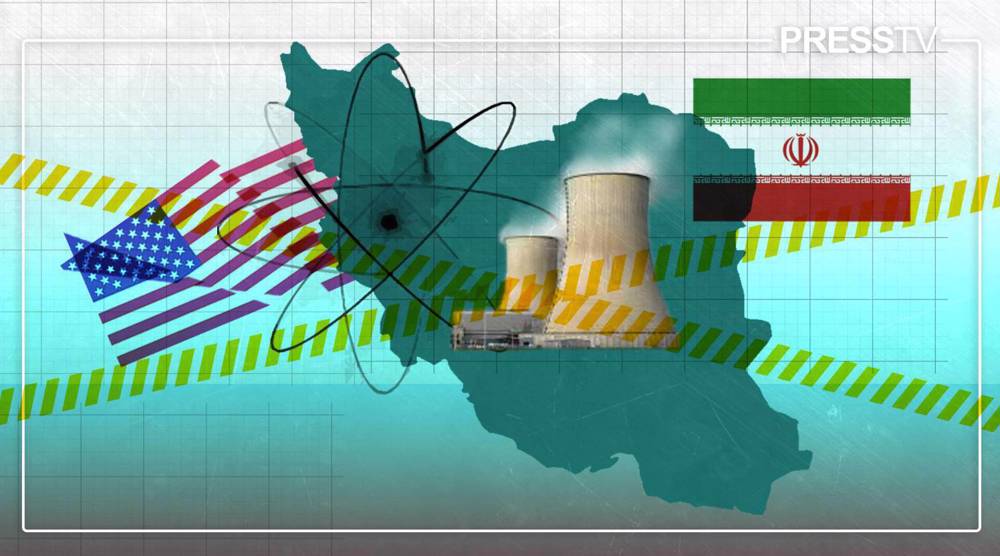
For years, the United States and the Israeli regime insisted that any final agreement with the Islamic Republic of Iran must effectively end its uranium enrichment capability.
This was always presented as an immutable red line that brooked no compromise.
The "zero enrichment" project – the strategic objective of stripping Iran of its nuclear sovereignty – was pursued through every available instrument of coercion: crippling economic sanctions, incessant military threats, overt and covert sabotage operations, relentless political pressure, and ultimately, the full-scale military option.
During the negotiations that culminated in the 2015 nuclear deal between Iran and the P5+1, Iran agreed to enrich uranium only to the bare minimum, a concession that demonstrated its willingness for diplomatic engagement.
Yet even that proved insufficient to persuade Washington to honor its own commitments under the multilateral pact. The US unilaterally withdrew from the agreement, reimposed crippling sanctions, and showed that its hostility toward Iran was never truly negotiable.
In February of this year, the US and its Zionist proxy launched a full-scale military aggression against the Islamic Republic, which was designed to finish the unfinished task: the complete obliteration of Iran's nuclear program.
This was a premeditated sequel to the aggression carried out in June of the previous year, when three key Iranian nuclear sites were bombed by the American war machine in a bid to deal a fatal blow to Iran's nuclear infrastructure.
But when the war option was also exhausted, Iran's position emerged stronger than ever. The enemy's entire arsenal was deployed and defeated. The full-scale war that lasted nearly 40 days failed to destroy Iran’s nuclear capabilities.
The failure of the military option, the ultimate recourse of the aggressor, confirmed what Iran had always maintained: its nuclear rights are non-negotiable, its resilience is unshakable, and its sovereignty is not for sale at any price.
Press TV’s Maryam Azarchehr emphasizes that Iran’s nuclear program is peaceful, domestically developed, and has persisted despite immense pressure, including US and Israeli targeting of Iranian scientists and nuclear sites.@TillDLastBreath pic.twitter.com/E6oGA97MqF
— Press TV 🔻 (@PressTV) April 27, 2026
The arsenal of failure: How every tool was tried and defeated
The hostile campaign against Iran's nuclear program was comprehensive in its scope and relentless in its execution. Economic sanctions, systematically tightened over the years, were designed to strangle Iran's economy and force the country’s submission.
They inflicted hardship but never broke the national will. Threats of military action, repeated with theatrical regularity, were meant to intimidate. They only strengthened the resolve to continue on the path. Sabotage operations, including cyberattacks and assassinations of Iranian nuclear scientists, were intended to cripple the program from within. They caused damage but could not stop progress. Political pressure, exercised through international institutions and diplomatic isolation, sought to delegitimize Iran's nuclear rights. It also failed to alter the fundamental reality of Iran's capabilities.
When all these tools proved insufficient, the United States and Israel resorted to the ultimate instrument of coercion: the full-scale and unprovoked war.
The full military option, which was supposed to compel Iran's capitulation, was unleashed with devastating force. Yet even this final gamble could not achieve its central political objective. Iran's enrichment capability survived and continues to thrive.
Iran's nuclear infrastructure remained intact. The very capability that the enemy had sought to eliminate was preserved, strengthened, and rendered undeniable
The strategic turning point: From zero enrichment to acceptance
By accepting the war-ending memorandum of understanding, the enemy effectively abandoned its long-standing demand for "zero enrichment."
This was not a concession freely offered but a clear admission forced by strategic reality after the 40-day war and its immediate aftermath. The other side moved from the position of demanding Iran's nuclear surrender to accepting Iran's nuclear capabilities as a fact. This represents a strategic gain of profound significance for Iran.
Consider what this means. For years, the central demand of the United States and the Israeli regime – the demand upon which all other demands depended – was the complete elimination of Iran's enrichment capability. This was the non-negotiable objective, the red line that could not be crossed.
Every sanction, every threat, every act of sabotage, and every military strike was ultimately directed at this single goal. The war option, the most extreme instrument of coercion available, could not achieve what sanctions and threats had failed to accomplish. Once the war option was also employed and failed, Iran's position became unassailable, and the enemy was left with no option but to abandon the futile pursuit.
The memorandum of understanding, among other things, represents the enemy's recognition of Iran's nuclear reality. The signature on that document is an implicit admission that the "zero enrichment" project is dead, as it produced zero results.
Iran has warned that it will take retaliatory measures if the International Atomic Energy Agency (IAEA) adopts a resolution against the country in the Monday session of its Board of Governors. https://t.co/Zdj1QKaXGZ
— Press TV 🔻 (@PressTV) June 9, 2025
The path forward: Negotiating from strength
Future negotiations must rest on this undeniable reality. Iran's enrichment capability remains in place, undiminished, and increasingly sophisticated. The other side cannot negotiate from a position of denial anymore.
They cannot pretend that Iran's nuclear program is a temporary anomaly that can be reversed through pressure. They cannot assume that the next threat, the next sanction, or the next military strike will finally achieve what all previous attempts could not.
Iran, by contrast, negotiates from a position of demonstrated strength. The preservation and protection of its enrichment capability is not a matter of diplomatic maneuvering but a fact established through years of resistance and confirmed through the failure of war.
This is not to say that future negotiations will be without challenges. But those challenges must be addressed based on mutual recognition. The other side has learned – or should have learned – that Iran cannot be forced to surrender its nuclear rights.
The comprehensive failure of coercion
The message here is clear and categorical. Sanctions failed, threats failed, acts of sabotage failed, a spree of assassinations failed, and the full-fledged war imposed on the country failed to accomplish the goal of obliterating Iran’s nuclear program.
Iran's peaceful nuclear program survived all forms of pressure, from economic strangulation to unprovoked and illegal military assault.
Each failure on the part of the enemy has been significant in itself. But taken together, they constitute a definitive rejection of the entire maximum-pressure approach. The enemy's toolkit has been exhausted. Every option has been tried and every instrument has been broken against the resilience of Iran's nuclear program.
The memorandum of understanding is the document that registers this reality, not because the enemy chose to accept it, but because the enemy had no other choice.
Exclusive: New IAEA draft resolution recycles Iran 'non-compliance' myth while ignoring two imposed warshttps://t.co/t2szMWE5bs
— Press TV 🔻 (@PressTV) June 8, 2026
The MoU as recognition, not concession
The war-ending memorandum, therefore, represents far more than a diplomatic arrangement. It is the other side's recognition of Iran's strength and nuclear reality, which is rooted in international law and Iran’s rights as a signatory to the Non-Proliferation Treaty.
This is not to suggest that the memorandum is without its challenges or its risks. Any agreement with an adversary that has demonstrated such willingness to violate its provisions must be approached with caution.
But the fundamental strategic significance of the memorandum lies in what it implicitly acknowledges: Iran's nuclear capabilities are irreversible.
The enemy was forced to accept, however grudgingly, that Iran will continue to pursue its peaceful nuclear program. The demand for zero enrichment has been effectively abandoned.
Future negotiations must reflect the reality that Iran's enrichment capability is not a bargaining chip to be traded away but a sovereign right that has been defended through years of indefatigable efforts and the sacred blood of martyrs.
 This makes it easy to access the Press TV website