
By Press TV Staff Writer
Based on information obtained from military sources, a Press TV investigation on Sunday revealed that two American destroyers came within minutes of total destruction, following a perilous attempt to transit the Strait of Hormuz.
Just four days after a ceasefire halted joint US-Israeli aggression against Iran after 40 days, the US military launched a desperate propaganda gambit in the strategic waters of the Persian Gulf, timed with the diplomatic talks in Islamabad.
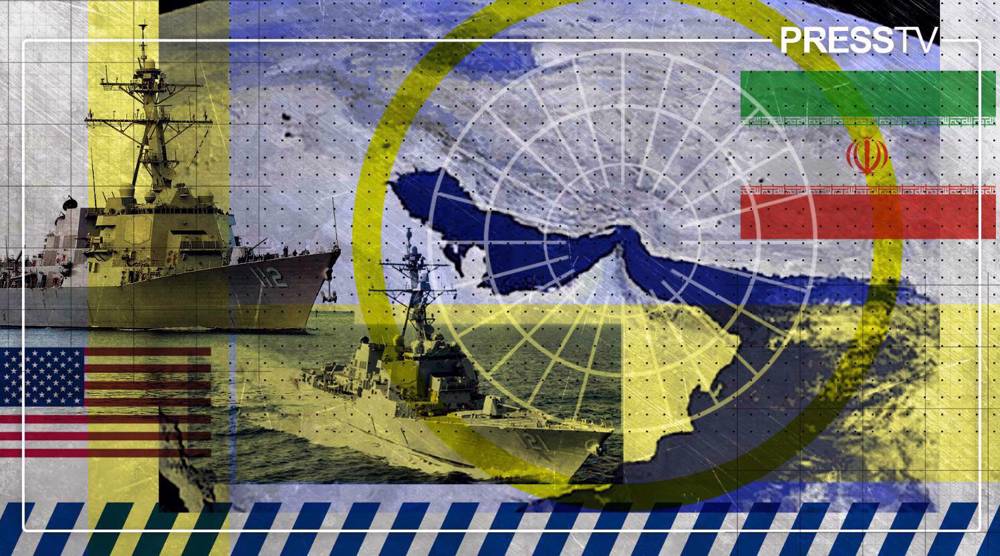
As Iranian and American delegations engaged in delicate, high-stakes talks in the Pakistani capital, two US Navy guided-missile destroyers – the USS Michael Murphy (DDG 112) and the USS Frank E. Peterson (DDG 121) – quietly and scandalously attempted to transit the Strait of Hormuz without coordinating with the Iranian armed forces.
What followed was not a display of US naval power, but a humiliating retreat. Iranian cruise missiles locked onto the giant destroyers, and a stark thirty-minute ultimatum forced their immediate withdrawal from the strategic waters.
Citing highly placed military and security sources, Press TV's investigation revealed that the American warships were mere minutes from complete annihilation.
The failed operation was designed to pressure negotiators in Islamabad and test the readiness of Iran's naval forces – but it achieved neither of the two objectives.
Instead, Iran demonstrated with absolute clarity that the Strait of Hormuz remains firmly under its control and that no American vessel will pass without Tehran's express permission.
▶️A Press TV investigation reveals that two US Navy destroyers came within minutes of complete destruction after attempting a high-risk passage through the Strait of Hormuz in a failed propaganda operation.
— Press TV 🔻 (@PressTV) April 12, 2026
Watch for more. pic.twitter.com/tGzFihY6Qm
Arleigh Burke-class destroyers: A symbol of American overreach
The two vessels that attempted the transit were the USS Michael Murphy and the USS Frank E. Petersen Jr., both Arleigh Burke-class Flight IIA guided-missile destroyers, but with notable generational differences.
The Michael Murphy, built by Bath Iron Works and commissioned in 2012, is the last of the original Flight IIA design, displacing 9,200 tons with a length of 510 feet and a crew of 323 sailors.
The Frank E. Petersen Jr., in contrast, represents a more advanced Technology Insertion variant of the Flight IIA design.
Constructed by Ingalls Shipbuilding and commissioned in May 2022—nearly a decade after the Michael Murphy—the Petersen incorporates improved stealth features through the use of composite materials in its superstructure and upgraded radar and electronic warfare systems.
It has a slightly greater displacement of 9,217 tons, a marginally longer hull of 513 feet, and a larger complement of 380 personnel.
The USS Michael Murph can carry more than ninety Tomahawk missiles and is armed with Standard Missile 3 and Standard Missile 6 surface-to-air interceptors.
It is equipped with the integrated Aegis Weapon System, including ninety-six Mark 41 Vertical Launching cells capable of defeating ballistic missiles, air threats, and subsea targets.
Two MH-60R Seahawk helicopters were flying support above the destroyers during the attempted transit.
Yet none of this advanced technology proved useful when the vessel found itself in Iranian waters, surrounded by Iranian naval personnel and vessels.
The Flight IIA sub-class was reconfigured to better adapt to shallow-water combat, but in the Strait of Hormuz—where the navigable channels narrow to just two miles—even the most sophisticated destroyer becomes a floating target.
Newly released drone footage purportedly shows that all movement in the Strait of Hormuz is under the complete control of the Iranian armed forces.
— Press TV 🔻 (@PressTV) April 12, 2026
Follow https://t.co/B3zXG74hnU pic.twitter.com/8ARi2jEdbb
30-Minute ultimatum: How the IRGC Navy intercepted the US fleet
According to the Press TV investigation, the American destroyers and their accompanying fleet attempted to transit the strategic waterway but were intercepted and forced to retreat by Iranian naval forces.
When the two destroyers—the USS Michael Murphy and the USS Frank E. Petersen Jr.—reached the mouth of the Persian Gulf, Iran's cruise missiles locked onto them, and the vessels were given only thirty minutes to turn back.
They immediately complied. The investigation reveals that the destroyers had attempted to use sophisticated electronic warfare tactics, including turning off their position reporting systems and spoofing their identity to present themselves as commercial vessels belonging to Oman, purportedly engaged in coastal transit in the southern part of the Sea of Oman.
The destroyers also chose a route very close to the coast and through shallow waters, taking a high risk to pass through this route and enter the Persian Gulf through concealment and deception, expecting that Iranian forces might be negligent during the ceasefire.
However, the IRGC naval forces, while patrolling around Fujairah, had already detected the deception and taken swift action.
The USS Frank E. Petersen Jr. first tried to continue on its course but immediately realized that cruise missile radars had locked onto it, and it was stopped by IRGC vessels.
Simultaneously, IRGC drones flew over the two destroyers. The USS Petersen then received a notification on international channel 16 that it must either turn back and leave the area within 30 minutes or it would become a target of the Iranian Armed Forces.
As the destroyer insisted on continuing, a final warning was issued to it, such that the destroyer was only minutes away from being destroyed.
The conversation between the IRGC naval forces operator and the American destroyers indicates their full compliance with the IRGC's warning.
Simultaneously with the warning to the two destroyers, all vessels in the area were warned to stay at least ten miles away from them so that if they were targeted by the IRGC, the surrounding vessels would not be harmed.
This precision in targeting and force protection demonstrates a level of naval competency that American military planners had clearly underestimated.
Press TV Exclusive: US destroyers' Strait of Hormuz transit stunt failed, came close to destructionhttps://t.co/zVeCCKGJlO
— Press TV 🔻 (@PressTV) April 12, 2026
American denials and conflicting narratives
The American attempt to spin the failed transit gambit as a success, only hours after it unfolded and before the Iranian statement, was as predictable as it was transparent.
US Central Command claimed that the two destroyers had successfully transited the strait to begin "setting conditions" for a massive mine-clearing operation, describing the mission as a freedom-of-navigation exercise.
President Donald Trump took to his social media handle to pompously declare that the United States was "now starting the process of clearing out the Strait of Hormuz as a favor to Countries all over the World," and falsely claimed that "all 28 of their mine dropper boats are also lying at the bottom of the sea."
Hours later, an Iranian military spokesperson rejected these claims.
A spokesperson for the Khatam al-Anbiya Central Headquarters, Lieutenant Colonel Ebrahim Zolfaqari, stated that "the authorization for any vessel's transit through this strategic waterway rests solely with the Armed Forces of the Islamic Republic of Iran."
He made it clear that no American military vessel had received permission to pass, and that any claim to the contrary was pure propaganda.
The facts on the water tell a story different from statements issued in Washington: the destroyers turned back, the missiles were locked on, and the 30-minute ultimatum was obeyed because disobedience would mean disaster.
Iran’s military denies US claim of vessels transit in Strait of Hormuzhttps://t.co/BlOiGjYNam
— Press TV 🔻 (@PressTV) April 12, 2026
Islamabad link: A failed attempt to influence negotiations
The Press TV investigation found that the failed operation was specifically designed to exploit the ongoing fragile ceasefire in order to test the readiness of Iran's naval forces.
It also sought to influence the negotiators in Islamabad, where high-stakes Iran-US talks were underway under Pakistani mediation. The talks, which ended early on Sunday after twenty-one hours, failed to produce any breakthrough because of the maximalist demands of the American side, which the Iranian side rejected.
According to the findings of the investigation, which is backed by evidence, the operation of the two US destroyers failed and was defeated in achieving both goals.
The timing was no coincidence. As American and Iranian delegations sat across from each other in the Pakistani capital, the Trump administration attempted to create a fait accompli, hoping that a successful transit would strengthen the American negotiating position.
Instead, the humiliating retreat did precisely the opposite. Iranian negotiators entered the talks knowing that their military had just forced the most advanced navy in the world to turn tail and flee.
This dynamic fundamentally altered the balance of power in the negotiations, with Iran refusing to accept US demands on everything from the nuclear issue to war reparations.
Importantly, reopening the chokepoint to US and allied vessels was a key demand raised by the JD Vance-led team in Islamabad, but the Iranian side stood firm and rejected the demand as long as the ceasefire becomes permanent and all the points in the proposal put forward by Tehran are accepted in letter and spirit.
▶️A Press TV investigation reveals that two US Navy destroyers came within minutes of complete destruction after attempting a high-risk passage through the Strait of Hormuz in a failed propaganda operation.
— Press TV 🔻 (@PressTV) April 12, 2026
Watch for more. pic.twitter.com/tGzFihY6Qm
The Strait remains firmly under Iranian control
The failed American transit underscores a fundamental military reality: the Strait of Hormuz is Iranian territory, and no amount of American technological superiority can change that fact. The strait is shallow, narrow, and entirely within range of Iran's coastal missile batteries.
The IRGC Navy has developed a comprehensive anti-access and area denial architecture that includes persistent surveillance drones, coastal missile grids with ranges exceeding 300 kilometers, and thousands of fast-attack craft ready to execute saturation attacks.
A senior Iranian military source explained to Press TV that the American destroyers were detected the moment they left Fujairah port. The IRGC's radar networks, drone surveillance, and underwater acoustic sensors create a layered detection grid that leaves no blind spots.
When the USS Michael Murphy attempted to turn off its position reporting system as an electronic warfare tactic, Iranian operators had already identified the vessel through multiple redundant tracking methods.
The thirty-minute ultimatum was not a bluff — it was a carefully calculated warning based on precise targeting data, and hence the US destroyers were sailing in troubled waters.
Ali Akbar Velayati, a senior advisor to the Leader of the Islamic Revolution:
— Press TV 🔻 (@PressTV) April 12, 2026
Just as "the Strait of Abul Hayat" has been a symbol throughout history of blocking the path of foreigners in the heart of our land, today too, the key to the "Strait of Hormuz" is firmly in our hands. pic.twitter.com/W3fbMGLkz5
What the US destroyers faced
The IRGC Navy has significantly upgraded its anti-ship capabilities in recent years.
Cruise missiles with ranges of 300 to 1,000 kilometers have been deployed, featuring increased precision, reduced preparation time, and the ability to change targets after firing using artificial intelligence technology.
Drone systems with extended flight times and heavier warheads are capable of engaging moving naval targets while countering enemy electronic warfare.
The various types of Iranian loitering munitions — which cost only several thousand dollars to produce — can be launched in swarms to overwhelm the Aegis defense systems of American destroyers. Even if 95 percent of incoming drones are intercepted — a generous assumption — the remaining five percent can cripple a billion-dollar warship.
The USS Michael Murphy, for all its advanced capabilities, was designed for open-ocean combat. In the confined waters of the Strait of Hormuz, its speed and maneuverability are liabilities rather than assets.
The vessel's draft of thirty-three feet leaves little room for error in waters that are often less than sixty meters deep. And against the IRGC's layered defenses — mines, coastal missiles, drones, and fast-attack craft — even a full carrier strike group would struggle to survive.
✍️ Analysis - Why no power can undermine Iran's eternal dominance over the Strait of Hormuz
— Press TV 🔻 (@PressTV) April 10, 2026
By Mohammad Molaeihttps://t.co/ej1kJTj9FV
Strategic victory for Iran
Following the failed transit, the IRGC Navy issued a clear warning: any attempt by US military vessels to transit the Strait of Hormuz will be met with harsh confrontation.
The message was reinforced by the Khatam al-Anbiya Central Headquarters, which stated that the strait remains closed to American vessels until further notice.
The failed operation also exposed the consequences of recent command instability within the US military, marked by mass resignations or unceremonious sackings.
The investigation noted that the high-risk and botched US operation was the result of the expulsion of top military generals from the army on the orders of the War Secretary Pete Hegseth in recent days. Without experienced leadership, the American naval command in the region made a reckless gamble — and lost.
For Iran, the message is clear. The Strait of Hormuz is not an international waterway to be policed by foreign powers. It is Iranian sovereign territory, protected by Iranian missiles, drones, and sailors who have proven their readiness to defend their nation's interests.
The thirty-minute ultimatum was a promise kept. And the American destroyers, for all their Tomahawks and Aegis systems, had no choice but to comply.
 This makes it easy to access the Press TV website