Exposed: Leaked docs show monarchists rallying Iranian diaspora to back attack on Iran
By Behnam Sarmadi
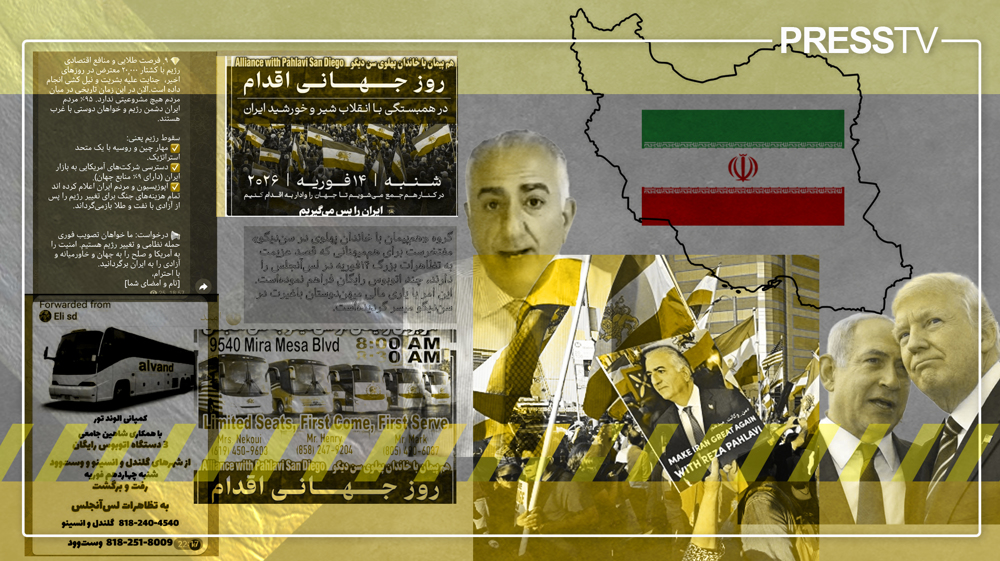
A set of leaked documents shared with the Press TV website offers a rare glimpse into a coordinated campaign by pro-monarchist groups to mobilize segments of the Iranian Diaspora in favor of foreign military intervention against Iran.
The documents — including an internal communique and a 10-point “media advisory” — outline a strategy that focuses not on political reform or even political change, but on external military action as a means of “regime change” in the Islamic Republic of Iran.
The clarion call coincides with Reza Pahlavi’s calls for street protests in Munich, Toronto, and Los Angeles this Saturday, while he is in Munich to lobby for military action against Iran.
Taken together, the materials suggest an organized attempt to influence public opinion abroad, creating the misleading impression that support for foreign military intervention originates organically within the Iranian community.
Ironically, it comes less than a week after tens of millions took to the streets across Iran on the 47th anniversary of the Islamic Revolution, reaffirming their pledge of allegiance to the revolution and firmly rejecting those who seek to destabilize the country through wars or riots.
A direct appeal for military action
The communique circulating among monarchist circles, from WhatsApp groups to Telegram channels, leaves no room for ambiguity. It explicitly and formally urges foreign military intervention:
“Our request: We demand the immediate approval of a military attack and regime change. Return security to America, peace to the world and the Middle East, and freedom to Iran,” it reads.
The document also frames the Islamic Republic's response to recent violent riots, which claimed over 3,100 lives, mostly civilians and security personnel, as a “massacre of 20,000 protesters,” a fabricated figure designed to manufacture moral justification for aggression.
The figure was amplified by certain Western “rights” groups and media outlets linked to monarchists and the Zionist lobby, despite lacking any supporting evidence.
Most of these claims were later debunked by Press TV, which exposed a coordinated disinformation campaign aimed at shaping and manipulating Western public opinion about events in Iran.
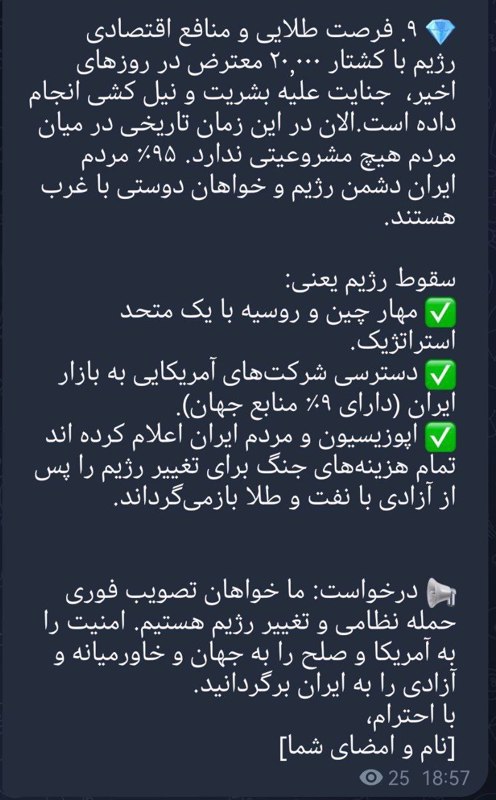
The documents explicitly and unequivocally promise foreign powers, including the United States, that a post-invasion Iran would serve their strategic interests.
“The fall of the regime means: containing China and Russia with a strategic ally, American companies accessing Iran's market, Iran possessing 9% of [the world's] resources.”
Going further, they pledge to repay the costs of war as well.
“The opposition and the people of Iran have announced that they will repay all costs of the war for regime change after liberation with oil and gold,” the leaked documents read.
The communiqué frames foreign intervention as a moral imperative, yet it reads more like a business proposition cloaked in patriotic rhetoric – an auction of national sovereignty to the highest bidder.
The puppet master
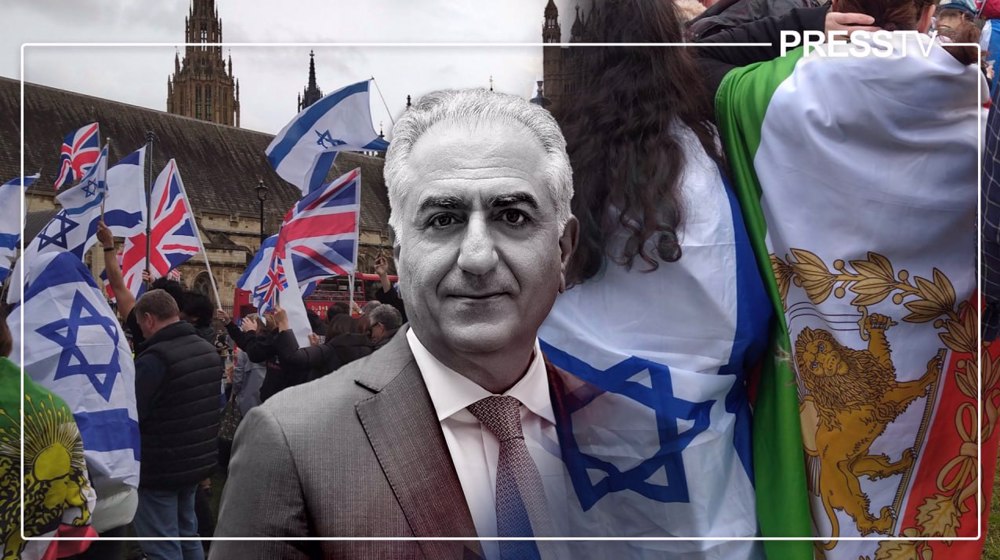
At the center of this operation is Reza Pahlavi, son of the West-backed dictator overthrown in 1979. From his home in Maryland, he has positioned himself as the figurehead of a project that critics describe as a “pawn in a sinister game played by the US and the Israeli regime.”
For years, Pahlavi maintained a veneer of political neutrality, acknowledging the implausibility of restoring the monarchy. Yet whenever unrest erupted in Iran, he seized the moment, calling for the removal of the Islamic Republic and restoration of the monarchy.
His alignment with neoconservatives and hardline Zionists during the Trump administration revealed his true orientation as he endorsed the so-called “maximum pressure” campaign against Iran, claiming that crippling sanctions reflected the Iranian people’s wishes.
His associations are equally revealing. He was seen alongside Sheldon Adelson, the late Republican billionaire who once suggested using a nuclear weapon against Iran, and attended events at the Washington Institute for Near East Policy (WINEP), an AIPAC-linked think tank known for its aggressive pro-Israel agenda.
When Trump’s policies failed to bring the “regime change” he worked so hard for, Pahlavi sought more direct support from the Israeli regime, visiting the occupied territories amid the ongoing genocide in Gaza, brazenly endorsing the genocide and the military aggression against Iran.
In the June 2025 war, he cheered the Israeli and American bombings on Iran, which claimed the lives of over 1,000 Iranians, most of them ordinary civilians, including women and children.
The 10-point media strategy
Organizers behind the scheduled protests have circulated a set of media “recommendations” that read less like grassroots guidance and more like a playbook for generating visibility as part of a coordinated influence campaign centered on Iran.
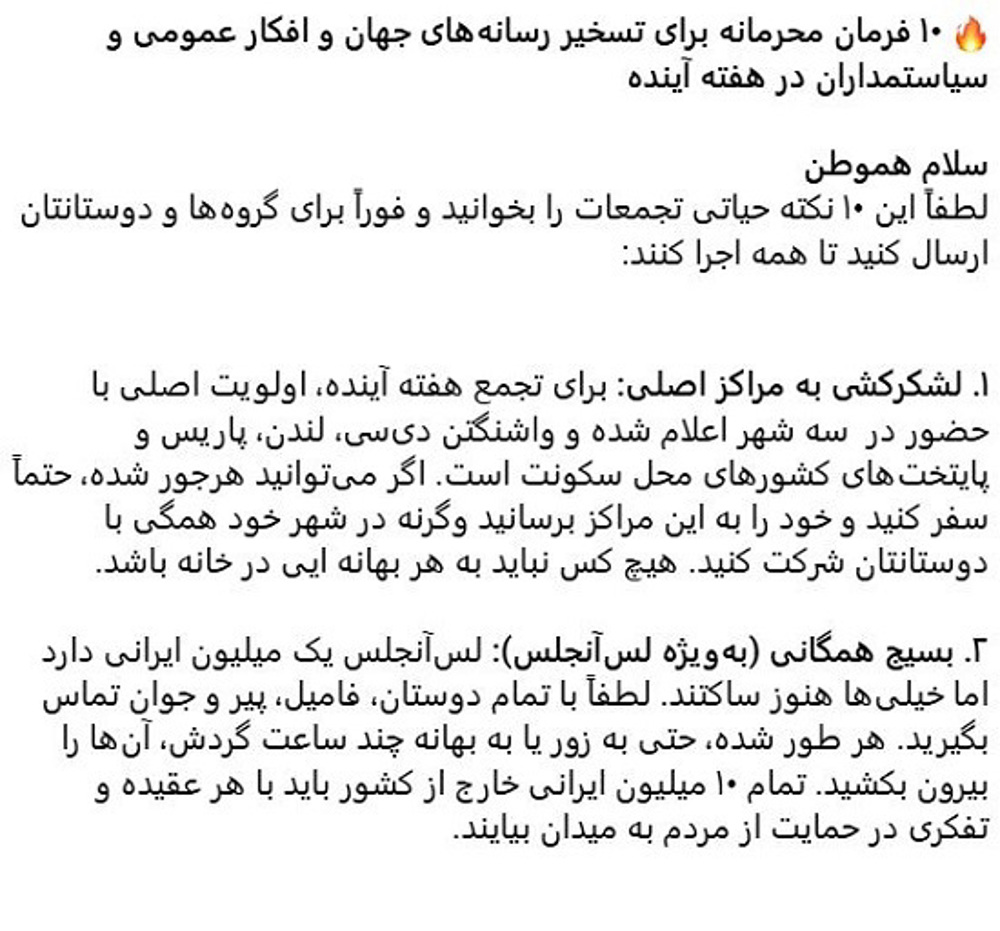
- Mobilization in capitals
Supporters are instructed to converge on Washington, London, Paris, Los Angeles, and other high-profile cities – not necessarily to build scale, but to create optics. The emphasis is unmistakable: proximity to major media hubs matters more than actual numbers on the ground.
- Compulsory participation language
In a revealing passage, participants are urged to bring friends and relatives “however possible,” even under alternative pretexts. The language prioritizes headcount over genuine engagement, suggesting that turnout, however assembled, is the overriding objective.
- English-language messaging
The advisory mandates that all slogans be in English and tightly centered on “regime change” and “military attack,” explicitly framed as a Western security concern. The guidance appears designed less for a domestic audience than for policymakers and foreign media outlets.
- Use of AI
It promotes the use of AI tools to mass-produce posters, compile journalist contact lists, and expand outreach to international media. Technology here acts as a force multiplier for narrative amplification rather than genuine civic engagement.
- Visual strategy
Participants are instructed to carry host-country flags and position themselves to create the impression of larger crowds in aerial footage.
Small, carefully staged gatherings at symbolic locations are considered more effective than larger but less visible rallies, a candid acknowledgment that perception can outweigh actual participation.
- Symbolic street installations
The plan also proposes memorial-style displays – photos, candles, and posters – left in busy public areas to sustain attention and drive social media circulation. The emphasis remains on prolonged visibility rather than grassroots engagement.
The document exposes a coordinated effort to attract global media attention while projecting the false impression that Iranians themselves are demanding war on their homeland.
Exploiting the diaspora
The strategy depends heavily on mobilizing Iranians abroad, many of whom carry genuine frustrations over economic concerns but deeply love their homeland. The attempt is to use them as instruments to influence Western governments against their own country.
“Even by force,” the guideline suggests, participants should be brought to gatherings.
Their nationalist pride is exploited through foreign flags, and their legitimate desire for change is co-opted to advocate military strikes that could endanger their own families inside Iran.
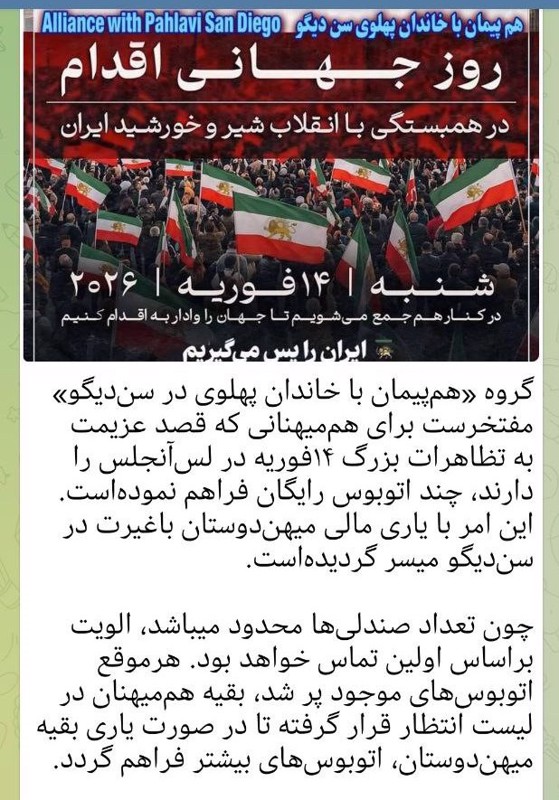
Flyers circulating online indicate that transportation to major rallies in cities such as Los Angeles has been organized by monarchist supporters and their financiers in various capitals.
While organized transport is common in political activism, the scale and coordination described in the advisory point to centralized planning.
Synchronizing with US threats
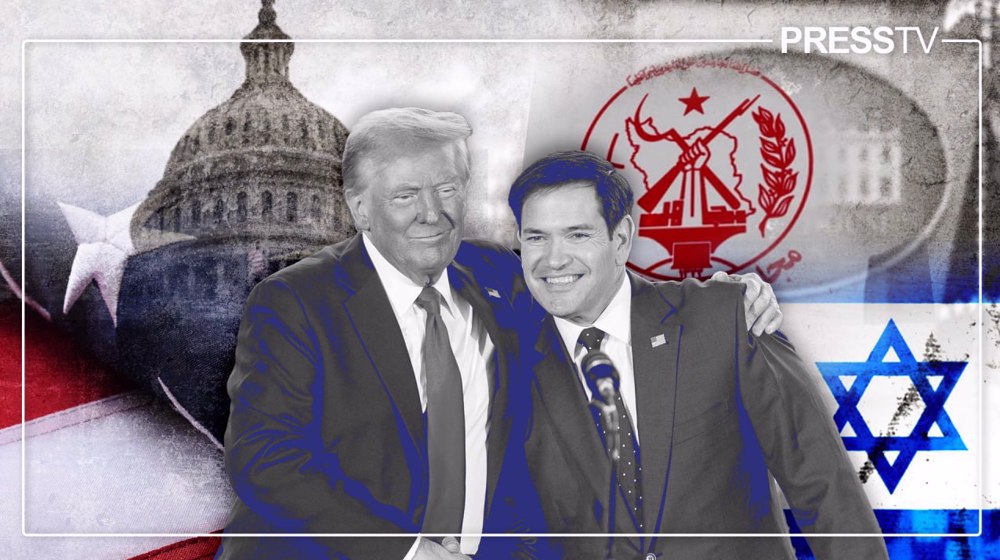
Following recent economic protests in Iran, which started off peacefully and eventually turned violent after being hijacked by American and Israeli-backed agitators, Donald Trump claimed that “help is on its way” and threatened that consequences would be “far worse” than the June strikes on Iranian nuclear facilities.
His administration eventually dispatched a fleet of warships and aircraft carriers to West Asia in order to force Iran into submission – a ploy that failed miserably.
In this context, a publicized diaspora demand for intervention, experts believe, could serve as political cover for hardline policy circles that seek military action against Iran.
The communique’s language – requesting “immediate approval” of military attack – effectively provides what foreign policymakers often cite as a prerequisite for intervention: an invitation framed as coming from the affected population.
The alignment in timing and messaging implies direct coordination between monarchist agents and hawkish US policymakers who have been strongly lobbying for war against Iran.
The 10-point playbook notably instructs supporters to bring photos of Trump, portraying him as the “savior of the Christian world,” which experts believe is a way to flatter the US president.
China rejects unilateral sanctions as Trump signs bill targeting Russia, Iran
Iran: US had intentionally prepared ground for withdrawing from Islamabad MoU
Iran retains initiative in Strait of Hormuz despite US claims: Armed Forces



Saudi Arabia bombs Yemen 760 times since escalating aggression
VIDEO | Press TV's news headlines
VIDEO | Saudi Arabia, UAE helping US, Israelis to fulfill their mission in region: Analyst
VIDEO | Israel’s targeting of Palestinian journalists part of broader campaign to control narrative: Analyst
Iran Army downs US Orbiter reconnaissance drone over Strait of Hormuz
Iran must fight US blockade with energy blockade: Deputy speaker
North Korea launches 2 ballistic missiles, dials up pressure on US
Iran’s president to attend UN General Assembly in New York


 PressTV NEWSLETTER
now
PressTV NEWSLETTER
now
 This makes it easy to access the Press TV website
