
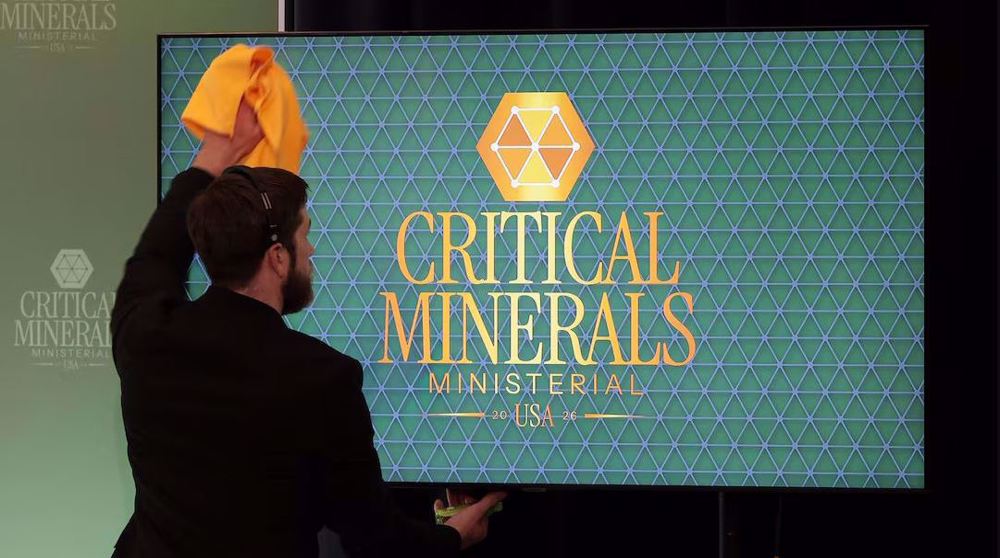
The United States has hosted representatives from more than 50 countries for talks to create a mineral “trade bloc” aimed at countering China’s dominance over rare earth supply chains.
China rose to dominance in rare earth minerals by investing heavily in mining and processing capacity over several decades. It currently controls around 60 percent of global rare earth reserves and processes about 90 percent of the world’s supply.
Amid the ongoing tariff war waged by US President Donald Trump against China and other countries, Beijing has imposed retaliatory measures on Washington, including restrictions on rare earth exports.
On Wednesday, in what officials described as an effort to strengthen coordination among allies and reduce reliance on China, the US hosted delegates from over 50 countries to explore forming what the Trump administration called a “critical minerals trade bloc.”
Administration officials said the proposed bloc would help break China’s near-monopoly and benefit the US and its partners by diversifying supply chains.

This is the second meeting on the matter within a month, with ministers from India, Japan, South Korea, Mexico, France, Germany, Italy, Canada, Australia, New Zealand, Argentina, the Democratic Republic of Congo (DRC), among others, taking part in the summit.
Trump administration officials have intensified efforts to counter China’s rare earth dominance following Beijing’s export restrictions, which expanded last year after trade tensions escalated. Those restrictions affect metals essential to US military systems, advanced electronics, renewable energy technologies and artificial intelligence infrastructure.
Rare earth minerals — 17 metallic elements including lanthanides, scandium and yttrium — have unique magnetic properties. They are used in products ranging from smartphone batteries and semiconductors to wind turbines and fighter jets.
Earlier this week, Trump announced the launch of a strategic US minerals stockpile known as Project Vault, backed by $2 billion in private capital and a $10 billion loan from the US Export-Import Bank.
While Washington is seeking to restructure supply chains toward US territory and allied countries, analysts note that the United States still lacks the large-scale processing capacity that underpins China’s dominance. China has also developed extensive proprietary processing technologies over the decades.
The push for a coordinated minerals bloc comes despite last year’s temporary trade truce between Trump and Chinese President Xi Jinping, which paused additional tariff escalations. However, the broader tariff framework remains in place, continuing to strain global trade flows and contributing to supply chain uncertainty.
 This makes it easy to access the Press TV website