
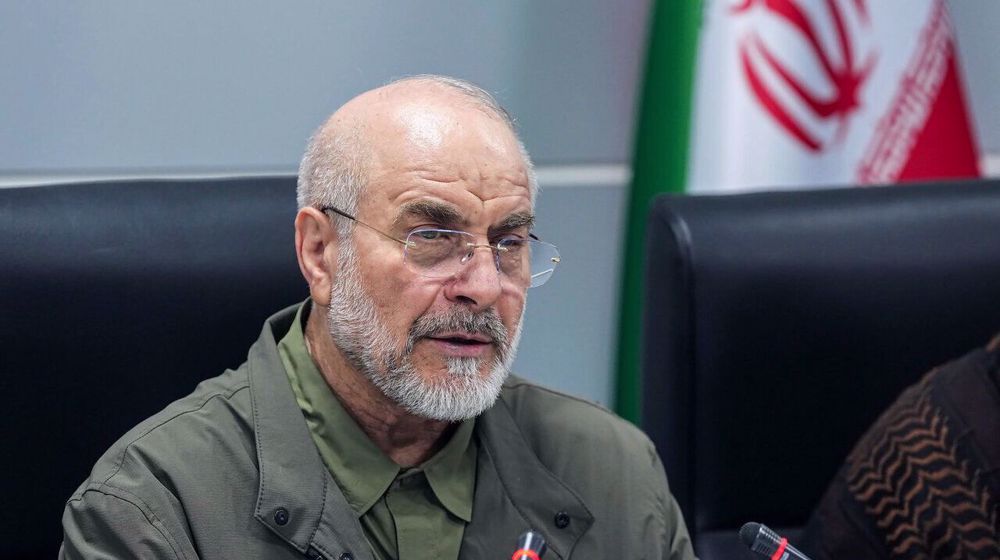
Iranian Parliament Speaker Mohammad Baqer Qalibaf says US Treasury Secretary Scott Bessent is lying and has failed to manage financial markets.
Qalibaf made the remark in a post on his X account on Saturday in response to Bessent’s earlier claim that the US blockade on Iran and its latest economic pressure campaign, dubbed Operation Economic Outcast, will “crush the failing Iranian economy”.
The Parliament speaker also reposted an article by Nobel Prize-winning economist Paul Krugman that criticized Bessent and described his handling of financial markets as an outright failure.
Qalibaf ridiculed Bessent’s claim that the United States had “guided 130 million barrels” of oil out of the Strait of Hormuz over the previous 14 days.
He directed Bessent's staff to review data from Moody's—a major financial analytics company—which has put the war's costs at over $130 billion
“For real 130s, tell your staffer to pull Moody's showing $130+ billion in war costs,” Qalibaf wrote.
Liar liar pants on fire.
— محمدباقر قالیباف | MB Ghalibaf (@mb_ghalibaf) August 29, 2026
For real 130s, tell your staffer to pull Moody's showing $130+ billion in war costs, and ask another how much Jane Street burned north of $130 million shorting oil for you in just one futures roll.
Liar liar yields on fire. https://t.co/j1Ej9K7hPL pic.twitter.com/BPykaanAOM
The speaker took another jab at Bessent over a reported financial loss involving the trading firm Jane Street, pointing out that the company “burned” over $130 million “shorting oil” in a single futures roll.
Shorting oil is a trading strategy that profits when the price of oil falls. Qalibaf was implying that Jane Street's major loss was a direct consequence of US government manipulation aimed at keeping oil prices low—a move that backfired.
“Liar liar yields on fire,” Qalibaf wrote, pointing to rising yields on US Treasury bonds.
According to information published on Qalibaf’s official website, the yield on 30-year US Treasury bonds had reached around 5.3 percent, its highest level since 2008.
The report said the US Treasury had sought through various measures to raise the price of long-term bonds and keep yields lower in an effort to portray a more favorable image of the country’s economy and the cost of government debt.
However, it said, the market had not accepted those efforts, with yields subsequently rising again.
According to the report, rising yields indicate that professional investors do not fully trust the narrative presented by the US government and Treasury Department and view risks as greater than officials suggest.
Oil markets have remained highly sensitive to developments around the Strait of Hormuz, a key route for global energy supplies that Iran has closed since the early days of the war in response to the aggression.
Iranian authorities have repeatedly said that a return to normal in the waterway would only happen when the US completely ends the aggression and lifts its sanctions and blockade on the country.
In peacetime conditions, roughly one-fifth of the world's oil supply and one-third of global agricultural fertilizer trade pass through the Strait of Hormuz.
The rising cost of basic goods resulting from the US war of aggression against Iran has impacted goods not only in the US but also in Europe and around the globe.

Earlier on Saturday, Iran's Foreign Minister Abbas Araghchi wrote on X that US government officials are manipulating energy markets for personal gain and using media narratives to keep US President Donald Trump mired in a “losing war.”
Araghchi said Iranian intelligence had detected “major efforts” to manipulate energy markets, adding that US officials are using media narratives to influence prices for personal gain.
 This makes it easy to access the Press TV website