Iran blocks IAEA inspections of attacked nuclear sites until new protocol established
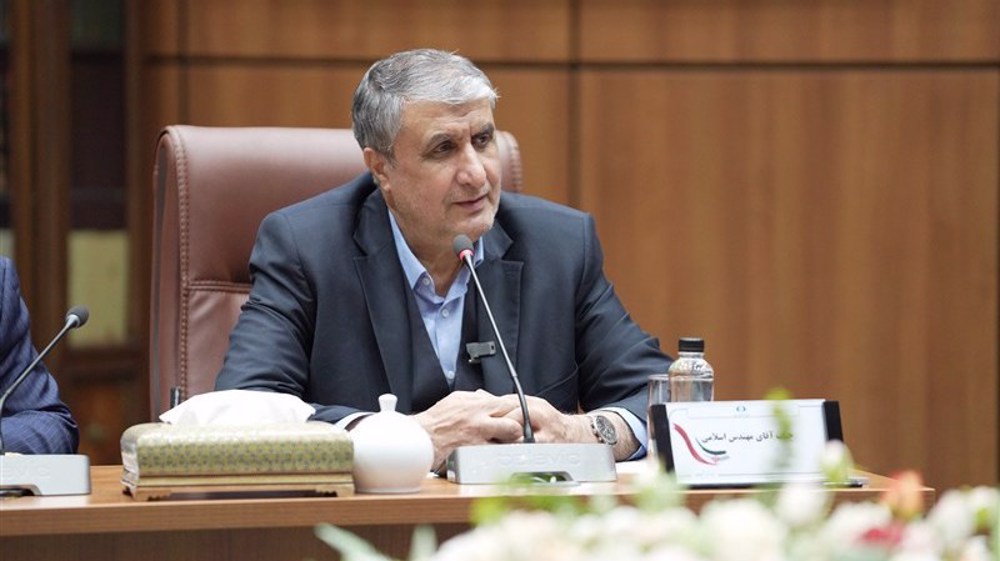
The head of the Atomic Energy Organization of Iran (AEOI) says the UN nuclear watchdog cannot demand access to inspect nuclear facilities damaged in the US-Israeli military strikes unless a specific, approved protocol for inspecting sites under wartime conditions is established.
Speaking on Wednesday at an event unveiling new knowledge-based achievements of the AEOI, Mohammad Eslami said Iran’s interactions with the International Atomic Energy Agency (IAEA) are strictly governed by a recent law passed by the Iranian Parliament, which has already been communicated to the agency.
“The IAEA is well aware that under current conditions, until the regulations and inspection protocols for sites that have been subjected to military attacks are drafted, approved, and communicated, it cannot claim the right to inspect them.”
While routine safeguards inspections continue normally at facilities that were not targeted, the situation for attacked sites is fundamentally different, Eslami said.
“The country remains in a state of war, and it is not yet the case that the conflict has ended and security at these sites has been fully restored.”
IAEA complicity in attacks
Eslami censured the IAEA’s dealing with the recent hostilities, saying all the targeted facilities were previously registered with and regularly inspected by the UN nuclear agency.
The IAEA’s failure, he added, to protest or condemn the military strikes calls its independence and competence into question.
The current push by Washington and Tel Aviv for the IAEA to visit the damaged sites is not about nuclear safeguards, but rather a transparent attempt to conduct battle damage assessment, he said.

“The only reason for this pressure is that they want to see what happened to these sites as a result of the military operations they carried out.”
He also touched on recent threats by the US president to bomb specific Iranian locations, such as the Kuh-e-Kalang site. Such rhetoric, he said, serves as a “historical lesson that international organizations are being used as playthings by the United States and Israel.”
The Iranian official urged the IAEA to resist external pressure and threats and to operate strictly according to its own statutes.
Continued civilian nuclear achievements
Eslami also highlighted the resilience of Iran’s civilian nuclear program.
The Iranian official announced new agreements to expand the use of plasma technology in agriculture. Eslami said experimental treatments have already increased wheat yields by at least 30%.
In the medical sector, he reported that 20 plasma-based wound healing clinics are currently operational, with several more set to open soon to treat chronic and diabetic wounds.
Eslami confirmed that Iran has successfully maintained the export of radiopharmaceuticals to several countries throughout the war, utilizing land routes when air networks were disrupted. Iran, he said, is now resuming regular air shipments.
The current standoff over site inspections is the latest escalation in a prolonged dispute between Tehran and the IAEA’s Board of Governors.
Over the past years, the Board, heavily influenced by the United States and its European allies – namely Britain, France and Germany - has passed multiple resolutions criticizing Iran’s nuclear activities.
These resolutions have frequently demanded immediate access to various Iranian nuclear facilities, often citing concerns over alleged undeclared activities or the presence of nuclear material traces at specific locations.
IAEA Board of Governors passes anti-Iranian resolution@ReinischDieter reports from Vienna pic.twitter.com/1Xmg9MjLcq
— Highlights (@highlightsnews1) June 11, 2026
Tensions reached a boiling point during the recent US-Israeli war on Iran, when strikes targeted several Iranian nuclear sites.
The stated objective of the strikes, according to US and Israeli officials, was to destroy Iran’s nuclear capabilities.
In the aftermath of the attacks, the IAEA initially expressed concern over the military strikes on nuclear facilities but stopped short of formally condemning the United States and Israel, a stance Tehran has vehemently denounced as a failure of the IAEA’s neutrality.
Subsequently, the Board of Governors passed a resolution demanding that Iran allow inspectors immediate access to the strike-damaged sites.
Iran has rejected this demand. Tehran believes Washington and Tel Aviv are weaponizing the IAEA to legitimize their aggression and conduct post-strike reconnaissance under the guise of nuclear safeguards.
Iran has declared that any future inspection of the damaged sites must be predicated on new, mutually agreed-upon security protocols that ensure the safety of Iranian personnel and respect the sovereign rights of the Islamic Republic during an active state of conflict.
Strait of Hormuz won’t reopen unless US accepts Iran’s conditions: IRGC
Pezeshkian: US will achieve nothing through economic pressure on Iran
Iran: Israel’s nuclear arsenal threatens global non-proliferation regime



VIDEO | Press TV's news headlines
Iran will not tolerate any hostile activity in Iraq’s Kurdistan: IRGC commander
Iran blocks IAEA inspections of attacked nuclear sites until new protocol established
VIDEO | Prophet Mohammed’s birthday arrives in Gaza amid ruins of mosques
Iran could take ‘pre-emptive’ action under new ‘offensive’ doctrine: Army spokesman
New Israeli settlement expansion aims to seize more Palestinian land: Hamas
Hostile media outlets could be military targets, Iran's armed forces warn
Strait of Hormuz won’t reopen unless US accepts Iran’s conditions: IRGC


 PressTV NEWSLETTER
now
PressTV NEWSLETTER
now
 This makes it easy to access the Press TV website
