
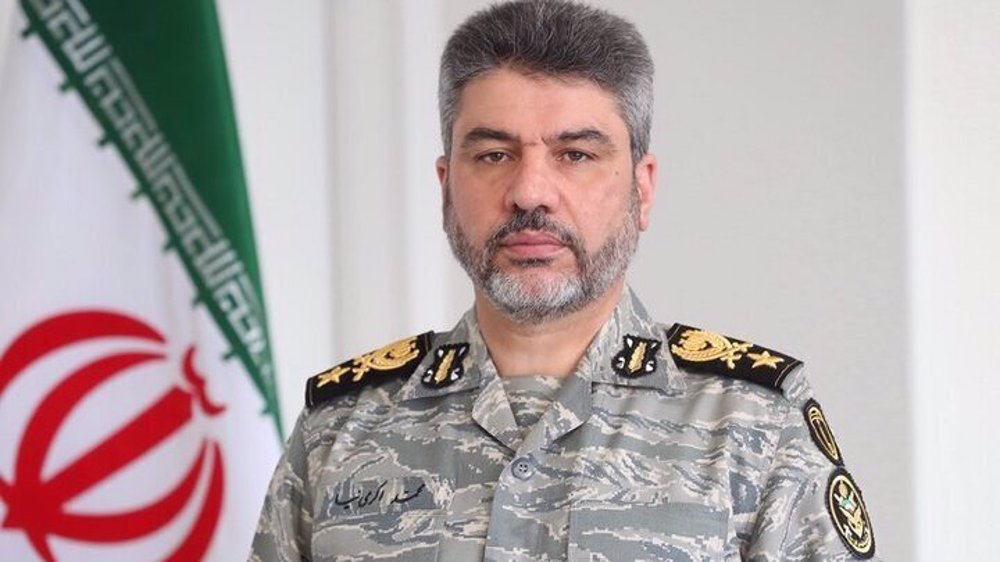
An Iranian Army spokesman says the country’s military doctrine has shifted from a defensive to an offensive posture, stressing that the armed forces are prepared to launch preemptive strikes if deemed necessary.
Brigadier General Mohammad Akraminia told reporters on Wednesday that the shift has already been implemented, with its impact evident in Iran’s “rapid response” to the US-Israeli aggression that began in late February.
“Today, this change in doctrine has thankfully been implemented, and its effects are visible,” he said. “We have shifted this military doctrine towards an offensive military doctrine.”
Akraminia described the shift as a “precious legacy” of Major General Seyed Abdolrahim Mousavi, the late Chief of Staff of Iran’s Armed Forces, who was martyred in the US-Israeli aggression. He said the change had been pursued under the directives of the martyred Leader of the Islamic Revolution, Ayatollah Seyyed Ali Khamenei.
He said the new doctrine was reflected in Iran’s “crushing response” to enemy attacks and its “preemptive” actions.
“Preemptive action is a legitimate action under international law and the [UN] Charter, of course, when it is accompanied by the principles of proportionality and necessity,” he said, referring to Iranian strikes on a US base in Jordan as American forces were mobilizing troops and equipment for further attacks on Iran.
“Overall, one of the achievements of the current war was this change in doctrine,” Akraminia said, adding that the shift is still “undergoing its own evolutionary stages.”
He said the process would continue until Iran achieves “complete deterrence against enemy threats.”
“Our armed forces will certainly continue this course and, within the same framework, that is, with an offensive approach, will employ newer equipment, tactics, and arenas in any future war,” he said.
Akraminia warned that any “miscalculation” by the enemy would draw an “immediate” Iranian response and could expand a future war across the region.
He cited the Bab al-Mandab Strait and a US base in Syria as examples of areas that became part of the current war despite previously falling outside its geographical scope.
“Today, threats exist across the entire region, and we have the capabilities to confront and deal with them,” he said.
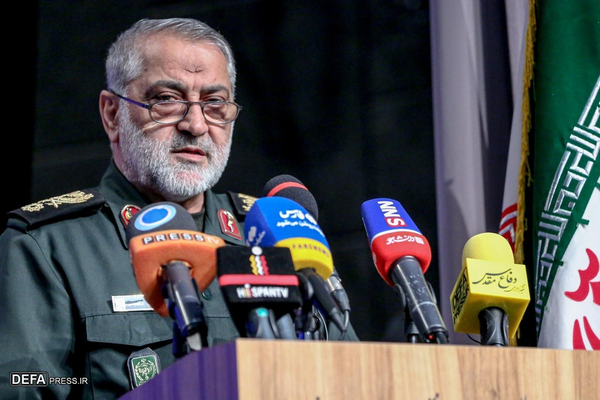
He warned that any future war could also put the region’s energy infrastructure and underwater communications networks in the Persian Gulf and the Sea of Oman at risk.
“Anywhere the enemy has interests could, in the event of aggression, fall within the framework of legitimate targets for the armed forces of the Islamic Republic of Iran. This means entering new domains of warfare,” Akraminia said.
He also stressed that Iran’s armed forces would be better prepared to confront any future aggression.
“If another aggression takes place in the future, all armed forces, including the Islamic Republic of Iran Army and the Islamic Revolution Guards Corps, will certainly be more prepared and confident in dealing with the enemy,” he said.
The US and Israel launched their latest aggression against Iran on February 28, roughly eight months after their previous unprovoked attacks on the country.
Iran responded swiftly, firing barrages of missiles and launching drones at the Israeli-occupied territories and US bases and interests across the region.
A ceasefire took effect on April 7. On June 18, the Iranian and US presidents signed a memorandum of understanding (MoU) to end the war and launch a 60-day diplomatic process aimed at resolving their differences.
The process, however, was derailed by renewed US strikes, prompting another Iranian retaliation.
 This makes it easy to access the Press TV website