Rising US bond yields, $40 trillion debt and looming economic crisis amid war on Iran
Y. P. Rāzi
These days, we hear a great deal about the rising yield on US Treasury bonds. This issue has caused grave concern among American officials to the point that, under the direct order of President Donald Trump to the White House economic team, the administration has resorted to financial engineering to prevent the country from sinking further into this endless quagmire.
To finance its annual budget deficit, the US government is authorized to sell bonds, provided it adheres to the debt ceiling limit set by Congress. These bonds are mostly offered with a fixed interest rate, meaning that bondholders receive a predetermined fixed payment every six months.
The primary domestic buyers of these bonds are investment and pension funds, the Federal Reserve, and primary dealers (which consist of 25 major Wall Street banks selected by the Federal Reserve). Domestic investors hold roughly twice as much US debt as foreign investors.
However, it is important to note that since 2022, the Federal Reserve has not only stopped purchasing new bonds but has also begun selling off its existing holdings, a policy known as quantitative tightening. The largest foreign holders of US debt include Japan, the United Kingdom, China, and others.
But if most of the bonds issued by the Treasury offer fixed interest rates, why do shifting political and economic conditions have such a dramatic impact on their effective yield? The answer lies in the secondary market.
The primary buyers, mostly domestic institutions, often sell these bonds to finance their own expenses, creating a vibrant secondary market. When investors are optimistic about future inflation and economic conditions, demand for bonds rises, driving up their market price. This, in turn, lowers the effective yield.
Conversely, when expectations point to a bleak future with high inflation, demand drops and buyers bid lower prices, sometimes even below the original purchase price, which pushes the yield upward.
To illustrate this, consider a bond with a face value of $1,000 and an annual fixed interest payment of $50. Its effective yield is 5%. However, if demand weakens and the same bond trades at just $800 in the secondary market, while the $50 annual payout remains unchanged, the effective yield rises to 6.25% (800 ÷ 50 = 6.25%).
The main drivers behind this rising yield (i.e., falling demand) are fears of persistent inflation, concerns over the government's ability to repay its mounting debt, and the growing appeal of competing markets, such as corporate stocks.
What are the consequences of this rising yield for the US government?
First, it causes a staggering increase in borrowing costs. The government will be forced to offer higher interest rates on future bond issuances to attract buyers.
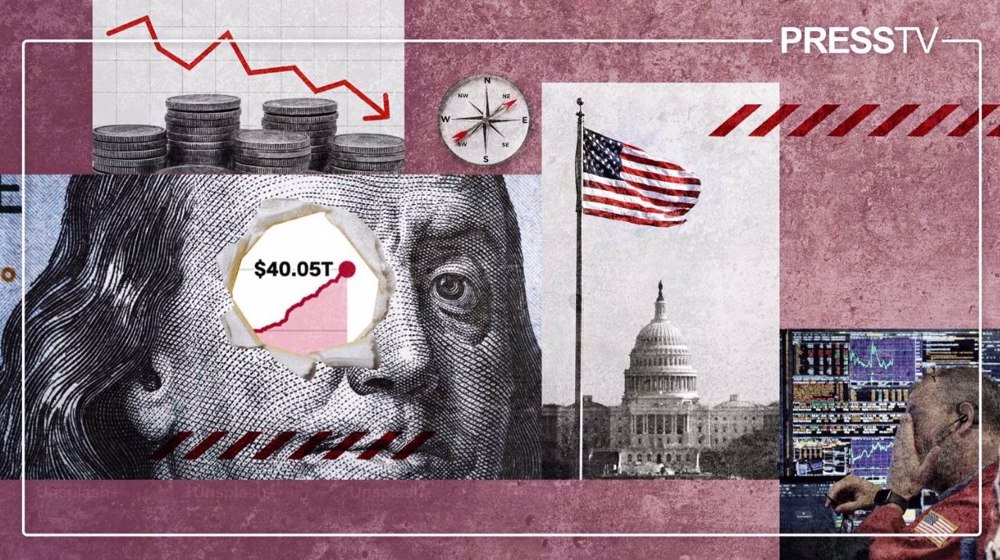
Second, it adds immense pressure to America’s already massive $40 trillion national debt. The government is already paying enormous sums in interest to bondholders. Imagine the crushing burden that even a one-percentage-point hike in rates would impose on the Treasury.
Third, it effectively paralyzes the federal budget. Interest payments on the national debt have already surpassed the entire defense budget. Now imagine the government not only having to service old debt but also having to roll it over at new, higher rates when it matures. This leaves virtually no room for essential public services.
Fourth, it severely limits the government's fiscal maneuverability for subsidizing essential goods or funding infrastructure projects.
Fifth, it undermines US creditworthiness, sowing doubt among bondholders about whether a government drowning in debt can ever repay its obligations. This growing fear only drives investors to demand even higher yields for lending to the US; a vicious cycle that feeds on itself.
If this trend escalates to the point where major countries or sovereign wealth funds refuse to buy US bonds due to elevated credit risk, it would trigger a full-blown financial catastrophe for the United States.
What will be the effects if this situation continues?
In the short term (6 months to 1 year):
1. The most immediate pain for ordinary Americans will come from higher mortgage and auto loan rates. A household that paid $2,000 per month on their home loan may soon face payments of $2,200 or $2,300: a direct hit to their purchasing power.
2. With bond yields rising, major investors sell off stocks to buy bonds, triggering red trading sessions on Wall Street. Retirees with pension funds tied to stock market performance will suffer serious losses.
3. As banks face higher funding costs, they will extend more expensive credit to businesses. Corporations will then postpone investments and freeze hiring.
In the medium term (1 to 3 years):
1. Stagflation will take hold. High borrowing costs reduce consumer spending, leading to slower business activity. At the same time, energy and raw material costs remain elevated, forcing producers to pass these costs onto consumers; further worsening price pressures. Taming this combination will be extremely difficult for the government.
2. With the federal government under mounting fiscal stress, deep budget cuts will be inevitable. Money for infrastructure projects and public investments will simply vanish.
3. Unemployment will rise. As firms shelve projects, new hiring will stall, and widespread layoffs will likely follow.
In the long term (3 to 10 years and beyond):
1. Economic growth will decelerate sharply. Instead of investing in advanced technologies such as artificial intelligence or biotechnology, the government will be forced to channel its revenues into servicing its debt. The decline in GDP growth will lead to a prolonged, chronic recession.
2. The US dollar’s status as the world’s primary reserve currency will be eroded. When foreign investors see the US debt spiral and the value of their assets shrinking, they will begin offloading US bonds in favor of gold or the yuan. This will cause a steep decline in the dollar’s value, reducing America’s purchasing power, curtailing imports, and fueling domestic inflation.
3. Inequality will intensify. Wealthy American investors will profit from buying discounted bonds with high yields, while the middle and lower classes will bear the brunt of the economic pain. This widening gap could trigger social unrest and political instability.
The war on Iran
In reality, US bond yields remained exceptionally low between 2008 and 2022, largely due to expansionary monetary policies. However, in 2022, surging inflation and the Federal Reserve’s aggressive rate hikes pushed yields sharply upward.
Today, the 10-year Treasury yield fluctuates between 4.65% and 4.75%, while the 30-year yield ranges from 5.21% to 5.33%. This stands in stark contrast to 2020, when yields hit a historic low of just 0.52%.
The bond yield is just one of many barometers of a nation’s economic health. Yet, by examining this single indicator alone, we can better understand why many economic experts view the ongoing war against Iran, launched during this economically bleak period, as one of the biggest strategic blunders not just of Trump, but of any US administration.
America launched this unprovoked and illegal war with its national debt already exceeding $40 trillion. History shows that the war on Vietnam, war on Iraq, and even the war on Afghanistan inflicted severe inflationary pressures and deepened debt crises on the US economy. Now, imagine waging war against a vastly different and strategically resilient adversary while carrying that level of debt.
Many analysts argue that America’s immense military power has long been the backbone of its economic strength. But a staggering military failure against Iran, a nation that has endured some of the harshest sanctions for nearly half a century, would dramatically undermine the credibility of the US armed forces and, by extension, confidence in the American-led global order.
All of this would inevitably accelerate the decline in trust in the US dollar. Pay no heed to Trump’s promotional posts on Truth Social; the economic data speaks for itself. It is the United States that needs peace with Iran, not the other way around.
Y. P. Rāzi is a Tehran-based senior journalist and political commentator.
(The views expressed in this article do not necessarily reflect those of Press TV.)

Without a binding ‘no aggression, no threat’ US guarantee, no war-ending deal can make headway

Why expelling US military and dismantling their assets are key to regional peace and stability

Saudi-Turkey-Pakistan military alliance won’t bring security, US ouster from the region will



Israeli chief rabbi denies Palestinians’ existence, rights in ‘hate-filled’ rhetoric
Pro-Israeli US lawmaker asks AIPAC to stay away from campaign: Report
Hamas hails ex-French, UK diplomats urging sanctions on Israel over Palestine
Chainsaw-wielding terrorist arrested during Iran’s foreign-backed riots executed
Defense Industry Day: How Iran turned sanctions into strength and rose as a global military power
Rising US bond yields, $40 trillion debt and looming economic crisis amid war on Iran
PMU fighters thwart Daesh attack in central Iraq, drive terrorists into rugged terrain
VIDEO | Analysts assess US pressure campaign on Iran, its global fallout


 PressTV NEWSLETTER
now
PressTV NEWSLETTER
now
 This makes it easy to access the Press TV website
