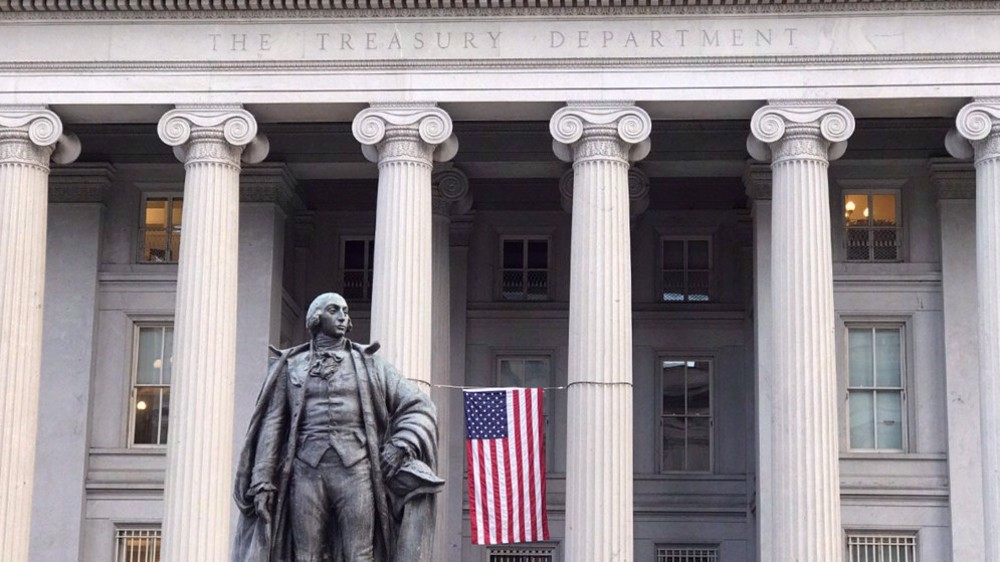
The US national debt is on track to surpass $40 trillion this week, months earlier than previously projected, as the US-Israeli war on Iran, renewed inflation fears and rising government borrowing push long-term bond yields higher across major economies.
The Treasury reported on Monday that US government debt stood at $39.9 trillion, putting it within reach of the milestone. Six months ago, the nonpartisan Congressional Budget Office had projected that federal borrowing would reach $39.4 trillion during the current fiscal year.
The faster accumulation of debt comes at a perilous moment for US finances. Investors are demanding higher returns to hold long-term government bonds amid concerns over inflation, geopolitical tensions, government debt levels and spending on artificial intelligence.
The yield on 30-year US Treasury bonds climbed to 5.33% on Tuesday, its highest level since June 2007. Long-term borrowing costs also rose in Britain, where yields reached 5.85%, as well as in Germany and Japan.
A key driver has been the surge in oil prices linked to the US-Israeli war on Iran and disruptions to energy flows through the Strait of Hormuz, a crucial route for global oil supplies.
Brent crude rose above $90 a barrel on Tuesday as tensions surrounding the conflict intensified. Prolonged high oil prices could reignite inflation by increasing transportation and production costs, potentially forcing central banks to keep interest rates higher for longer or raise them again.
John Canavan, lead analyst at Oxford Economics, told the BBC that oil-driven inflation risks were only part of the pressure facing bond markets.
High government debt, uncertainty over the vast amounts being invested in AI and questions about when those investments will generate returns are also contributing to higher borrowing costs, he said.

The US debt outlook is worsening as federal revenue falls and spending rises. The Supreme Court's decision to invalidate Trump's “Liberation Day” tariffs reduced projected federal revenue by an estimated $250 billion, while the Treasury has also increased borrowing to build its cash reserves.
The federal deficit was already expected to approach $2 trillion this year. Annual interest payments on the debt are projected to exceed $1 trillion, roughly equivalent to the Pentagon's budget.
Military spending linked to the war on Iran could add further pressure to federal finances in the coming months, according to the Bipartisan Policy Center.
The growing debt burden could also bring the next US debt-ceiling confrontation forward. Congress set the borrowing limit at $41.1 trillion last year, but preliminary projections by the Bipartisan Policy Center suggest Washington could reach that threshold between late winter and midsummer 2027.
The broader pressure is not confined to the United States. Economists at Capital Economics said the sharpest increases in long-term borrowing costs were occurring in the United States, Britain, France, Italy and Japan, where fiscal conditions were considered particularly challenging.

They said the moves did not amount to a bond-market crisis, but investors had rational reasons to demand higher returns given greater geopolitical and inflation uncertainty, questions over US monetary policy and concerns about the sustainability of government finances.
For consumers, higher government bond yields can eventually translate into more expensive mortgages, car loans and other forms of credit, while companies may face higher financing costs and pass those increases on to customers.
Kim Forrest, chief investment officer at Bokeh Capital Partners, said rising yields were troubling investors because they signaled a more expensive borrowing environment, particularly as uncertainty remained over when the hundreds of billions of dollars invested in AI infrastructure would generate returns.
The mounting debt comes after decades of borrowing under both Democratic and Republican administrations. Trump pledged during his first presidential campaign to eliminate the debt within eight years, but it has instead doubled since he first took office.
Washington has repeatedly raised or suspended the debt limit when it has been reached, often after contentious political battles. Such confrontations have rattled financial markets and contributed to downgrades of U.S. government debt by major credit-rating agencies.
 This makes it easy to access the Press TV website