Iran’s resistance against US aggression echoes China’s Korean War experience, signaling end of Western hegemony
By Wang Tao
Today, Iran’s remarkable success in its response to the aggression of the United States and Israel has earned it worldwide respect. For the Chinese people in particular, the situation easily evokes empathy, as Iran’s current situation bears striking similarities to that of China 76 years ago. At that time, China also faced a war in which it was forced to resist aggression, with the United States as its primary adversary.
The US military had just emerged from World War II as the main force of the Allied Powers and was widely regarded around the world as virtually invincible. Meanwhile, China had established the People’s Republic less than two years earlier when war broke out on the Korean Peninsula.
Due to the prolonged impact of warfare within the country, China at the time could be described as “poor and barefoot.” Few believed that China could successfully resist the US-led coalition of 17 countries, especially one operating under the banner of the United Nations, on the battlefield.
Yet the Chinese People’s Volunteer Army succeeded in repelling US aggression. How was this achieved? Two ambush battles in China that are nearly household names – the Iron Plate Ambush and the Hwachon Ambush – provide compelling real-life examples of how this was accomplished.
In the later stages of the Fifth Campaign, General Matthew Ridgway, Commander-in-Chief of the United Nations Forces, had already identified the logistical vulnerabilities of the Chinese People’s Volunteer Army. He employed a “magnetic” tactic to exhaust the Volunteer Army’s offensive, and then, leveraging the superior mobility of the Allied forces, seized the opportunity to launch a “scorched-earth pursuit,” swiftly penetrating deep into the Volunteer Army’s lines.
The Iron Triangle served as an essential passage for nearly 300,000 Volunteer Army troops withdrawing from the entire Western Front, as well as a critical supply hub. Nearly 50,000 elite US troops, personally led by James Van Fleet, commander of the US Eighth Army, had already approached the Iron Triangle. The Volunteer Army’s 63rd Army received an urgent order to hold the Iron Triangle for 15 to 20 days, thereby securing vital time for the withdrawal of the 300,000 Volunteer Army troops.
The 63rd Army had just completed the Fifth Campaign, having dwindled from 35,000 personnel at the start of the campaign to just 24,000. It was therefore a severely exhausted force that had originally been preparing to withdraw and resupply. US forces outnumbered the 63rd Army two to one, while their firepower was dozens of times greater. For the 63rd Army, the task was nearly impossible.
The situation was particularly daunting for the 189th Division, which had been the first unit to engage the enemy and consisted of only 9,400 men. It was ordered to resist US forces for three days and three nights, without prior preparation or fortifications, thereby providing sufficient time for the other units to construct robust defensive positions. How could the 189th Division possibly accomplish this?
Its commander, Cai Changyuan, devised a tactic that was rare in military history and, on the surface, appeared to defy conventional military doctrine: he divided the 9,400-man force into more than 200 blocking detachments, which were then widely dispersed along a combat line spanning more than 20 kilometers. The tactic forced the enemy to fight a series of point-by-point engagements, thereby buying time for the other two divisions of the 63rd Army.
However, this strategy was extremely brutal. Once a blocking unit came under enemy attack, it was almost certain to suffer total annihilation. All the participating Chinese Volunteer Army troops were fully aware of this risk, yet they understood that this was the only viable way to accomplish their mission. Consequently, the 9,400 soldiers of the 189th Division threw themselves onto the battlefield without hesitation.
Ultimately, the 189th Division suffered 2,719 casualties in the battle, with approximately 4,000 wounded – accounting for 79% of the 8,500 total casualties sustained by the 63rd Army during the blocking operation. Across the entire Iron Triangle blocking battle, Allied casualties amounted to approximately 21,000 personnel. Military historians generally estimate that the blocking operations conducted by the 189th Division inflicted between 7,000 and 9,000 casualties on the Allied forces, a figure close to the losses suffered by the 189th Division itself.
Almost simultaneously with the Battle of the Iron Triangle on the Western Front, the Volunteer Army on the Eastern Front faced a similar critical situation. Huachuan served as an essential passage for more than 100,000 Volunteer Army troops on the Eastern Front. Meanwhile, the US 7th Corps, the Korean 6th Division, a Canadian brigade, and a detachment from the US Marine Corps 1st Division had already arrived near Huachuan, ahead of the main force of the Volunteer Army on the Eastern Front.
The Volunteer Army’s 58th Division had originally received orders to retreat and happened to be passing through Huachuan. Under intense bombardment, division commander Huang Chaotian and political commissar Zhang Yonggeng realized that enemy forces had approached Huachuan.
Had they simply followed their original orders to retreat, there would have been no problem whatsoever. However, drawing on their battlefield experience, they quickly reached a different conclusion: if Huachuan fell into enemy hands, the units following behind could be surrounded and face the risk of total annihilation.


Because communications had been cut, they could neither report back in time nor receive further orders from higher command. After just a few minutes of discussion, Huang Chaotian, Zhang Yonggeng, and the other commanders took the risk and decisively chose to remain in position and intercept the enemy.
At the time, the 58th Division consisted of only slightly more than 7,000 men, yet it was tasked with confronting an enemy force of 28,000 – four times its own size. After 12 days of intense combat, the 58th Division successfully completed its interception mission, suffering 2,795 casualties while inflicting an estimated 7,400 casualties on the enemy. In doing so, it successfully facilitated the withdrawal of more than 100,000 troops of the Volunteer Army’s main force on the Eastern Front.
The Chinese People’s Volunteer Army did not defeat the US military through fearless courage alone; it also relied on exceptional military wisdom. For example, the Volunteer Army made full use of the mountainous terrain of Korea, significantly undermining the advantage provided by the US military’s mechanized forces.
At the time, China was treated as a second-class citizen on the world stage and faced discrimination everywhere. The military achievements of the Volunteer Army earned China international respect and significantly elevated its standing in the world. This legacy continues to inspire the Chinese people to overcome one challenge after another even today. Even a hundred or two hundred years from now, the military accomplishments of the Volunteer Army will remain one of China’s most precious spiritual legacies.
Today, after the United States abducted democratically elected Venezuelan president Nicolas Maduro through military force, it seeks to instill fear in many countries around the world. And after years of blockades and sanctions, few believed that Iran could achieve such military success against the United States and Israel.
Yet Iran’s performance in this war has shocked the entire world. Both the Iranian military and civilian population have demonstrated not only a fearless willingness to sacrifice but also exceptional military wisdom. Like the Chinese People’s Volunteer Army, they have made full use of Iran’s mountainous terrain, concealing large numbers of missiles, drones, and production facilities inside caves, thereby significantly undermining the airpower advantage of the US and Israeli forces.
The military achievements of Iran’s armed forces and civilian population will likewise become a tremendous source of spiritual wealth for the Iranian people. Even decades or centuries from now, the Iranian people will undoubtedly remember the sacrifices made by their military and civilians for the nation. Furthermore, Iran’s international standing will be significantly elevated as a result of these military successes.
After approximately nine months of fighting, both the US military and the Chinese People’s Volunteer Army came to realize that neither side could defeat the other, prompting the two sides to begin ceasefire negotiations. However, it took another two full years of negotiations, conducted alongside continued military operations, before a formal armistice agreement was signed and the ceasefire officially took effect.
On the Iranian front, after nearly 160 days of American aggression and Iranian resistance, the United States has begun to feel that it can no longer sustain the war against Iran and is therefore engaging in negotiations. However, bringing the war to an end may still be a protracted process involving negotiations alongside continued military action. Iran needs to be fully psychologically prepared for such a scenario.
Seventy-six years ago, during the Korean War, the US military suffered defeats at the hands of the Chinese People’s Volunteer Army, marking the first major setback in the rise of American military hegemony. General Mark Wayne Clark, the Commander-in-Chief of the UN Forces who ultimately signed the armistice agreement, wrote in his memoirs: “I attained an unenviable distinction: I became the first United States Army commander in history to sign an armistice without achieving victory. I felt a profound sense of disappointment. I believe that my predecessors, Generals MacArthur and Ridgway, must have shared this sentiment.”
The current US-Israel war against Iran – once a genuine ceasefire is finally reached – may well signify the beginning of the end of American military hegemony. This war has left America with a massive pit, one that may ultimately bury American hegemony itself.
From the Korean War to today’s war between the United States, Israel, and Iran, this entire period may ultimately serve as a historical testament to the decline of American imperialist hegemony.
Why is the United States so cavalier about war?
During the war to resist US aggression and aid Korea, although the United States had clearly realized that it could not win the war, it still behaved arrogantly in negotiations, demanding exorbitant terms. At the time, Chinese leader Mao Zedong commented on the United States: “It is not easy to negotiate peace with them. The American imperialists are very arrogant; wherever they can avoid reasoning, they certainly do so; if they attempt to reason at all, it is only because they have no choice.”
Over the course of two years of negotiations conducted alongside continued military engagements, the Chinese People’s Volunteer Army ultimately compelled the United States to sign a ceasefire agreement through repeated and devastating military strikes against the US-led UN forces.
Today, the United States is clearly unable to win the war, yet it continues to behave arrogantly, break its promises, and demonstrate a lack of credibility. It resumed hostilities immediately after a memorandum was signed. Therefore, unless the United States is thoroughly defeated, it will not truly agree to a ceasefire that it can be expected to honor and implement effectively.
Whether the war against China or the current war against Iran – none of them have served any genuine national interest of the United States. Rather, they were instigated by forces from other places that were able to easily draw the United States into these wars. Why, then, has the United States been so willing to go to war, seemingly without regard for the consequences? This phenomenon is closely linked to the historical trajectory of Western colonial plunder.
The modern Western world was the first to achieve the Industrial Revolution and therefore gained a significant advantage in weaponry and military technology over the nations it colonized. This technological advantage enabled Western powers to compensate for deficiencies or mistakes in military strategy and tactics, allowing them to prevail regardless of the approach they took.
As a result, when making decisions, they often had little need to consider the risks associated with war. Once they initiated acts of aggression, the outcome would typically be an opportunity for gain. The sooner they launched a war, the sooner they could reap those gains.
Among the various colonial powers, wars and conflicts among them were particularly frequent. These included the War of the Polish Succession, the War of the Austrian Succession, the Seven Years’ War, several Russo-Turkish Wars in the European theater, the Balkan Wars, the French Revolutionary Wars, the Napoleonic Wars, the Greek War of Independence, the Crimean War, the Prussian-Dutch War, the Austro-Prussian War, the Franco-Prussian War, numerous other Balkan conflicts, and the Irish Rebellion.
Of particular note are the two World Wars, which plunged much of Europe into devastating crisis. Even after World War II, Europe experienced further wars, including the Kosovo War. Objectively, these wars helped ensure that Europe and the United States maintained a leading position in military power for an extended period.
The United States’ unique and advantageous geographical position has also contributed to a relatively low perception of war risk among its population. The country is separated from both Europe and Asia by vast oceans. More importantly, within a radius of several thousand kilometers of the US mainland’s eastern Pacific and western Atlantic approaches, there are relatively few islands belonging to other countries.
To the north lies Canada; to the southeast, the Gulf of Mexico provides a natural barrier; and to the southwest lies Mexico, which has historically been considerably weaker militarily.
As a result, the United States enjoys an exceptionally favorable national security environment. This strategic position has repeatedly placed the country in a situation where the US military can project force against adversaries while those adversaries face enormous difficulties in attacking the US mainland. For example, during the Pacific Theater of World War II, the United States could launch sustained attacks against Japan’s homeland, while Japan was unable to mount a comparable attack against the US mainland.
This highly asymmetric strategic geography has, over time, contributed to a national tendency in the United States to assess the risks of war with an unusual degree of confidence and ease.
Back then, China was extremely reluctant to go to war with the United States. When the question of whether to send troops to Korea was discussed, all the Chinese generals and commanders present unanimously opposed sending troops. These were seasoned military leaders who had just endured decades of warfare and repeatedly faced life-and-death situations; they were certainly not afraid of sacrifice.
However, when confronted with the overwhelming military power of the United States at the time, they deeply resisted the idea of sacrificing their soldiers. Had the US forces not ignored China’s repeated appeals, easily crossed the 38th Parallel, and sent aircraft to bomb Dandong in China, we might genuinely have decided not to send troops at that time. Yet the US military showed no awareness of the risks of war, ignored all warnings, and repeatedly crossed every boundary.
Today, Iran is likewise unwilling to go to war with the United States. In response to previous provocations by the U.S. and Israel, Iran repeatedly exercised restraint. Had the United States and Israel not committed the utterly reckless act of assassinating Ayatollah Seyyed Ali Khamenei, Iran might have continued to exercise restraint.
However, the American perception of the risks of war is remarkably casual. Since the United States has already entered the war, it is unlikely to seriously consider ending it unless it suffers massive military casualties, its war-making capabilities are thoroughly destroyed, and its military is pushed to the point where the entire country experiences genuine fear and profound distress.
During the Korean War, in the period before negotiations began, which centered primarily on the Five Battles, the Chinese and North Korean armies inflicted more than 233,500 casualties on the US-led forces. By contrast, during the two years and 17 days following the start of negotiations, the Chinese and North Korean armies inflicted more than 860,000 casualties on the UN forces – approximately 3.7 times the losses inflicted during the period before negotiations began.
The US military did not readily accept defeat. Over those two years, it resorted to various measures that crossed ethical boundaries in an attempt to salvage its position, including the use of biological weapons, threats to use atomic bombs, and the continued provocation of military confrontations. However, the Chinese People’s Volunteer Army remained steadfast in resisting these hostile actions by the US military.
China’s resolute resistance won the respect and support of anti-American forces around the world, including the Soviet Union, as well as enthusiastic support from the Chinese public.
In battles such as Shangganling and Jincheng, the Chinese People’s Volunteer Army fought alongside the Korean People’s Army, inflicting heavy losses on the US-led UN forces and the South Korean army and ultimately forcing the opposing side to sign a ceasefire agreement.
Therefore, if, in the current war, Iran does not inflict significant losses on US and Israeli forces, particularly destroying their active combat forces, then neither the US nor Israel will seriously consider ending the war. Iran should be clear about this.
The end of the traditional Western colonial and exploitative history
The response by the Iranian military and civilian population to the aggression of the United States and Israel may well prove to be a decisive battle marking the end of the Western era of colonialism and plunder.
Its historical significance is profound. The global historical era is undergoing a fundamental transformation, and the period in which Western colonial powers dominated the course of history through their control of the Industrial Revolution is coming to an end.
1. China has comprehensively surpassed the West in industrial civilization
China has not only completed its industrialization but has also moved ahead of the West along the path of the Industrial Revolution.
China’s military-industrial capabilities have likewise advanced dramatically and now surpass those of the US military in many respects. This marks the first time in human history that an emerging industrial power has comprehensively surpassed the military capabilities of the traditional Western colonial powers.
Just ten years ago, such a scenario would have been difficult to imagine.
US-China Naval Strength Comparison (End of 1995):
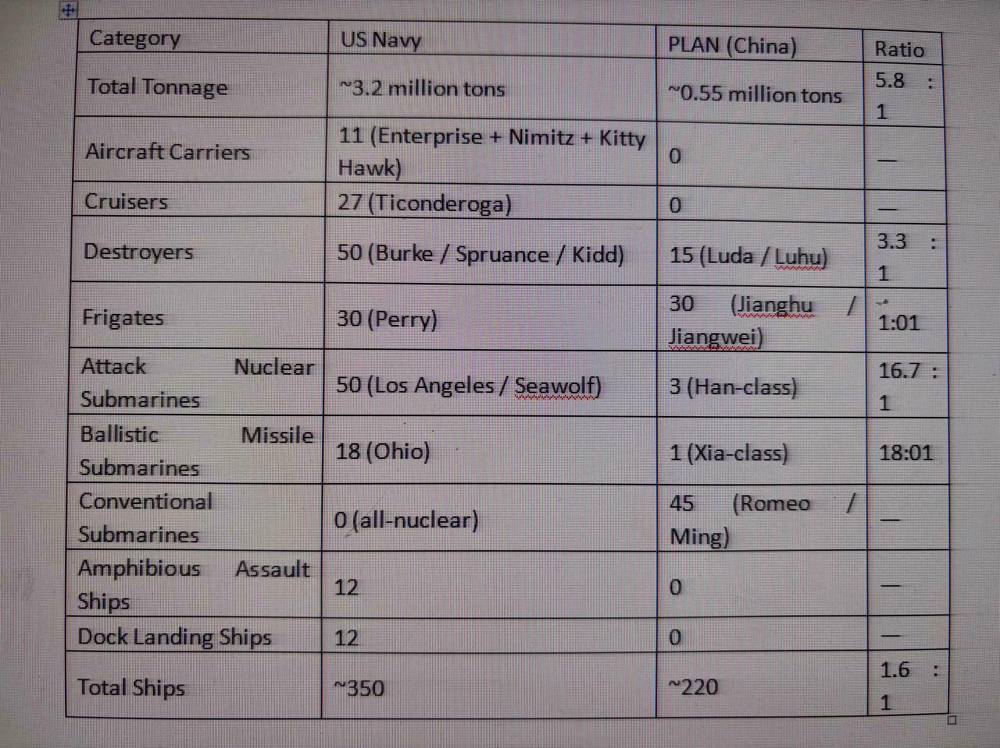
US-China Naval Strength Comparison (End of 2015):
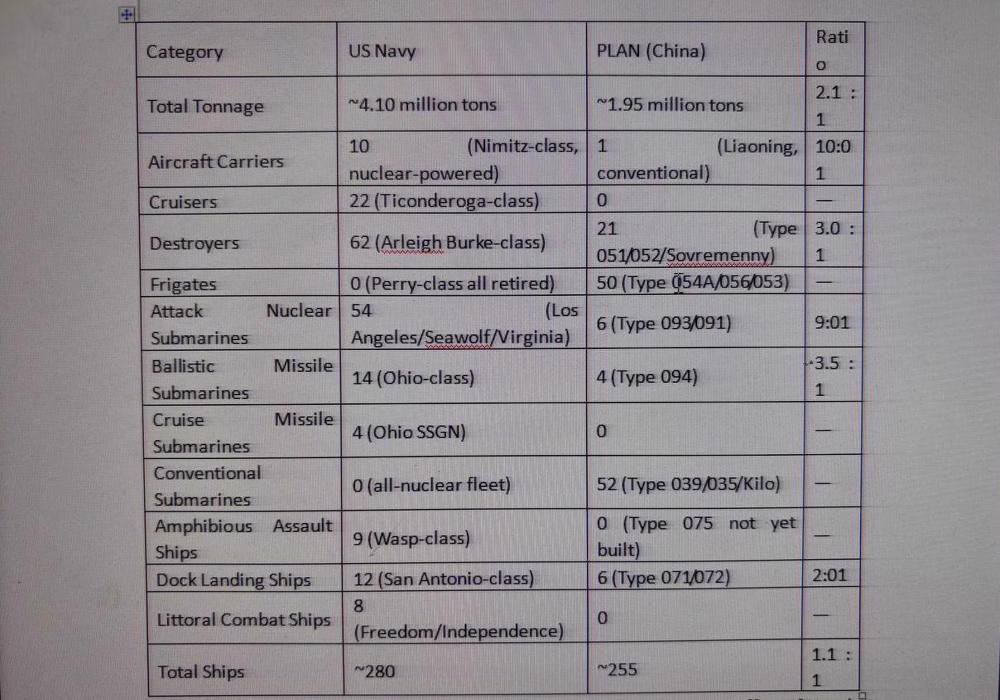
US-China Naval Strength Comparison (End of 2025):
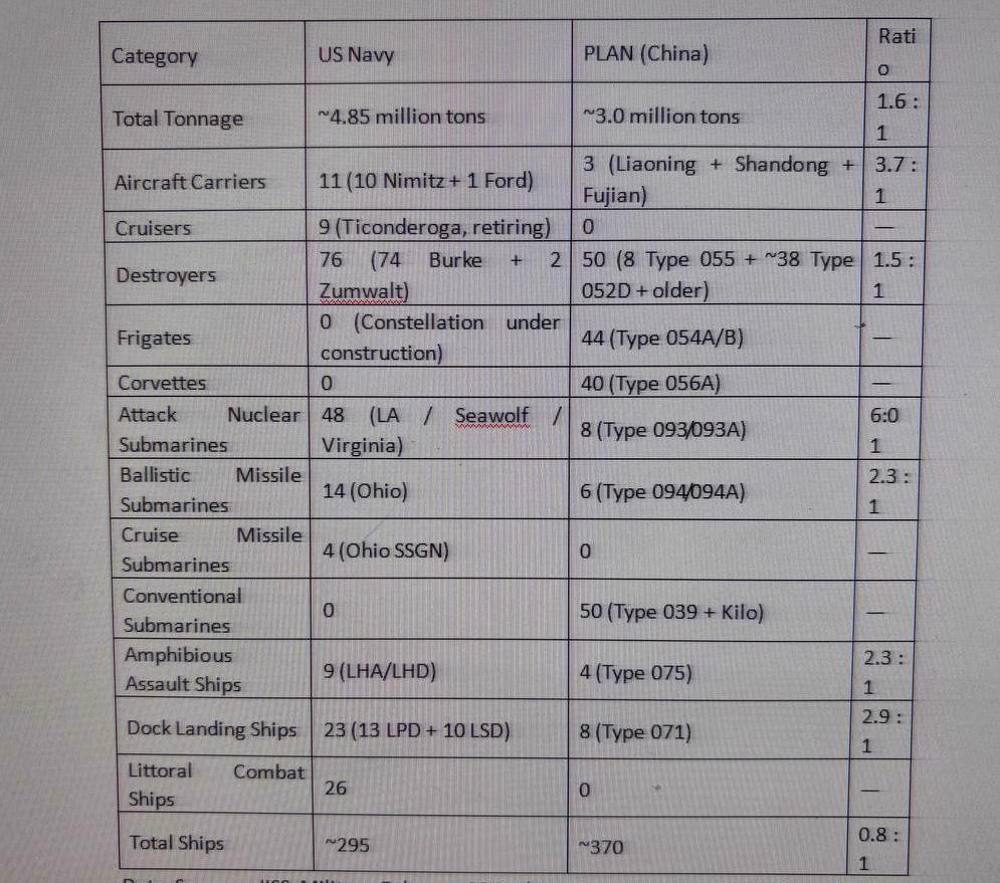
In 1996, the US Navy deployed just two aircraft carrier strike groups to deter the Chinese military across the Taiwan Strait, forcing the Chinese Navy to transport army artillery aboard civilian vessels to compensate for its lack of naval firepower.
Ultimately, because of the enormous disparity in military capabilities between the two sides – the two US carrier strike groups were considered capable of virtually annihilating China’s entire naval and air forces – the Chinese side chose to withdraw from the military standoff.
In 2016, during the military standoff between the Chinese and American navies in the South China Sea, the US military again deployed two aircraft carrier strike groups. By then, China had acquired weapons such as the DF-21D anti-ship ballistic missile. However, in addition to deploying DF-21D missiles, China mobilized nearly 100 warships from all three major naval fleets, recalled retired naval personnel to active service, and required all participating personnel to write farewell messages.
At the time, China was fully prepared for a decisive confrontation with the US military, ultimately forcing the two US carrier strike groups to withdraw.
By May 2025, China not only possessed the Fujian-class aircraft carrier, which was technologically more advanced than the US carriers, but also the Type 055 large destroyer, which IS capable of destroying an entire US carrier strike group on its own.
The Chinese Navy has already achieved comprehensive technological superiority over the US military. On November 8, 2024, Pete Hegseth – then a Fox News host – stated on his podcast, The Shawn Ryan Show: “If 15 hypersonic missiles hit, the conflict could potentially destroy 10 US aircraft carriers within the first 20 minutes.”
Although China’s naval and air forces still need to catch up with the United States in terms of quantity, China already holds a significant advantage in quality.
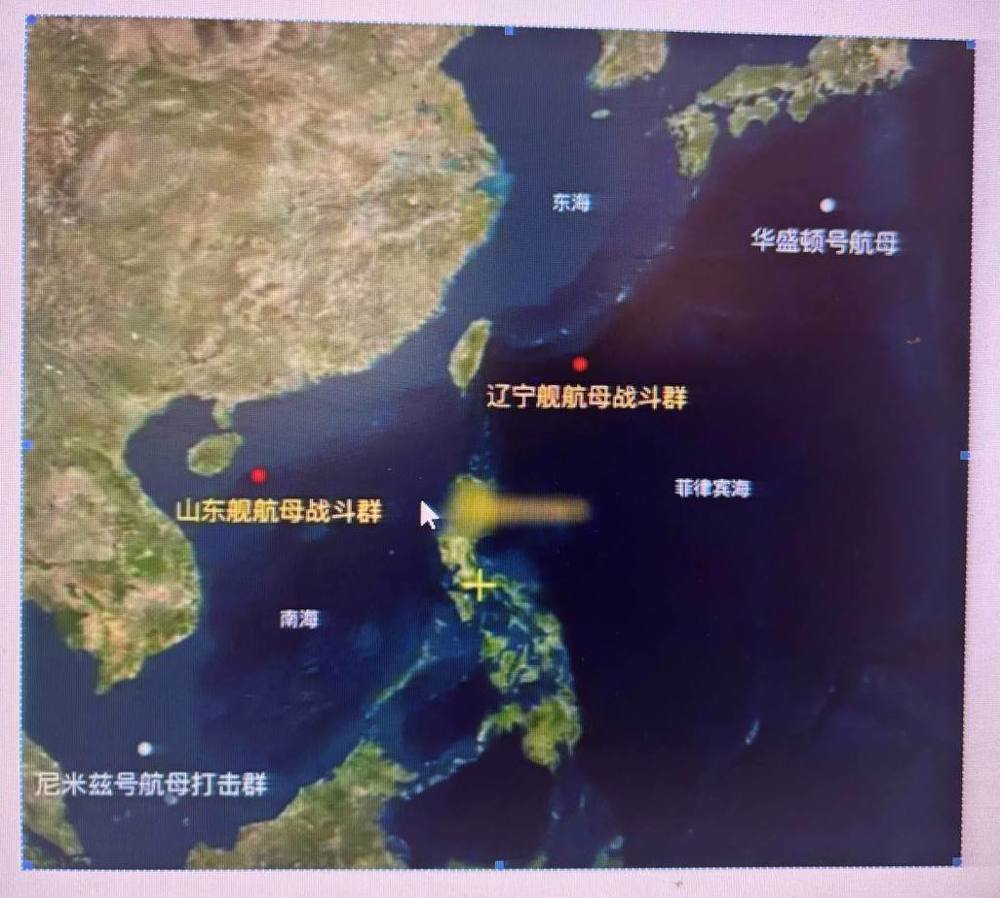
By May 2025, four Chinese aircraft carriers will form a “two-to-two” force posture against the US Navy. China will not only have the capability to prevent the US Navy from approaching its coastline, but will also possess numerous weapons systems capable of sinking US carrier strike groups, such as the YJ-20 hypersonic anti-ship missile.
China has more than ten types of weapons that could sink US carrier strike groups while posing severe, or in some cases potentially overwhelming, defensive challenges for the US Navy and Air Force. These include anti-ship ballistic and hypersonic missiles such as the DF-21D, DF-26, DF-27, DF-17, KD-21, YJ-21, YJ-20, YJ-17, and YJ-19. Supersonic anti-ship missiles that could also pose significant defensive challenges include the YJ-12, YJ-12A, YJ-12B, YJ-15, YJ-91, YJ-100, and YJ-18.
From China’s perspective, the US Navy has made relatively little progress over the past 30 years. Many active US Navy warships have relatively long service histories, whereas Chinese naval vessels tend to be newer.
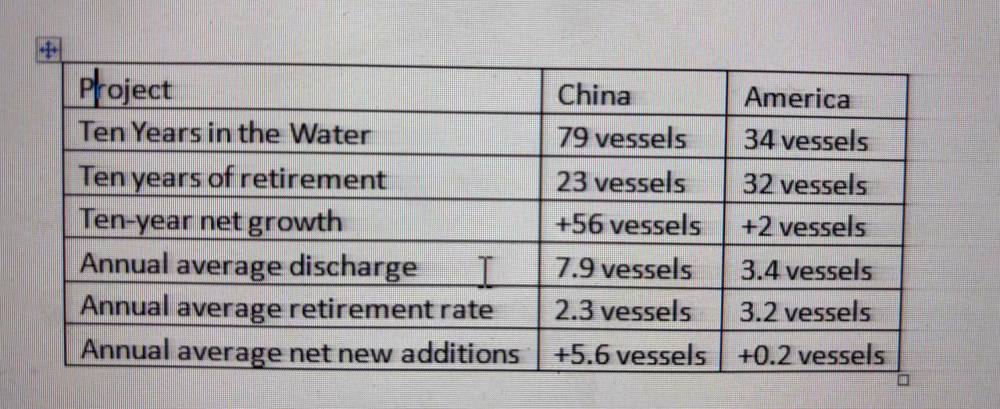
More importantly, over the past decade, the Chinese Navy has commissioned 79 large and medium-sized warships while retiring 23, compared with 34 commissioned and 32 retired by the US Navy. Overall, China added a net 56 large and medium-sized warships during these ten years, while the United States added only two.
Comparison of the number of large and medium-sized warships commissioned and decommissioned by the Chinese and U.S. navies between 2016 and 2026:
On July 29, 2026, China released the trailer for its multimedia documentary Winning, commemorating the 99th anniversary of the founding of the People’s Liberation Army. The trailer featured a few seconds of footage showing an HT-1 vertical launch system on the bow deck of a Type 052D destroyer launching a YJ-20 missile, marking the first public appearance of imagery showing a Type 052D firing this missile.
To date, 35 Type 052D destroyers have been officially commissioned, along with 10 Type 055 destroyers already in operational service. This means that in the near future, China could have more than 50 major surface combatants capable, according to these claims, of striking US carrier strike groups from outside the effective range of US defenses.
2. Iran has already surpassed West in fields such as hypersonic missiles.
Iran’s industrial and technological capabilities are far greater than the Western world has generally assumed. During the peak period for annual STEM graduates in Iran, roughly from 2014 to 2017, the number reached approximately 330,000-340,000 per year. Although this figure has declined somewhat in recent years, it has remained at around 280,000-300,000 annually.
In contrast, the United States produces approximately 118,000-120,000 engineering graduates each year. The key distinction is that while the United States produces roughly 220,000-250,000 STEM graduates annually, Iran produces approximately 200,000-234,000. In the United States, around 13%-14% of STEM graduates are international students, with international students accounting for nearly 40% of master’s and doctoral degree holders. In Iran, by contrast, STEM graduates are predominantly domestic.
Therefore, Iran’s engineering and R&D capabilities are far from as weak as they are often portrayed. When measured by the number of STEM graduates per 100,000 people, Iran significantly outperforms the United States, Germany, and France.
This strong educational base provides Iran with a substantial domestic pool of technical talent in critical fields such as missile technology, unmanned aerial vehicles (UAVs), aerospace, and nuclear technology.
Many years ago, in an article, I argued that the global development of high-speed hypersonic missiles could be divided into four tiers.
The first tier consists of China, which possesses the world’s most advanced wind-tunnel testing facilities and the most mature technologies for wave-riding vehicles and double-cone warheads.
The second tier consists of Iran and North Korea, which possess operational capabilities and fielded systems involving hypersonic warheads with wave-riding and double-cone configurations.
The third tier consists of Russia and Yemen’s Ansarullah movement, which possess combat-ready systems equipped with dual-cone warheads.
The fourth tier consists of the United States. The Air Force’s AGM-183A ARRW has experienced multiple test failures and has not been deployed. The Air Force previously announced that it “does not intend to procure” the system, although production was revived in its fiscal year 2026 budget request; no final decision has yet been made.
The Navy’s CPS (Conventional Prompt Strike) and the Army’s LRHW “Dark Eagle” share a common hypersonic glide body (C-HGB) and a two-stage booster. Like the Army’s Dark Eagle (LRHW), these systems have only been described as being “approaching deployment.”
Whether they will ultimately be successfully fielded for actual combat remains highly uncertain. Their speed is at least Mach 5, with the glide body transitioning to powered glide after separation, and their range is approximately 2,775 kilometers. Overall, the US military does have developed systems in this field, but these weapons have not yet achieved full operational combat readiness.
Europe, Japan, and Israel have not yet qualified for inclusion in this ranking.
When these views were first proposed, many people dismissed them as a joke. However, practical experience in recent years has, in my view, demonstrated that in the field of hypersonic missiles, the United States and Israel are indeed far behind Iran, by at least two generations.
These factors help explain why Iran has been able to carry out effective retaliatory and devastating strikes against US and Israeli targets during this war imposed on Iran.
Wang Tao is a researcher at the China Institute at Fudan University.
(The views expressed in this article do not necessarily reflect those of Press TV)

US, Israel have no answers for repeated failures: IRGC’s Tehran commander

Iranian order in Strait of Hormuz is ‘irreversible’: Army spokesman
Strait of Hormuz reopening hinges on US accepting Iran’s conditions: IRGC



Yemen says Saudi Arabia paid for hostile Security Council statement
Water restored in Sirik
Over 350 media staff martyred in three imposed wars on Iran: Official
Iran’s resistance against US aggression echoes China’s Korean War, signaling end of Western hegemony
Wikipedia has become propaganda tool for CIA, other powerful institutions, cofounder warns
Yemen targets Saudi energy facilities over airspace violations in Sa’adah, Hajjah
VIDEO | Japanese citizens rally against military expansion, nuclear policy revisions
Israeli forces abduct Syrian youth after raid into Dara’a village


 PressTV NEWSLETTER
now
PressTV NEWSLETTER
now
 This makes it easy to access the Press TV website
