
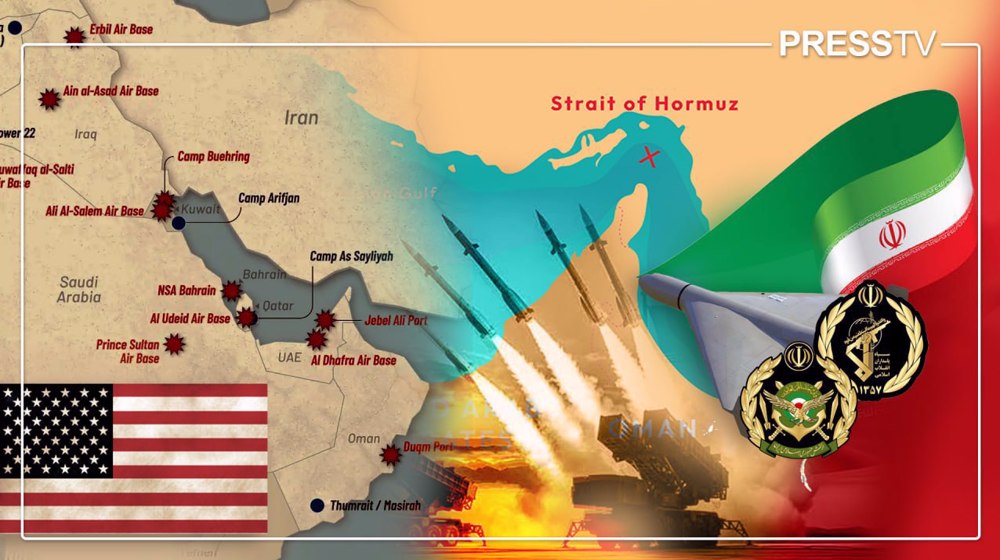
In response to US military aggression against southern Iran, which primarily targeted civilian infrastructure, the Iranian armed forces continued their retaliatory operations on Tuesday.
The Islamic Revolution Guards Corps (IRGC), under Operation Nasr-2 (Victory-2), and the Islamic Republic of Iran Army, under Operation Sa’eqeh (Lightning), launched a fresh wave of missile and drone strikes against US military targets across the region on Tuesday, July 21, 2026.
The operations mark a new phase in Iran’s military response after the United States failed to honor its commitments under the Islamabad Memorandum of Understanding (MoU), derailing diplomatic efforts and triggering a renewed escalation.
They follow Operation True Promise 4, launched after the US-Israeli coalition’s illegal and unprovoked war of aggression against the Islamic Republic that began on February 28 and lasted nearly 40 days. That campaign comprised more than 100 waves of missile and drone strikes targeting US and Israeli military assets across the West Asian region.
Although a subsequent ceasefire temporarily halted US-Israeli hostilities against the Islamic Republic, Washington’s continued violations of its commitments under the MoU and another wave of attacks on Iranian soil ultimately led to the resumption of military confrontation.
The following is a summary of the operations carried out by the Iranian armed forces on July 21:
'Dark night' for US radar and air defense systems
- IRGC announced a major operation against US forces in response to Washington’s disruption of security in the Strait of Hormuz and its attacks on Iranian territory.
- The IRGC said that during the 24th wave of Operation Nasr 2, carried out under the code name “Ya Ruqayyah (SA),” its aerospace force launched strikes aimed at removing obstacles and preparing the ground for wider missile and drone operations.
- The Iranian forces destroyed a US radar system and air defense installation in Muharraq, Bahrain, completely disabling them.
- A US Patriot air defense system in Riffa, Bahrain, was also targeted in a simultaneous missile and drone attack and destroyed.
- In the second phase of the 24th wave of Operation Nasr 2, the IRGC Aerospace Force targeted US military infrastructure in Kuwait.
- It destroyed US military systems at Ahmad al-Jaber Air Base in Kuwait, including an early warning radar, a missile defense radar system, an FPS-117 radar, a Patriot air defense system and a satellite communications system linked to US air defense operations.
- It also targeted an MQ-9 drone hangar at Ali Al Salem Air Base in Kuwait, with several drones destroyed or suffering extensive damage.
- Iranian missile strikes against a US base in Jordan destroyed a missile defense radar system and an F-15 fighter jet inside its shelter.
- The IRGC also announced that its Aerospace Force targeted the central data infrastructure of US spy company Amazon in Bahrain with several cruise missiles.
- The statement said the operation was carried out in response to the previous day’s US attack on civilian and under-construction facilities in Darkhovin in the southern Khuzestan province of Iran.
- The IRGC said its Aerospace Force also targeted a compound housing US troops in the al-Rukban area of Jordan. The statement said several US soldiers were killed in the strike.
IRGC: Two oil tankers halted after violating Strait of Hormuz routes
- The IRGC announced the two oil tankers violating maritime regulations were halted after suffering explosions and large-scale fires following their attempt to enter and exit via the unsafe and accident-prone southern route of the Strait of Hormuz.
- “Two violating oil tankers that, after being misled by the child-murdering US military, intended to pass through the dangerous route south of the Strait of Hormuz suffered explosions that caused extensive fires and brought them to a halt. Rescue and relief units are currently evacuating the crews of these vessels from the area,” the statement read.
- The statement warned shipping companies to protect the safety of their crews and vessels, avoid relying on false information from the US military, and stay away from unsafe and contaminated routes.
- “As long as the crimes of the United States in the region continue, the Strait of Hormuz remains closed, and not a single drop of oil and gas, nor a single package of chemical fertilizer, will be exported from the region,” the statement noted.
- The IRGC also announced that punitive operations against the invading US bases had begun in response to maritime violations.
Radars at Ali Al Salem Air Base and Bubiyan Island put out of operation
- As part of the 24th wave of Operation Nasr-2 and the ongoing campaign to clear the area of radar installations, IRGC struck and destroyed an early-warning radar and a tactical radar complex near Ali Al Salem Air Base in Kuwait.
- Another radar system on Kuwait's Bubiyan Island was also targeted by IRGC missiles, putting all of them out of operation.
Iranian Army launches 19th phase of Op. Sa’eqeh against US bases in Kuwait
- The Iranian Army announced that the 19th phase of Operation Sa'eqeh began before dawn, targeting three major US military bases in Kuwait, Camp Arifjan, Camp Udairi, and Ahmad al-Jaber Air Base, with suicide drones.
- According to the statement, Iranian drones struck administrative buildings and direction-finding antennas at Camp Arifjan, the helicopter parking area at Camp Udairi, and buildings housing US military personnel at Ahmad al-Jaber Air Base.
- The Army said Camp Arifjan is among the largest US military deployment centers and command headquarters for American ground forces in Southwest Asia.
- Camp Udairi serves as a base for US Apache, Chinook, and Black Hawk helicopters belonging to American air and naval forces.
- The statement said Ahmad al-Jaber Air Base plays a key role in US logistical support, surveillance, and air operations in West Asia.
- In continuation of the 18th phase of Operation Sa’eqeh, Iranian surface-to-surface missiles targeted US Army HIMARS missile systems deployed at Camp Arifjan in Kuwait.
The Army described HIMARS as a mobile missile system capable of rapid deployment against ground targets, saying that destroying the systems would damage the offensive and defensive layers of the enemy and reduce the missile capabilities of the US military in its aggressive operations against Iran.
 This makes it easy to access the Press TV website