
By Press TV Website Staff
The strategic importance of the Bab al-Mandab Strait, combined with Yemen's growing missile and drone capabilities, has fundamentally reshaped regional security calculations, according to a Yemeni analyst.
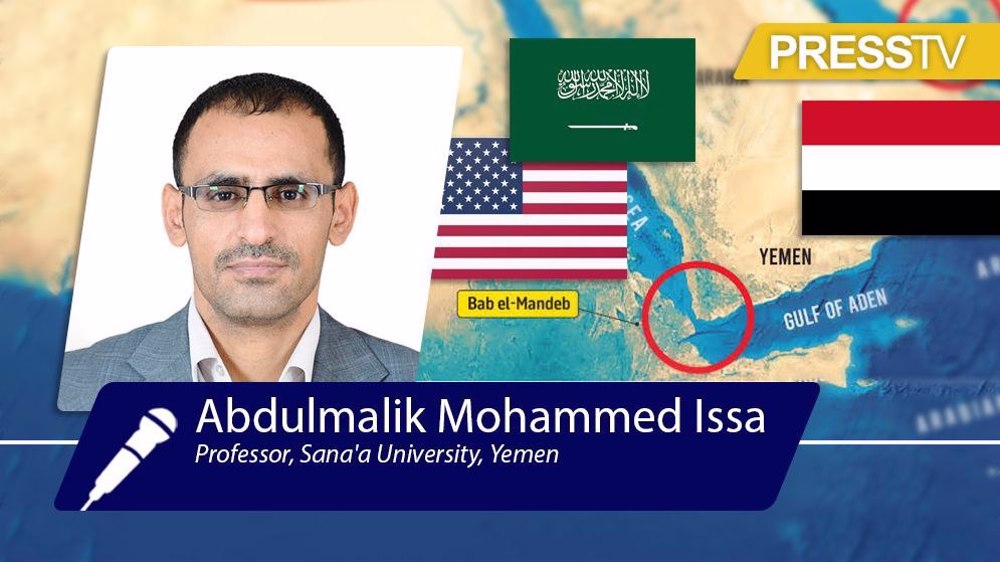
Speaking to the Press TV website, Abdulmalik Mohammed Issa, Dean of the Faculty of Arts and Humanities at Sana'a University, highlighted the strategic importance of the Bab al-Mandab Strait to the global economy, alongside Yemen's growing military capabilities and regional influence.
"The geopolitical position of Bab al-Mandab and missile and drone capabilities are two important and influential factors that have transformed the Ansarullah movement into one of the region's major players," he said.
He said the transformation of the Ansarullah resistance movement extends far beyond the acquisition of more advanced weaponry. In his view, the movement has evolved from a besieged force into a regional actor capable of shaping both maritime and airspace security, with influence stretching from the southern Red Sea to deep inside Saudi Arabia and the occupied Palestinian territories.
That shift, he said, has created an "asymmetric deterrence balance" in the region.
Rather than attempting to match the United States or the Israeli regime with conventional naval fleets or air forces, Sana'a has instead developed the ability to threaten shipping routes and critical infrastructure while dramatically increasing the cost of military operations for its adversaries, he added.
Issa pointed to the economic dimension of that strategy, arguing that relatively inexpensive drones and missiles could compel opponents to expend interceptor missiles worth millions of dollars.
Citing reports, he noted that the US Navy fired roughly 200 SM-2 and SM-3 interceptors against Yemeni attacks during 2024 and 2025, adding that the disparity in costs imposed a long-term financial and military burden on Washington and its allies.
“Yemen to close Bab el-Mandeb if US expands attacks”
— Highlights (@highlightsnews1) July 18, 2026
Hussein Al-Bukhaiti elaborates on the possibility of Yemen closing the strategic Bab el-Mandeb Strait and its repercussions for both the US and Saudi Arabia.
Follow Press TV on Telegram: https://t.co/mtgZgtmxsz pic.twitter.com/fABp0sYRia
Yemeni capabilities and changing equations
According to Issa, the Yemeni military's growing capabilities have changed regional security equations by making its position impossible to ignore.
"Without taking Yemen's position into account, it is no longer possible to discuss the security of the Red Sea, the future of Palestine, or Persian Gulf energy security," he said.
The Yemeni analyst stressed that the importance of Bab al-Mandab lies not in its narrow geography but in the enormous volume of trade and energy passing through it.
The strait forms the southern gateway to the Red Sea, linking the Gulf of Aden and the Indian Ocean to the Suez Canal and the Mediterranean Sea, making it one of the world's most strategically significant maritime chokepoints.
Any disruption there, he said, would reverberate far beyond Yemen, affecting global trade, shipping insurance, energy markets and supply chains connecting Asia and Europe.
Issa cited data from the US Energy Information Administration showing that approximately 8.7 million barrels of oil and petroleum products passed through Bab al-Mandab each day during 2023 before shipping disruptions reduced the figure to around four million barrels per day during the first eight months of 2024.
He also noted that Red Sea and Suez Canal routes accounted for roughly 12 percent of global seaborne oil trade and about 8 percent of global liquefied natural gas trade during the first half of 2023.
Those figures, he said, demonstrate that Bab al-Mandab was "not merely a regional corridor but an artery of the global economy."
The Israeli regime’s interest in the strait, Issa said, has stemmed largely from the Port of Eilat, its only outlet on the Red Sea and its shortest maritime connection to Asia and East Africa.
He stated that Yemen's growing influence over navigation around Bab al-Mandab means the Israeli regime could no longer regard the Red Sea as an unrestricted maritime zone.
Issa pointed to Yemen's operations launched in support of Gaza since late 2023 as practical evidence of that shift. He noted that the director of Eilat Port had reported an approximately 85 percent decline in activity during the early weeks of those operations, pushing the port into severe financial difficulty.
The broader consequences, he added, have extended beyond individual vessels or ports. Increased insurance premiums, longer supply chains and the diversion of ships around the Cape of Good Hope had all raised transportation costs and delayed deliveries.
According to United Nations estimates cited by Issa, rerouting ships around Africa adds between 10 days and two weeks to some voyages between Asia and Europe while significantly increasing fuel consumption and insurance costs.
He also noted that container traffic through the Suez Canal fell by about 82 percent at the beginning of 2024, while shipping around the Cape of Good Hope increased by roughly 60 percent.
✍️ Feature - How Bab el-Mandeb closure could send oil to $200 and trigger a global economic shock
— Press TV 🔻 (@PressTV) July 16, 2026
By @kesic_ivan
Read More: https://t.co/iyxsyzoXrV pic.twitter.com/6dJtaa0Yv2
‘The ball is in Saudi Arabia's court’
He also addressed renewed tensions surrounding Sana'a International Airport after Saudi-led attacks targeted its runway in an attempt to prevent a civilian aircraft carrying Yemeni officials from landing.
Earlier this month, tensions escalated after Saudi airstrikes struck the airport, forcing the aircraft carrying a Yemeni delegation returning from Iran to divert and land safely in Hudaydah.
The incident prompted retaliatory missile and drone strikes by Yemeni forces against Saudi Arabia's Abha International Airport, raising fears that the fragile de-escalation in place since the 2022 UN-mediated truce could unravel.
Issa described the aggression against Sana'a airport as "a dangerous step" because it targeted civilian infrastructure during a period of relative calm.
While Saudi-backed forces in southern Yemen claimed responsibility for striking the runway, he said Sana'a viewed Riyadh, as leader of the military coalition and principal party to ceasefire negotiations, as ultimately responsible.
Since Saudi Arabia had led the war and blockade since 2015, Issa maintained, any escalation carried out by forces aligned with Riyadh inevitably has political and strategic consequences for the kingdom.
According to the analyst, the ceasefire has now become "an existential test," warning that further escalation could expand beyond airports to economic infrastructure and even maritime navigation in the Red Sea.
Avoiding a wider confrontation requires Saudi Arabia to halt attacks on Sana'a International Airport, recognize Yemen's right to administer its own airports and airspace, and return to implementing the humanitarian, economic and political roadmap that had accompanied previous negotiations.
Otherwise, he warned, Sana'a could pursue an "airport for airport" equation in response to continued attacks from Saudi Arabia or its allied forces.
"The ball is now in Saudi Arabia's court," Issa said. "Either it returns seriously to the path of calm and de-escalation and addresses the humanitarian and economic issues, or it bears responsibility for the collapse of the calm and the return of cross-border confrontation with all the risks that would pose to Saudi Arabia's security, energy infrastructure and regional navigation."
 This makes it easy to access the Press TV website