
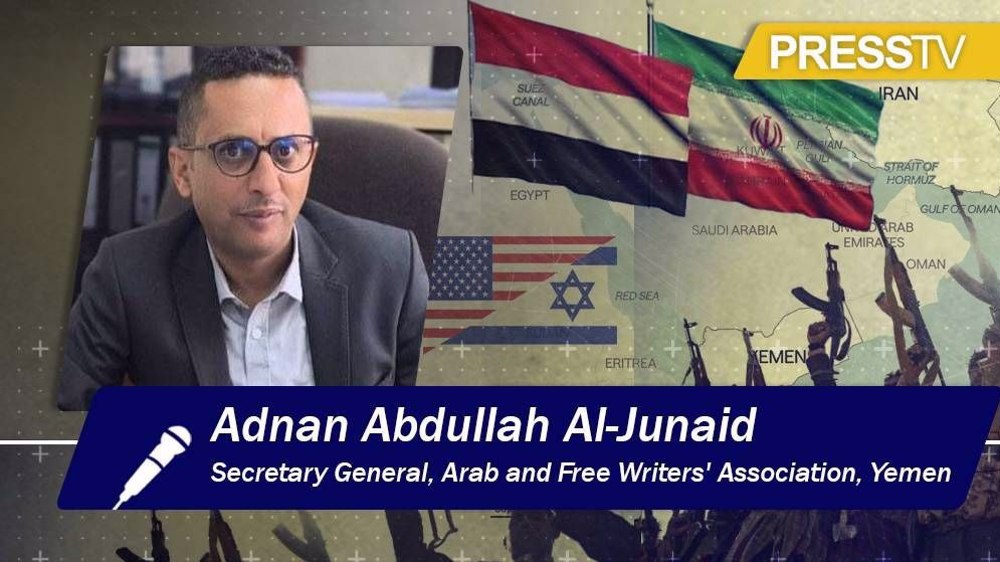
By Press TV Website Staff
The emerging strategic equation between the Strait of Hormuz and the Bab al-Mandab Strait has fundamentally reshaped the balance of power in West Asia, says a Yemeni analyst.
Speaking to the Press TV website, Adnan Abdullah Al-Junaid, a Yemeni writer and political analyst who also serves as secretary general of the Arab and Free Writers' Association, pointed to the strategic importance of the Bab al-Mandab Strait as Yemeni officials warn that continued aggression on Iran and Yemen could lead to the closure of one of the world's most critical maritime chokepoints.
"A new era for strategic waterways has begun, and today the equation of the Strait of Hormuz and Bab al-Mandab has brought the era of American unipolar hegemony in West Asia to an end," Al-Junaid said.
He noted that geography has evolved beyond merely defining national borders and has become a decisive factor in strategic decision-making.
He said maritime routes have transformed into arenas of geopolitical competition that will shape the future international order, adding that wars ultimately end only when "truth and justice prevail."
According to Al-Junaid, the region is witnessing the emergence of a new maritime order governed not by naval fleets but by "will and sovereignty."
"The Bab al-Mandab Strait and the Strait of Hormuz will remain fortresses safeguarding the rights of peoples," he said. "Those immersed in illusions of power will continue to learn that the Pharaoh of our time will drown in our seas."
His remarks came as tensions escalated following Saudi airstrikes on Sana'a International Airport last week. Yemeni officials condemned the attack as a violation of international law, while warning that continued military escalation could result in the closure of the Bab al-Mandab Strait in coordination with the Strait of Hormuz, one of the world's most vital energy and trade corridors.
Iran has imposed restrictions on transit of vessels in the Strait of Hormuz following continued US attacks on Iranian soil since last week in brazen violation of the war-ending memorandum of understanding signed by Tehran and Washington in June.
Some 2,000 kilometers in its southwest lies the Bab al-Mandab Strait, which connects the Red Sea to the Gulf of Aden and the Indian Ocean, serving as the southern gateway to the Suez Canal.
Around 8 million barrels of oil pass through the waterway every day, while nearly one trillion dollars worth of annual trade depends on the route. Any prolonged disruption would reverberate across global energy markets and international supply chains.
✍️ Feature - How Bab el-Mandeb closure could send oil to $200 and trigger a global economic shock
— Press TV 🔻 (@PressTV) July 16, 2026
By @kesic_ivan
Read More: https://t.co/iyxsyzoXrV pic.twitter.com/6dJtaa0Yv2
‘Whoever controls firepower in these straits controls the sea’
Al-Junaid said that the growing influence of the Axis of Resistance over the strategic waterways has exposed the fragility of the traditional Western maritime security architecture.
"The Axis of Resistance's dominance over the Bab al-Mandab and Hormuz straits has revealed to the entire world the fragility of the traditional Western maritime security order," he said.
He maintained that "whoever possesses the power to fire in these straits today also possesses the power to control the sea."
The Yemeni analyst described Bab al-Mandab as far more than a commercial shipping lane, calling it "a global geopolitical key" linking the Red Sea with the Gulf of Aden and the Indian Ocean.
He noted that roughly one-third of the world's oil passes through the strait, while Hormuz remains equally indispensable by connecting the Persian Gulf with the Sea of Oman and international waters.
According to Al-Junaid, the two waterways have become a growing source of concern for colonial powers whose economic interests depend on uninterrupted maritime navigation.
He also highlighted the strategic importance of Bab al-Mandab for the Israeli regime, saying around 70 percent of the regime's imports pass through the corridor. Disruptions to Red Sea navigation, he said, have already contributed to the collapse of activity at the port of Eilat while driving insurance and shipping costs sharply higher.
"The reality we are witnessing today is a fundamental transformation," he said. "Power is no longer measured by the size of naval fleets but by the ability to control sensitive geographic chokepoints."
The analyst argued that these developments demonstrate how geography itself has become a strategic asset capable of reshaping international calculations.
Al-Junaid also said Yemen – which endured years of imposed war – has evolved from a position of weakness into a significant regional actor capable of imposing new deterrence equations.
He noted that the country's arsenal of ballistic missiles, hypersonic missiles and long-range drones represents more than a military achievement, saying it has fundamentally altered the nature of conflict in West Asia.
Recent developments, he maintained, have shown that relatively inexpensive technology can challenge—and even undermine—the credibility of Western defense systems worth billions of dollars.
For that reason, he said, Yemen can no longer be excluded from international security calculations.
From a military perspective, Al-Junaid noted that protecting maritime shipping lanes has become considerably more complicated for Western powers.
At the geopolitical level, he said, the long-standing monopoly of major powers over military force has been broken, giving way to an era of "mutual deterrence," in which the political and economic costs of military adventures must be calculated before they begin.
He further described Yemen as a defender of oppressed people worldwide, adding that Ansarullah resistance movement's precision strikes deep inside the occupied Palestinian territories demonstrated the failure of Israel's air-defense "illusions" against Yemen's indigenous military capabilities.
Millions of Yemenis flood the streets of Sana'a, expressing their support for Iran and denouncing the Saudi aggression and siege on the country.
— PressTV Extra (@PresstvExtra) July 17, 2026
Follow Press TV on Telegram: https://t.co/h0eMpifVIe pic.twitter.com/cMTUuLRZJZ
'Saudi decisions are not made in Riyadh'
The latest escalation followed unprovoked and illegal Saudi strikes targeting Sana'a International Airport after they sought to prevent the return of an Iranian aircraft carrying a Yemeni delegation.
The airport, already operating under years of restrictions imposed during the Saudi-led blockade, remains a critical humanitarian gateway for patients and civilians requiring medical treatment abroad.
Asked about Iran's role in breaking the siege of Sana'a airport, Al-Junaid praised Tehran's actions as evidence of unity within the Axis of Resistance. He said Iran's move demonstrated the Islamic Republic's opposition to hegemonic policies and proved that "the battlefield shapes politics."
He sharply criticized international organizations for their silence over Yemen's years-long blockade, noting that the same double standards were evident in Gaza, where they stood "with the executioner" and were unwilling to enforce international law unless it served the interests of powerful states.
As a result, he said, free peoples have no choice but to rely on their own strength and divine principles rather than institutions that have “lost both their moral and legal legitimacy.”
Turning to Saudi Arabia, Al-Junaid described the strike on Sana'a airport as "a blatant act of savage aggression" carried out in the service of the United States and Israel. He said that the unprovoked act of aggression eliminated any remaining opportunity to reduce tensions.
"We affirm that Saudi Arabia's decisions and actions are not made in Riyadh but are controlled by global arrogance," he said, describing the attack as another chapter in the suffocating blockade imposed on the Arab country for years.
At the same time, he described the aggression as an act of "strategic foolishness" that would carry serious consequences for those responsible, stressing that Yemen's position would not be swayed by threats.
"We follow firm directives rooted in faith, and whoever possesses the power to fire in the seas does not fear threats, because experience has proven that fearing threats leads only to disastrous defeat."
 This makes it easy to access the Press TV website