
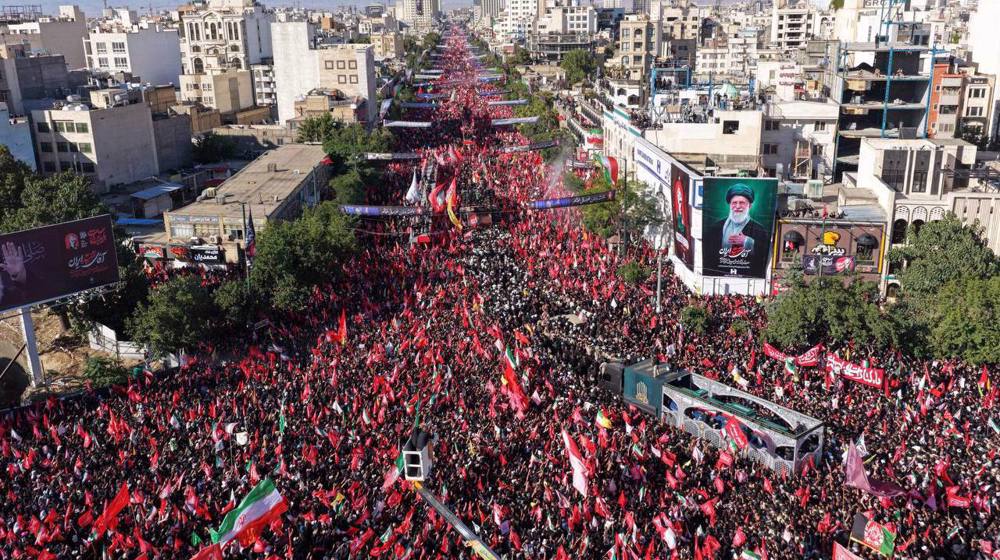
Millions of mourners bring several days of nationwide mourning to their climax in Mashhad, as the final farewell ceremony for martyred Leader of the Islamic Revolution Ayatollah Seyyed Ali Khamenei concludes at the Holy Shrine of Imam Reza (AS).
Following unprecedented ceremonies in Tehran, Qom, Najaf and Karbala, the funeral procession reached its final destination in Mashhad, where the body was received by a massive crowd from across Iran and dozens of countries around the world to be buried at the shrine on Thursday.
THREAD
— PressTV Extra (@PresstvExtra) July 9, 2026
July 9: Press TV's real-time coverage of the funeral and farewell ceremonies for the martyred Leader of the Islamic Revolution, Ayatollah Khamenei
Follow https://t.co/0EMmcJs6DL pic.twitter.com/rTpvjcKMwB
The endless sea of mourners, who had gathered since early morning, accompanied the vehicle carrying the blessed bodies, transforming the streets of Mashhad into a scene of unparalleled grandeur and devotion.
The sheer scale of the gathering defied description. From the moment the funeral vehicle entered Imam Reza Street, it was completely surrounded by waves of mourners who had traveled from every corner of Iran—Kurds, Turks, Persians, Arabs, and Lors—all united in grief and determination.
Their tear-streaked faces and fervent chants filled the air, creating an atmosphere that observers described as one of the most remarkable displays of national unity in recent history.
The slogans "Death to America," "Death to Israel," and "Death to those opposed to the Guardianship of the Jurist" reverberated throughout the procession route, reflecting the unwavering commitment of the people to the principles for which the martyred leader had stood throughout his life.
Red flags of vengeance bearing the inscriptions "Ya Letharat al-Hussein" (O Avengers of Hussein) and banners of the Islamic Republic waved across the streets, symbolizing both mourning and the determination to seek justice.
Among the mourners, special attention was drawn to delegations from various ethnic groups. Sunni Muslims from Sistan and Baluchestan, dressed in their traditional white attire, were visibly present, having traveled to Mashhad to pay their respects.
Representatives from Chaharmahal and Bakhtiari province, adorned in their distinctive local costumes, carried the national flag high above the crowds.
The presence of diverse groups served as a powerful testament to the inclusive nature of the late leader's legacy and the deep bonds of unity he had fostered among all segments of Iranian society.
The significance of the event extended far beyond Iran's borders. Mourners from Afghanistan, Pakistan, India, Turkey, and Nigeria have crossed geographical boundaries to declare that the message of anti-arrogance, dignity, independence, and pride championed by the martyred leader had transcended borders and touched eager hearts worldwide.
A particularly poignant moment came when a Canadian pilgrim, who had traveled over 10,000 kilometers to be present, spoke of his profound respect for a man whose influence, he said, reached far beyond any single nation.
Similarly, a pilgrim from India expressed how the news of the leader's martyrdom had broken the hearts of Muslims across the subcontinent, bringing them to Mashhad to participate in this historic farewell.
Sheikh Ibrahim Zakzaky, the leader of the Nigerian Islamic Movement, was also present among the mourners, his participation underscoring the global resonance of the martyred leader's message of resistance against oppression and injustice.
Turkish mourners were heard chanting "Labbaik Ya Seyyed Mojtaba" (Here I am, O Seyyed Mojtaba), as were followers from Nigeria, demonstrating the international reach of the late leader's spiritual and political legacy.
At one point, the density of the crowd forced the vehicle to change course from Danesh Junction, moving instead toward the Ferdowsi football field, where a helicopter was deployed to transport the blessed bodies to the shrine.
Throughout the procession, the voice of the martyred leader played from loudspeakers, prompting waves of collective weeping that swept through the multitude.
Placards bearing messages in English reading "We stand up to the end..." were visible among the crowds, conveying the determination of the people to continue the path of resistance.
The prayer for the deceased was led by the martyred leader’s eldest son Seyyed Mostafa Khamenei, who performed the ritual prayers over the bodies.
So vast was the congregation that in addition to the shrine itself, the prayers were also conducted along the streets of Navvab Safavi, Tabarsi, and Shirazi, where countless mourners had gathered.
The martyred Leader and members of his family were tragically martyred in a terrorist attack on February 28, carried out by the United States and the Zionist regime against the leader's residence.
Among those martyred were new Leader Ayatollah Seyyed Mojtaba Khamenei's wife, the late leader’s son-in-law; a daughter of the late leader and his 14-month-old granddaughter.
The funeral ceremonies began last Friday, with tributes from political officials from over 45 countries and scholars from more than 90 nations. This was followed by farewell ceremonies at Tehran's Mosalla over the weekend, where millions paid their respects.
On Tuesday, the bodies were processed through Tehran with similarly massive participation, and on Wednesday, ceremonies were held in Qom and at the Jamkaran Mosque.
The remarkable participation continued internationally when about 10 million Iraqis gathered in Najaf and Karbala on Wednesday to pay their respects.
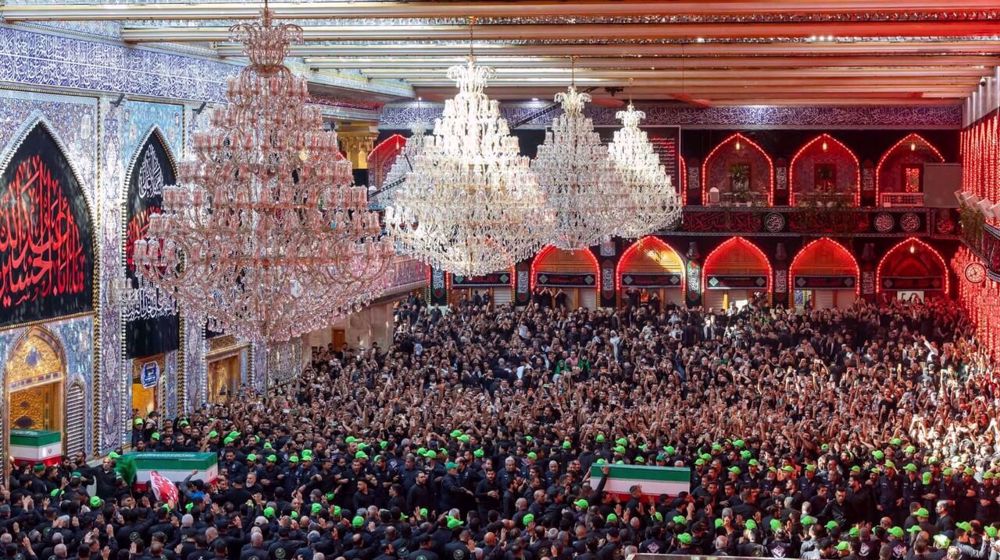
Iraqi officials confirmed it as one of the largest funeral gatherings in recent history. Religious and political figures across Iraq participated in the ceremonies, demonstrating the deep bonds between the Iranian and Iraqi peoples forged through shared faith and common struggles.
As the funeral procession finally concludes with the burial in the Dar al-Dhikr prayer hall, located near the blessed Rawdah and adjacent to the Dar al-Surur prayer hall in the Azadi Courtyard of the shrine, the day will be remembered as one of the most significant in Iran's modern history.
The location was chosen to ensure easy access for future pilgrims wishing to pay their respects.
The presence of mourners carrying banners condemning US President Donald Trump and chanting slogans demanding vengeance reflected the people's insistence on holding the perpetrators accountable.
"The murderer of the leader deserves nothing but the noose / There will be no forgiveness," they chanted, while others demanded "Revenge, revenge" from the armed forces.
Even as night fell and the official ceremonies concluded, crowds continued to gather in the streets surrounding the shrine, reciting prayers and expressing their devotion.
The red and black banners of mourning and vengeance remained unfurled, while the words "Labbaik Ya Hussein" (Here I am, O Hussein) echoed through the streets, ensuring that the spirit of this historic farewell would endure long after the physical procession had ended.
This unprecedented display of national unity and international solidarity has not only honored the memory of a beloved leader but has also reaffirmed the unwavering commitment of the Iranian nation to the principles of independence, resistance against oppression, and devotion to the ideals of the Islamic Revolution.
The martyred leader has found his eternal resting place, but his legacy and the determination of his followers to continue his path remain more vibrant than ever.
 This makes it easy to access the Press TV website