Martyred Leader’s legacy of resistance elevated Iran’s standing on global stage: Ex-deputy speaker
By Press TV Website Staff
As Iran prepares for the funeral of Ayatollah Seyyed Ali Khamenei, a senior Iranian politician says the martyred Leader's defining legacy lies in his unwavering commitment to the doctrine of resistance, a vision that reshaped Iran's regional influence and elevated its standing on the global stage.
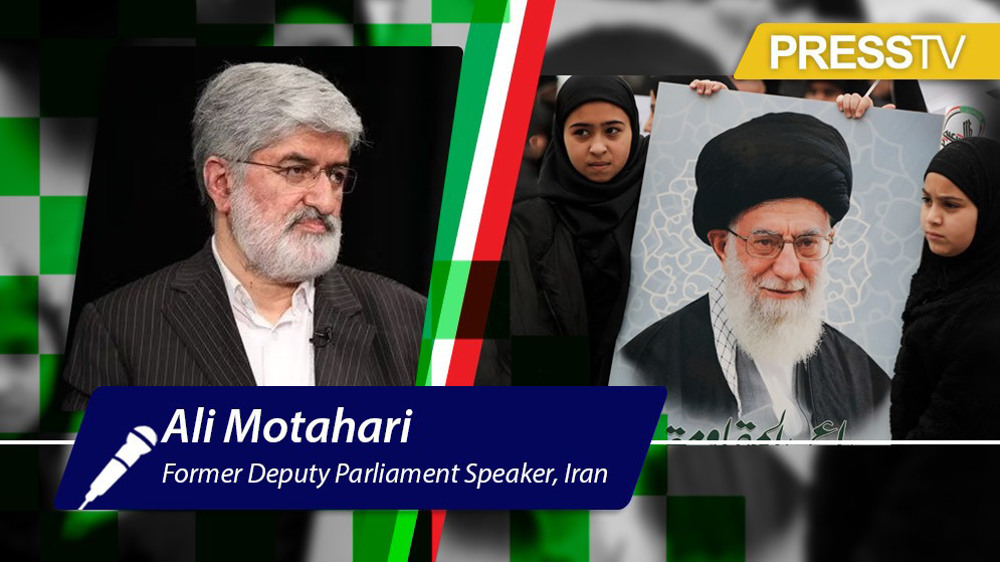
Speaking to the Press TV website, former deputy speaker of the Iranian parliament (Majlis), Ali Motahari, reflected on the enduring legacy of the late Leader of the Islamic Revolution.
“His most important legacy was resistance against the global dominance of the United States and Israel, and the fact that this resistance broke that perceived dominance,” the former lawmaker said.
His remarks come as Iran hosts week-long funeral ceremonies for the late Leader of the Islamic Revolution and members of his family, who were martyred in a US-Israeli strike at the outset of the recent 40-day war on Iran.
Delegations from more than 90 countries are attending the ceremonies across Iran before the commemorations continue in the Iraqi holy cities of Najaf and Karbala.
Motahari said the martyred Leader's doctrine of resistance not only strengthened Iran's strategic position but also enhanced its international stature.
Beyond foreign policy, he credited Ayatollah Khamenei with championing scientific and technological advancement, saying the late Leader's consistent emphasis on research, education and indigenous innovation helped propel Iran's progress in strategic fields.
“To a large extent, the country's scientific progress is indebted to his emphasis and recommendations,” he told the Press TV website, adding that Iran now ranks among the world's leading countries in some scientific disciplines.
Asked about Ayatollah Khamenei's religious decree declaring nuclear weapons forbidden, Motahari said the ruling was firmly rooted in Islamic jurisprudence, explaining that a religious jurist derives such rulings through established principles and authoritative Islamic legal sources.
At the same time, he stressed that the true strength of Iran and the Islamic Revolution does not rest on military capabilities such as nuclear weapons, but on their ideological, intellectual, and moral foundations.
“The power of Iran, and indeed the power of the Islamic Revolution, is its intellectual and ideological force,” Motahari said. “Our influence in the world, especially in Islamic countries and the region, stems from the ideology of the Islamic Revolution.”
He said the Revolution's ideals, the supporters it has attracted internationally, and the Axis of Resistance are all rooted in shared beliefs rather than military power.
“Our power is not an atomic bomb. We do not want to move forward with an atomic bomb,” the former senior lawmaker said. “It is this intellectual and ideological force that wins hearts and carries the Islamic Revolution forward.”
Looking ahead, Motahari expressed optimism about Iran's future, adding that the country had passed through a difficult turning point during the recent imposed war.
He said the war convinced the United States and Israel that Iran could not be forced into submission through military action. Washington, he maintained, also retreated on certain issues under the Islamabad Memorandum of Understanding, which was signed last month, reflecting a change in its approach toward Iran.
“They understood that they cannot bring Iran to its knees through force and pressure,” he told the Press TV website.
Motahari said that Iran's future progress would depend on preserving the same principles that defined Ayatollah Khamenei's leadership for nearly four decades.
“If we maintain our resistance and our unity, I think we will be able to move more successfully along the path of progress, development and prosperity,” he said.

BRICS paving way for alternative world order, not a war machine against West: Analyst
Iran’s strategic location, energy resources position it as a key player in BRICS alliance: Analyst
Yemeni military advance along Red Sea alters balance of power amid Saudi siege, aggression: Analyst



Zionist settlers murder 19-year-old in West Bank amid record surge in violence
Saudi airstrikes intensify as Yemeni army advances toward Taiz
VIDEO | On Non-Violence Day, Gazans still suffer Israeli brutality
Iraqi resistance official hails public defiance that broke US siege on Najaf-Iran flights
Iraq allows 40 daily Iranian flights to and from Najaf after protests over US sanctions
Israel intensifies al-Aqsa incursions as over 11,400 settlers storm holy site
China calls for respecting Iran's right to peaceful use of nuclear energy
Seoul demands Ukraine apology after Zelensky discloses North Korean POW transfer


 PressTV NEWSLETTER
now
PressTV NEWSLETTER
now
 This makes it easy to access the Press TV website
