
By Mohammad Ali Haqshenas
Iran's 2026 FIFA World Cup campaign ended before the knockout stage, but an unbeaten run, resilient performances, and the team's dignified response to off-field challenges ensured that its seventh appearance on football's biggest stage will be remembered for far more than its final standing.
For the first time in the country's World Cup history, Team Melli completed the group stage unbeaten. Three hard-fought draws against New Zealand, Belgium, and Egypt proved insufficient to secure a place in the round of 32, as Iran narrowly missed out after a dramatic sequence of results elsewhere left it one place outside the qualifying positions among the tournament's best third-placed teams.
The elimination was particularly heartbreaking because qualification had appeared within touching distance.
Against Egypt, Shoja Khalilzadeh believed he had scored a dramatic stoppage-time winner that would have sent Iran through automatically, only for VAR to rule the goal out for offside.
A day later, last-minute goals and surprise results in other groups extinguished Iran's hopes of reaching the knockout stage for the first time.
Yet, viewed in its entirety, Iran's World Cup campaign told a far more nuanced story.
An unbeaten first
Iran's three draws marked the country's first unbeaten World Cup campaign across seven appearances, from 1978 to 2026, a milestone that underscored the team's growing competitiveness on football's biggest stage.
The statistics also painted the picture of a side capable of competing with the tournament's strongest teams. Iran scored three goals in total, held formidable Belgium to a goalless draw, and pushed Egypt to the final whistle in a match that could easily have swung in its favor.
✍🏻 Viewpoint - From Strait of Hormuz to World Cup stage, Iranians never back down or relinquish their rights
— Press TV Sports (@presstvsports) June 29, 2026
By Maryam Shakiba@presstvsports https://t.co/kQ5sWHtSW5
Former Iran striker Mohsen Bayatinia believes the team’s campaign at the 2026 World Cup deserves far greater recognition than the final standings suggest.
"If we look at Iran's World Cup history, we achieved our best results because we did not lose and we scored three goals," he said, arguing that the team's overall performances compared favorably with previous tournaments.
Bayatinia acknowledged that the opening draw against New Zealand ultimately proved costly but cautioned against judging the campaign in simplistic terms.
"We should not look at football in black and white," he said. "The team's achievements at this World Cup were much better than in previous editions, and that is the reality."
Football under extraordinary circumstances
Iran's preparations were unlike those of almost any other team at the tournament.
Months before the World Cup, the United States and the Israeli regime launched an unprovoked military aggression against Iran, killing hundreds of people, damaging critical infrastructure, disrupting the domestic football league, and severely complicating Team Melli's preparations for the biggest football tournament.
Several planned friendly matches in the lead-up to the tournament were canceled because of the war and the resulting logistical challenges.
The football federation ultimately decided to have the base camp in Mexico's Tijuana city after logistical complications and US visa denials forced the team to abandon its original training camp in Arizona.
Several members of Iran's delegation were denied US visas, compelling the squad to train in Mexico and commute across the border for its matches in the United States.
For its first two fixtures in Los Angeles, Iran was permitted to enter the US only the night before each match and was required to return to Mexico immediately after the final whistle.
Players and head coach Amir Ghalenoei repeatedly described the arrangement as disruptive to the team's preparations and recovery, while captain Mehdi Taremi criticized FIFA for failing to resolve the logistical problems despite earlier assurances.
The unusual circumstances became a defining feature of Iran's campaign, forcing the team to balance football with lengthy travel, uncertainty and intense political scrutiny.
▶️ "This has been a disastrous World Cup."
— PressTV Extra (@PresstvExtra) June 27, 2026
Iran captain Mehdi Taremi launched a blistering critique of FIFA and US World Cup organizers, calling the tournament 'disastrous' and accusing them of deliberately weaponizing logistical hurdles to eliminate the Iranian team. pic.twitter.com/KTEq0tikUM
Unity forged under pressure
The difficult circumstances surrounding Iran's World Cup campaign in the US also appeared to strengthen the bond within the squad, turning adversity into an opportunity.
Players and coaches frequently spoke of their determination to represent their country under such extraordinary conditions, and the shared experience fostered a strong sense of unity and resilience within the camp.
That cohesion was evident on the pitch as well. Throughout the tournament, Iran remained largely free of internal distractions, with players consistently presenting a united front despite the immense pressures surrounding the team.
Support from Iranian fans, inside and outside the country, also proved to be a defining factor in the team’s campaign.
Before the tournament, there had been concerns that pro-monarchist groups would dominate the atmosphere inside the stadiums, particularly in Los Angeles, creating additional psychological pressure for the players.
Instead, large numbers of Iranian supporters turned out to back Team Melli, generating a far more positive and supportive atmosphere than many had anticipated
Growing stronger with every match
The team's performances also improved steadily as the tournament progressed.
After an unimpressive opening draw against relatively weaker New Zealand, Iran delivered a disciplined defensive display against Belgium, frustrating one of Europe's strongest sides with its organization, tactical discipline, and swift counterattacking play.
The final group match against Egypt showcased Iran's most complete performance of the tournament. The team recovered from an early setback, bounced back with greater confidence and purpose, and continued pressing until the final seconds, when Khalilzadeh's goal, disallowed under controversial circumstances, and Saeid Ezatolahi's effort off the crossbar left supporters wondering what might have been.
⚽ "Iran — the unluckiest team in history."
— Press TV Sports (@presstvsports) June 28, 2026
24 hours of insane twists:
❌ Goal in 93rd minute → VAR disallowed
❌ Ghana couldn't beat Croatia
❌ Congo won from behind
❌ Austria equalized in 96th minute@presstvsports pic.twitter.com/HTfI3dKMTY
Former Iran defender Behrouz Rahbarifard believes the team's progression over the three tournament matches was unmistakable.
"We were much better against Belgium and then excellent against Egypt, but unfortunately we couldn't win," he said.
"Overall, I think the national team deserves a passing grade, especially considering the difficult conditions in which it entered the tournament, the lack of proper warm-up matches, and the pressures imposed on the team by the host country."
Individual milestones
Iran also left a lasting impression through a series of outstanding individual performances.
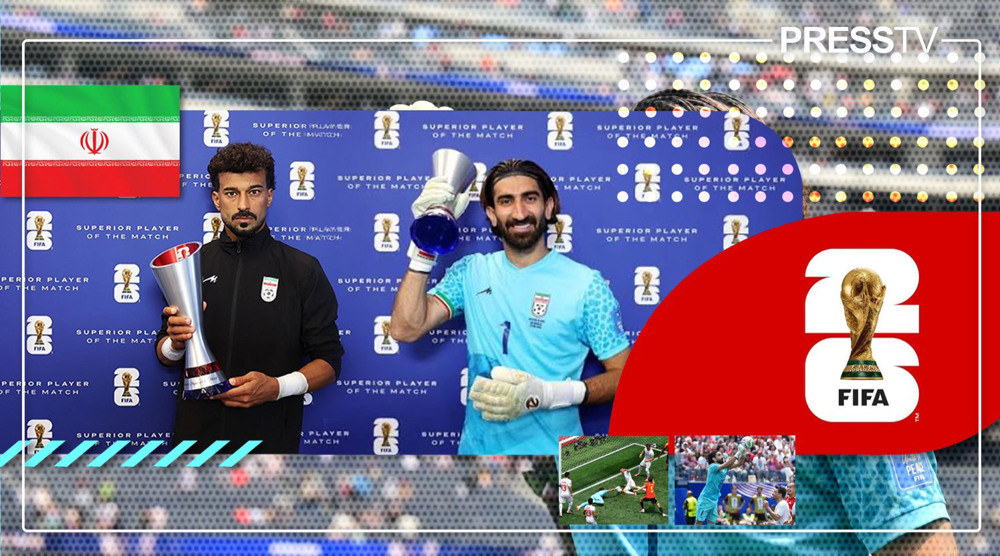
Ramin Rezaeian was named Player of the Match twice, while goalkeeper Alireza Beiranvand earned the same honor against Belgium after producing a string of exceptional saves.
No Iranian player had previously received the Player of the Match award at a FIFA World Cup. In 2026, however, Iran produced the Player of the Match in all three group-stage fixtures, with Rezaeian claiming two awards and Beiranvand one.
Beiranvand also finished among the tournament's leading goalkeepers in total saves, while Taremi topped the group-stage rankings for aerial duels won.
Winning admiration beyond the pitch
If Iran fell short of its stated goal of reaching the knockout stage at the 2026 World Cup, it gained something equally meaningful during its eventful 24-day stay in Mexico.
Residents of Tijuana embraced the team throughout the tournament, gathering outside the team's hotel before and after matches, offering messages of encouragement, and transforming the border city into an unexpected home away from home.
⚽ Taremi tops aerial duels, Beiranvand among leading goalkeepers after World Cup group stage@presstvsportshttps://t.co/3pfrf5bFLg
— Press TV Sports (@presstvsports) June 29, 2026
In a farewell message before departing Mexico, the players thanked the local community, writing: "You showed us that hosting the World Cup is not just about stadiums and tickets; it is about respect, humanity and dignity."
They added that Mexico had become "not only our host, but also our second country and our second team."
The squad also renewed its concerns over unequal treatment during the tournament, saying it left with "one serious question: Did all teams truly enjoy equal opportunities and equal standards?"
Recognition from FIFA
Even FIFA President Gianni Infantino, who faced blistering criticism for failing to provide Team Melli equal playing conditions during the tournament, acknowledged the team's remarkable resilience.
"Remaining unbeaten through a challenging FIFA World Cup group stage is a remarkable feat that proved your exceptional quality and teamwork to the world," he said in an Instagram message.
"Unfortunately, it was not enough to progress, but your passion and desire were there for all to see. Thank you for playing with such heart and for giving everyone so much to be proud of."
Iran team thanks Mexico, questions World Cup fairness in farewell message from Tijuanahttps://t.co/7f5vSWysy6
— PressTV Extra (@PresstvExtra) June 30, 2026
The road ahead
The 2026 World Cup also exposed the challenges that continue to separate Iran from football's elite.
Beyond the disappointment of failing to reach the knockout stage, the tournament underscored the need for stronger domestic structures, higher-quality preparation, continued tactical evolution, and more consistent exposure to top-level international competition.
At the same time, Iran demonstrated the qualities that have long formed the foundation of its success: resilience, defensive discipline, collective spirit, and the ability to compete with stronger opponents.
Looking ahead, many experts have emphasized the importance of integrating a new generation of players into the squad while building on the lessons of the World Cup to prepare for next year's AFC Asian Cup in Saudi Arabia.
 This makes it easy to access the Press TV website