
By Ivan Kesic
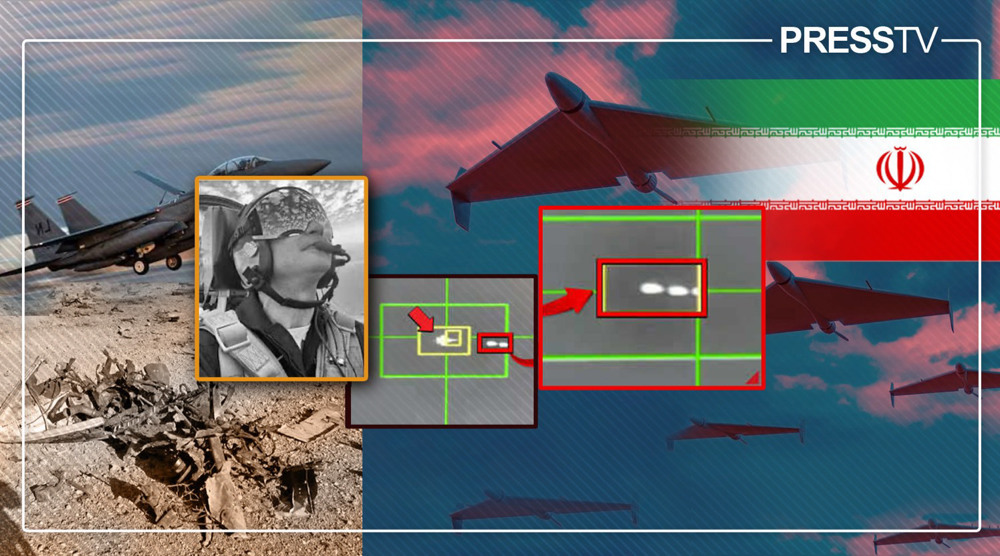
When a US F-15E Strike Eagle pilot, after ejecting over central Iran, described seeing Iranian drones moving as a single coordinated entity resembling a giant jellyfish, his account triggered intense debate within American intelligence circles over whether Tehran had secretly fielded one of the most advanced autonomous drone swarm capabilities ever witnessed in combat.
On April 3, 2026, during the joint US-Israeli military aggression against Iran, an American F-15E Strike Eagle was successfully shot down over central Iran, marking the first confirmed loss of a US fighter aircraft over Iranian territory during the 40-day imposed war.
The pilot, as per reports in US media, later recounted during intelligence debriefings a sight he initially struggled to comprehend: multiple Iranian drones hovering and maneuvering in perfect coordination, with smaller drones positioned beneath larger ones like tentacles, forming a synchronized aerial formation that resembled a giant jellyfish.
The extraordinary account, described by US intelligence officials as "real alien stuff," ignited a fierce debate within the US intelligence community over whether Iran had achieved a breakthrough in mesh networking and autonomous drone swarm technology, capabilities that American intelligence had not previously assessed Tehran as possessing.
The downing of the F-15, followed by the catastrophic failure of a US combat search-and-rescue mission that ended with the destruction of two C-130 transport aircraft and two Black Hawk helicopters in Isfahan province, exposed the extent to which American air power had become vulnerable to Iran's rapidly evolving unmanned warfare capabilities.
The episode also underscored the expanding role of Iranian drones on the modern battlefield. Beyond carrying out surveillance and precision-strike missions, they have demonstrated the potential to function as aerial minefields, force multipliers for integrated air-defense networks, and, potentially, as counter-air platforms capable of detecting, engaging, and destroying manned aircraft.
F-15 Pilot and the myth of American rescue
The pilot's account, first revealed in June, two months after the US was forced to seek a ceasefire, described a drone formation unlike anything he had ever encountered.
According to reports, citing sources familiar with the intelligence debriefing, he reported seeing multiple Iranian drones interconnected and moving as a single coordinated entity, with smaller drones suspended beneath larger ones like legs.
Officials present at the briefing characterized the description as "real alien sh*t."
Another source told the US media that the pilot described witnessing a "minefield of drones" suspended in the sky, an aerial barrier capable of damaging or destroying any aircraft attempting to fly through it.
The account immediately presented the US military and intelligence community with a credibility dilemma.
The pilot had suffered a concussion after ejecting from his aircraft, and it was the second time he had been shot down during the war, having previously survived a friendly-fire incident involving Kuwaiti forces, as per reports.
During the debriefing, US intelligence officials repeatedly questioned whether he was certain about what he had seen, reflecting the difficulty of reconciling his testimony with existing assessments of Iran's drone capabilities.
Some officials suggested the concussion might have affected his perception, while others argued that the account was too detailed and internally consistent to dismiss as hallucination or optical illusion.
Footage captures missile launches during the IRGC's early-morning retaliatory missile and drone operation against US aggression.
— Press TV 🔻 (@PressTV) June 28, 2026
Follow: https://t.co/mLGcUTS2ei pic.twitter.com/phhGBTOulv
The subsequent American narrative of a dramatic rescue operation for the downed pilot, however, is not supported by the available evidence.
According to information obtained by sections of Iranian media, the White House hastily constructed what was described as a "Hollywood-style" rescue story to conceal a catastrophic military failure that exposed the fallacy of US military superiority.
The failed operation in Isfahan province on April 5, 2026, which Washington later presented as a “rescue mission,” was, according to these accounts, an attempt to infiltrate an Iranian nuclear facility.
American special operations forces landed at an abandoned airstrip near one of Iran's nuclear sites, believing Iranian air defenses would be unable to respond effectively. Instead, Iranian forces had already mobilized and were waiting. The operation had walked directly into a carefully prepared trap.
The first C-130 transport aircraft, carrying dozens of special operations personnel, was allowed to land. Minutes later, a second C-130 approached carrying specialized vehicles and support equipment.
At that point, Iranian forces, including the Army, Law Enforcement Command, the Islamic Revolution Guards Corps, and local popular forces, targeted the second aircraft before it could land.
Two Black Hawk helicopters arrived shortly afterward, but by then all American aircraft had become exposed targets. After recognizing that the operation had been compromised, the White House Situation Room reportedly shifted its objective from the original mission to an emergency effort to extract the trapped commandos.
The withdrawal was carried out in such haste that American personnel abandoned equipment, including the identification documents of an officer, in their effort to escape. US fighter aircraft later bombed the abandoned equipment to prevent it from falling into Iranian hands, as per reports.
The Khatam al-Anbiya Central Headquarters later announced that Iranian joint forces had destroyed two C-130 transport aircraft and two Black Hawk helicopters in Isfahan province.
Images of burning wreckage, geolocated and independently verified by multiple sources, quickly circulated across global media and social platforms, prompting immediate comparisons with the failed 1980 American Operation Eagle Claw at Tabas.
The episode represented not only a military defeat for the US but also a profound strategic and political humiliation for it. The US president's repeated assertions that the mission had successfully rescued the pilot, made without photographic or video evidence of the purported extraction, were rejected by Iranian officials as an attempt to mask an unprecedented setback.
As the Speaker of the Iranian Parliament remarked with sharp sarcasm: "If the United States gets three more victories like this, it will be utterly ruined."
What the jellyfish drone formation actually means
The capability described by the pilot is known as one-to-many mesh networking, a system that enables a single operator – or an autonomous command architecture – to control multiple drones simultaneously in a coordinated, real-time manner.
This represents a fundamental departure from the looser swarms of independently operating drones that Iran has previously demonstrated, such as mass launches of Shahed-type loitering munitions that operate in large numbers but without close coordination.
In a mesh network, drones communicate directly with one another rather than relying exclusively on a central controller. This peer-to-peer architecture creates redundancy, making the network far more resilient to jamming, electronic warfare, and the loss of individual nodes.
If one communication link is disrupted, data is automatically rerouted through other drones, allowing the formation to maintain its integrity and continue operating.
The visual formation described by the pilot – larger drones occupying an upper layer with smaller drones suspended beneath them like legs or tentacles – suggests a distributed, multi-layered architecture capable of performing several military functions simultaneously.
Within such a formation, some drones could carry intelligence, surveillance, and reconnaissance (ISR) sensors, while others might be equipped with electronic warfare payloads, communications relay systems, decoys, or precision-guided munitions.
Information gathered by any individual platform could be shared instantly across the network, enabling the entire swarm to respond rapidly and collectively to changing battlefield conditions.
Artificial intelligence would likely play a central role in maintaining formation, preventing collisions, assigning tasks, and adapting to the loss of individual drones. While a lead operator or autonomous command node could oversee the overall mission, individual drones would retain the ability to operate semi-autonomously if communications were degraded.
✍️ Feature - From Tabas to Isfahan: Iran destroys two US C-130s, echoing the 1980 Eagle Claw debacle
— Press TV 🔻 (@PressTV) April 5, 2026
By Ivan Kesichttps://t.co/kWCox3jKQZ
Such a formation offers several significant operational advantages. Its distributed architecture provides far broader sensor coverage, allowing threats to be detected simultaneously from multiple directions.
The swarm could also conduct electronic warfare by jamming enemy radars, spoofing navigation systems, or generating deceptive signals to confuse opposing forces.
By presenting defenders with dozens, or potentially hundreds, of coordinated targets, the formation could overwhelm air-defense systems designed to intercept only a limited number of high-value threats.
Perhaps most significantly, the swarm could function as a "living minefield," loitering over a designated area and autonomously responding to approaching threats.
Any aircraft attempting to penetrate such a screen could potentially be damaged through collisions, proximity-fused munitions, or, according to some theoretical concepts, interconnected cables suspended between drones.
In many respects, the concept resembles a modern evolution of the barrage balloons employed during World War II, but one enhanced by mobility, artificial intelligence, distributed sensing, and the ability to actively engage targets.
Earlier generations of Iranian drone swarms demonstrated in previous wars or confrontations relied primarily on mass and attrition, saturating enemy defenses by launching large numbers of relatively independent drones.
The jellyfish-like formation described by the pilot, if accurate, would represent a significant leap toward a new generation of swarm warfare based on cooperative autonomy, in which individual drones not only operate in concert but continuously exchange information and adapt their behavior according to the collective state of the swarm.
Russia and China have been among the leading developers of such technologies. If the pilot's account accurately reflects what he encountered, it would suggest either that Iran has benefited from external technical assistance or that its domestic aerospace industry has achieved a comparable level of technological sophistication.
Anti-air defense: drone as a counter-air weapon
The concept of using drones as air-defense systems is rapidly evolving from theoretical research into operational reality.
Drone swarms are capable of performing a wide range of defensive missions, including intercepting hostile aircraft, establishing aerial barriers, and denying contested airspace to enemy forces.
Large numbers of inexpensive, expendable drones operating in coordinated formations can effectively restrict an adversary's freedom of action, functioning as an airborne minefield that hostile aircraft cannot safely penetrate.
During the conflict in Ukraine, the first widely reported instance of a jet aircraft being brought down by a drone occurred when a Russian-operated Shahed drone destroyed a Ukrainian MiG-29.
Western and Ukrainian officials characterized the incident as accidental, maintaining that the drone happened to be in the wrong place at the wrong time.
According to the official American and Ukrainian narrative, the MiG-29 simply collided with the drone while it was conducting a routine mission, a version that analysts have dismissed as an attempt to downplay the broader military significance of the incident.
By contrast, the relative silence of both Iranian and Russian officials regarding the technical details has drawn attention. Some analysts argue that the absence of detailed public discussion may reflect a deliberate effort to preserve operational surprise if technologies enabling drone-versus-aircraft engagements have indeed reached operational maturity.
✍️ Investigation - Through lens of satellite imagery: How Iran's precision strikes dismantled America's Persian Gulf military network
— Press TV 🔻 (@PressTV) June 28, 2026
By Yousef Ramazanihttps://t.co/1QmwYMuzWK
The deliberate destruction of a manned aircraft by an unmanned system would represent a major shift in aerial warfare, potentially exposing fighter aircraft to threats that conventional air-defense doctrines have only recently begun to address.
Another incident further fueled that debate. On June 8, 2026, a US Army Boeing AH-64 Apache attack helicopter was shot down by a drone near the Strait of Hormuz, marking another notable demonstration of Iran's expanding unmanned aerial capabilities.
The two crew members were reportedly rescued by means of an unmanned surface vessel. Although American officials offered several explanations for the helicopter's loss, observers argued that the official account left important questions unanswered.
The AH-64 Apache is widely regarded as one of the world's most heavily armed and survivable attack helicopters, equipped with sophisticated defensive countermeasures and designed to operate at low altitude to reduce its vulnerability.
Its reported loss to an Iranian drone, coming after Iranian unmanned systems had already demonstrated the ability to operate in any airspace and were believed to have contributed to the downing of F-15E Strike Eagles and other high-performance aircraft, has led some analysts to argue that Iran has developed effective counters even against advanced American rotary-wing platforms.
The integration of drone swarms with conventional air-defense systems could create a layered architecture significantly more resilient than any individual platform operating on its own.
Within such a network, drone swarms could provide early warning, cue missile batteries, conduct electronic warfare, perform battle-damage assessment, and potentially intercept incoming missiles or aircraft directly.
The jellyfish-like formation described by the American pilot, as reported in US media, may represent precisely such an integrated architecture: a distributed network of sensors, communications nodes, and strike platforms capable of detecting, tracking, and engaging aerial threats with unprecedented flexibility.
The downing of the Apache by an Iranian drone adds further weight to the possibility that Iran has operationalized concepts involving drone-versus-drone and drone-versus-helicopter combat, marking what could be a significant evolution in the employment of unmanned systems on the modern battlefield.
Previous famous encounters with unknown aircraft
The psychological shock experienced by the American F-15 pilot upon encountering the jellyfish drone formation is part of a recurring pattern in the history of aerial warfare, as military experts concur.
Throughout the past century, pilots have repeatedly encountered aircraft that seemed to belong to the future, forcing them to adapt to new realities in seconds or die.
As one aviation historian observed, the strongest reactions were reserved for aircraft that appeared to have "jumped several years overnight."
During the final months of the Second World War, Allied pilots encountered the Messerschmitt Me 262, the world's first operational jet fighter.
One RAF Tempest pilot recalled seeing what appeared to be a normal fighter in the distance, only to realize moments later that it was already gone.
Another Mosquito crew wrote that the jet "closed from astern with unbelievable speed." RAF pilot and test pilot Eric Brown later wrote that seeing the Me 262 for the first time gave the impression that aviation had "jumped several years overnight."
✍️ Explainer: Why IRGC's Shahed-161 drone symbolizes Iran’s leap in indigenous defense tech
— Press TV 🔻 (@PressTV) April 6, 2026
By Ivan Kesichttps://t.co/wpu8w6itNR pic.twitter.com/FhdsxqvN9q
Experienced airmen who had developed an instinctive understanding of relative motion found that the Me 262 violated everything they had learned about aerial combat. One pilot famously remarked: "By the time I'd identified it, it had already gone."
The appearance of the MiG-15 over Korea in November 1950 produced an even greater shock. US pilots initially mistook the swept-wing fighters for unknown aircraft before realizing they were confronting a new generation of Soviet-designed jets.
The MiG-15 could climb dramatically faster than the F-80 Shooting Star and operate comfortably at altitudes previously considered safe for American bombers.
One F-80 pilot later remarked that watching the MiGs performing effortless aerobatics high overhead made him think, "this has got to be a crazy war."
The legendary test pilot Chuck Yeager, after flying against a captured MiG-15, famously declared that the aircraft "could climb like a homesick angel," a phrase that became one of the most famous descriptions in aviation history.
The greatest psychological effect fell on B-29 Superfortress crews, who had grown accustomed to being largely beyond the reach of enemy interceptors.
Against MiG-15s, however, the huge bombers became vulnerable. On "Black Tuesday" in October 1951, MiGs devastated a B-29 formation, convincing the United States to withdraw daylight strategic bombing missions over much of North Korea.
One gunner recalled: "They came down out of the sun like hawks. You saw flashes of silver and then holes appeared in the airplane." Several B-29 veterans remarked that it was the first time they truly felt like prey instead of heavily armed bombers.
During the Vietnam War, American pilots encountered the MiG-21, which used ground-controlled interception to make one high-speed missile attack before disappearing.
The tiny delta-wing fighter accelerated rapidly and presented a very small visual target. One American pilot recalled that trying to see a MiG-21 was "like looking for a mosquito," and that he would never see the enemy fighter until it was already leaving.
Another pilot joked: "The MiG's favorite maneuver was afterburner." A US Navy pilot summarized the experience: "You'd never see him until he was leaving."
One F-4 Phantom pilot later admitted that the first time he saw a MiG-21 on his radar, he thought his equipment was malfunctioning; the fighter was simply too small and too fast to be real.
The encounters exposed deficiencies in U.S. air combat doctrine and contributed directly to programs such as the Navy's Top Gun school.
Another pilot recalled the frustration of facing a fighter that refused to dogfight: "It wasn't turning with us, it wasn't trying to. Instead it simply accelerated away."
The development of stealth aircraft created a different kind of surprise. During the 1991 Gulf War, Iraqi pilots and radar operators struggled to understand why aircraft were striking heavily defended targets around Baghdad with little warning and few successful interceptions.
Iraqi radar operators later said they initially believed their radars were malfunctioning because explosions occurred where no aircraft appeared.
One Iraqi operator reportedly said: "Something was bombing us that wasn't there." An Iraqi MiG-29 pilot later admitted that his first encounter with a stealth aircraft was terrifying; he saw the explosion of a target on the ground but could see nothing on his radar screen, feeling as though he was fighting a ghost.
One air defense commander in Baghdad was quoted as saying, "We are fighting something that does not exist."
Iran unveils three new vertical takeoff drones, The Homa, Dideban and Shahin-1 FPV suicide drone, at the Iranian Army's southeastern drone and air base.
— Press TV 🔻 (@PressTV) May 22, 2025
Follow Press TV on Telegram: https://t.co/boCY50qfi9 pic.twitter.com/gXUmdU1RnQ
The Cold War produced perhaps the most surreal encounters with the SR-71 Blackbird. Although Soviet interceptors never successfully intercepted one, Soviet pilots frequently described the Blackbird almost with a mixture of frustration and awe.
One MiG-25 pilot reportedly joked: "By the time we reached altitude, he was already over another country."
A US Air Force officer summarized the SR-71's reputation beautifully: "You didn't intercept the Blackbird. You watched it leave." Another American pilot remarked that flying against the SR-71 in training was like trying to shoot down a meteor.
The analogy between these historical encounters and the jellyfish drone sighting is instructive.
In each case, pilots experienced not just fear but disbelief—seeing an aircraft climb impossibly fast, appear unexpectedly on radar, outrun every pursuit, attack from previously unimaginable distances, or, in the case of the Iranian drones, arrange themselves into a coordinated formation that violated every assumption about how unmanned systems operate.
In each case, the moments of surprise marked the beginning of a broader transformation in air warfare, forcing new tactics, technologies, and training that would define the next generation of aerial combat.
One Israeli pilot described entering a missile envelope in 1973 with the haunting words: "It was like flying into a wall." Another said: "The sky suddenly belonged to someone else."
The F-15 pilot's description of the jellyfish formation as "real alien stuff" echoes the reactions of previous pilots who encountered disruptive technologies.
The MiG-15's ability to climb straight up, the Me 262's impossible speed, and the F-117's apparent invisibility each generated similar reactions, a recognition that the rules of engagement have changed, and that what they had thought was possible was no longer the limit.
The exact nature of the jellyfish formation remains unconfirmed by independent sources, but the fact that it generated this kind of reaction within the US intelligence community is itself significant.
It suggests that Iran has achieved a technological breakthrough that places it at the forefront of drone warfare, joining an elite group of nations capable of fielding autonomous, cooperative drone swarms that can operate as a single, coordinated entity in contested airspace.
As one US official reportedly said during the debriefing: "We will spend huge, huge dollars, like a lot of blood and treasure, protecting ourselves from something that can coordinate like that." This would represent a fundamental shift in the balance of power in the region, one that the United States and its allies are ill-prepared to counter.
 This makes it easy to access the Press TV website