The banner of battlefield victory today underpins Iran’s diplomacy of strength: Qalibaf
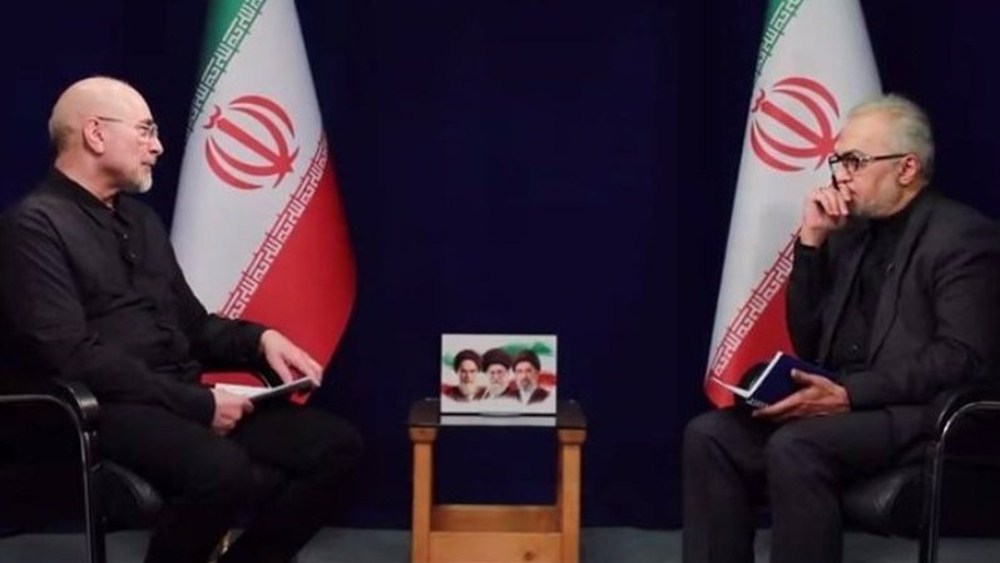
The speaker of Iran’s Parliament and head of the Islamic Republic’s negotiating team says the country is pursuing a "diplomacy of strength" backed by its battlefield victory over the United States and the Israeli regime, stressing that negotiations have served as a method of struggle rather than a sign of retreat.
In a televised interview on Tuesday, Mohammad Baqer Qalibaf said the key difference between the latest round of talks and previous diplomatic efforts was that negotiations were conducted from a position of strength.
Parliament Speaker Qalibaf says he could speak from a position of strength in the talks because of the strong performance of Iran’s armed forces and the people’s nightly rallies in the streets.
— Press TV 🔻 (@PressTV) June 17, 2026
Follow https://t.co/B3zXG73Jym pic.twitter.com/bwnmdxYYXI
"When I speak of negotiation and diplomacy, I mean a diplomacy of strength," he said. "I also said during the JCPOA period that I was not opposed to negotiations, but I supported negotiations that themselves constitute a method of struggle," the senior official added, referring to the 2015 nuclear agreement that was betrayed by the US under Donald Trump's former administration.
"The difference between the current negotiations and previous periods is that today this banner of battlefield victory, which both enemies and friends have acknowledged, serves as the backing for negotiations," he added.
The top legislator's remarks came as Iran and the US are scheduled to sign a memorandum of understanding in Switzerland on Friday following a ceasefire announced by Trump on April 7 in the midst of the United States' and the Israeli regime's latest bout of unprovoked aggression targeting the Islamic Republic. The announcement came amid decisive and successful Iranian retaliation and after the Islamic Republic closed the strategic Strait of Hormuz to enemies and their allies in reprisal.
Factbox: 14-point US-Iran MoU lays out terms to end imposed war, reshape regional security framework
— Press TV 🔻 (@PressTV) June 17, 2026
https://t.co/tIpBWnFaTX
Qalibaf said Iranian armed forces emerged victorious against fully equipped adversaries, arguing that negotiations conducted as a form of struggle leave no room for either surrender or empty slogans.
He also said the Iranian nation stood firm in the face of a war imposed by the United States and the Israeli regime, adding that although recent developments may have unfolded regionally, their consequences were global.
Iran's retaliation saw the armed forces target American outposts and interests in a wide range of regional countries, and deliver crushing blows to Israeli interests throughout the occupied territories.
'Four arenas of struggle'
Qalibaf said Iran's defense and retaliation in the face of adversaries span four interconnected arenas.
"The war today is underway in four arenas: The arena of military struggle, the arena of the people’s struggle on the streets, the arena of diplomatic struggle, and the arena of [ensuring provision of] service to the people," he said.
According to the senior official, Iran prevented Washington and Tel Aviv from achieving any of the nine objectives they had publicly declared – a reference to publicly stated goals that included, among other things, the overthrow of Iran’s Islamic establishment and the destruction of its military capabilities.
He said the struggle was carried out across the four arenas depending on circumstances, with each sphere contributing to Iran’s overall victory.
Qalibaf also credited public participation on the streets for strengthening Iran’s position, saying citizens entered the field of struggle from the earliest days of the aggression and played a central role alongside the armed forces and diplomatic efforts.
'Negotiations in tandem with military readiness'
The parliamentary speaker noted how Iran continued to respond to hostile actions, while diplomatic contacts were underway.
Referring to developments in the Persian Gulf, he referenced Iran's responding to enemy violations during the ceasefire period and emphasized that military responses and negotiations proceeded simultaneously.
"All these events took place while we were negotiating at the same time," he said.
Qalibaf argued that the combination of military power and diplomacy enabled Iran to secure outcomes that could not have been achieved through military action alone.
Lebanon and the role of diplomacy
The high-ranking official said Lebanon was one of the key issues raised during negotiations, referring to Iran's insistence that cessation of aggression should encompass all fronts, including Lebanon.
He described the country as part of the Axis of Resistance, saying Iran used both diplomatic pressure and military leverage in response to Israeli attacks on Beirut, and reminding that Tehran issued an ultimatum through diplomatic channels, while maintaining readiness to respond militarily.
Despite the Islamic Republic's insistence, the ceasefire period would feature regular Israeli attacks on Lebanon. Reacting to the violations, Tehran would consistently reassert emphasis on cessation of the Israeli atrocities, besides moving proactively to respond to Tel Aviv with strikes against the occupied territories.
"We were able to stop the fire in Dahiyeh through negotiation, but this success was achieved with the backing of our military power," he said, pointing to the Iranian armed forces' response to the Israeli regime's assaults targeting a Beirut suburb.
The official added that Iranian negotiators informed mediators that Tehran would respond to attacks regardless of the circumstances, a stance he said altered the atmosphere of the talks.
Negotiation as a method of struggle
Emphasizing the role of diplomacy, Qalibaf said military achievements must ultimately be translated into political and legal gains.
"Every war that ends in victory, if it does not ultimately lead to a legal and political document and those victories are not recorded, will bring no benefit," he said.
He maintained that negotiations helped transform battlefield achievements into tangible outcomes, including arrangements reached under the memorandum of understanding.
Iran’s strength as the main guarantee
Elsewhere in his remarks, Qalibaf said Iran’s primary guarantee was not international resolutions, but national strength and public unity.
"Even if there is a final agreement and it is endorsed by a UN Security Council resolution, it is still not trustworthy. Our guarantee is Iran’s power," he said.
He added that Iran would implement its commitments only if the other side fulfilled its obligations, describing the principle governing the memorandum as "action in return for action."
Qalibaf concluded by thanking the Iranian people, the country’s armed forces, and the nation's leadership for their role in securing the achievements of the recent period.
Iran: US had intentionally prepared ground for withdrawing from Islamabad MoU
Iran retains initiative in Strait of Hormuz despite US claims: Armed Forces
Iran’s nuclear doctrine not changed, but NPT withdrawal possible: Top security official



How Iran turned US military and economic aggression into strategic leverage to dictate terms
‘No restraint’ against any aggression: Iran's top military command warns US, its regional allies
Poll: Over half of US Jews say Netanyahu fueling American anti-Semitism
Trump and Netanyahu will face same fate as Saddam Hussein: Top Iranian cmdr.
VIDEO | Protesters flood Buenos Aires in rally against Milei's economic policies
Iran claim basketball bronze at 2026 Asian Games, win delegation’s first medal
Yemen warns Saudi escalation will draw stronger response
Iraqi MP: Resistance weapons aimed at enemies, terrorist groups



 PressTV NEWSLETTER
now
PressTV NEWSLETTER
now
 This makes it easy to access the Press TV website
