War will not end without Israel halting Lebanon attacks, occupation: Araghchi
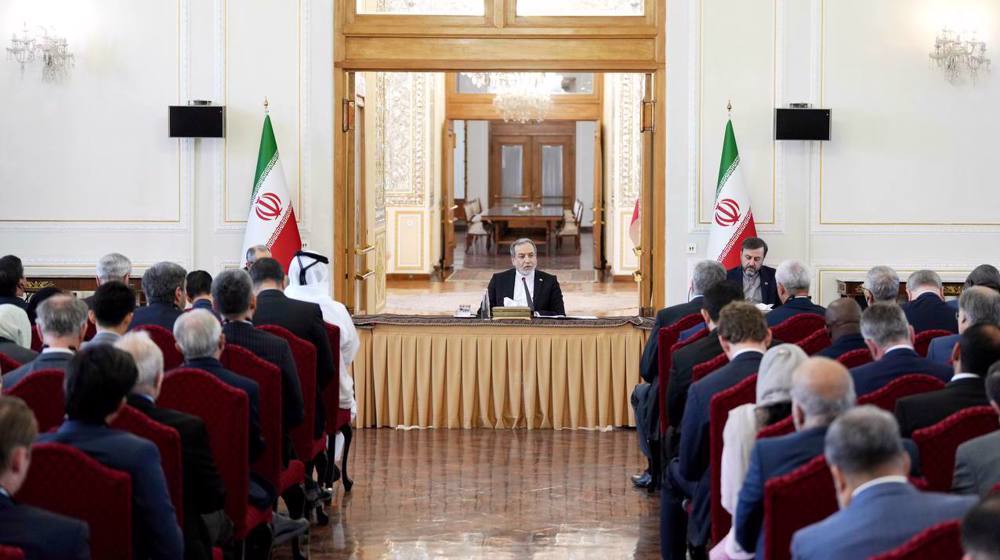
Iranian Foreign Minister Abbas Araghchi says any future Israeli attacks on Lebanon or continued occupation of recently-seized territories in the Arab country would constitute a violation of a memorandum of understanding that is scheduled to be signed between Iran and the US.
Speaking at a meeting with foreign diplomats based in Tehran on Tuesday, Araghchi identified the most important provision of the memorandum as declaration of an immediate and permanent end to the war across all fronts, including Lebanon.
Iran deputy FM says MoU with US finalized, to be signed in Geneva on Fridayhttps://t.co/eS8FKwJZ54
— Press TV 🔻 (@PressTV) June 14, 2026
He, therefore, stressed that the end of the aggression against Lebanon forms an integral part of the MoU.
On February 28, the United States and the Israeli regime began their latest round of unprovoked aggression against Iran. At the same time, the regime intensified its attacks on Lebanon in violation of a standing ceasefire with Beirut and a subsequent ceasefire arrangement.
The Islamic Republic has consistently maintained that any ceasefire with Washington must apply to all fronts, including Lebanon, saying peace and stability in the region cannot be achieved unless the arrangement was implemented comprehensively.
During the American-Israeli aggression, which continued until April 7, Iranian armed forces carried out retaliatory operations against the aggressors' interests, while also responding to Israeli violations of commitments in Lebanon.
On Sunday, the Iranian Foreign Ministry announced that the memorandum of understanding had been finalized and is scheduled to be formally signed in Switzerland on Friday.
Iran deputy FM says MoU with US finalized, to be signed in Geneva on Fridayhttps://t.co/eS8FKwJZ54
— Press TV 🔻 (@PressTV) June 14, 2026
"Because the war in Lebanon and the Zionist regime's aggression against southern Lebanon became connected to the war with Iran, and the two fronts became intertwined and dependent on one another, the Islamic Republic considered ending the war in Lebanon a requirement for ending the war with Iran from the very beginning," Araghchi said.
The foreign minister also emphasized that the end of the war also requires an end to the Israeli presence in the territories that the regime has occupied since escalating its aggression against Lebanon.
"The end of the war includes the end of occupation. Without the withdrawal of Israeli forces from territories they occupied during this war, the war will have not been fully brought to an end," he said.
The official also outlined Tehran's interpretation of the parties to the memorandum.
"The important point I want to emphasize here is that, in our view, the two sides to this memorandum are the United States and Israel on one side, and Iran and [Lebanon's] Hezbollah [resistance movement] on the other," he said, reiterating, "The end of the war in Lebanon is an inseparable part of the complete end of the war."
The foreign minister, meanwhile, noted that the war was declared over on Monday morning, Tehran time, following finalization of the MoU, although the memorandum will officially enter into force on Friday upon taking place of the signing stage.
Araghchi also announced that a new round of negotiations between Iran and the United States aimed at reaching a final agreement is expected to begin on Friday following the formal signing process.
"Most likely on Friday, at a location that will be announced later, the memorandum will be formally signed, and on the same day, a new round of negotiations between Iran and the United States to reach a final agreement will begin," he said.
Nuclear issues, sanctions to be addressed in final agreement
The foreign minister said Tehran and Washington decided to divide negotiations into two phases because of difficulties stemming from the unprovoked aggression.
He said the first phase focused on ending the war, the Strait of Hormuz, the US's illegal naval blockade of Iran's ports and vessels, the release of Iranian frozen assets, reconstruction issues, and related matters, resulting in the MoU.
According to the official, upon signing of the memorandum, negotiations will continue for 60 days in an effort to reach a comprehensive agreement.
"In the final agreement, decisions will be made regarding nuclear issues and the lifting of sanctions, and we will reach a final conclusion," he said.
Araghchi also thanked Pakistan for its constructive role in mediation between Tehran and Washington.
Iran FM outlines seven-day plan for conditional reopening of Strait of Hormuz
Gharibabadi: International law’s credibility hinges on states’ equality before the law
ECO can play greater role in regional peace, economic integration: Araghchi



VIDEO | Yemeni army releases video showing strikes on Saudi military buildups, vehicles
Hamas: Board of Peace’s 'hostile stance' on UNRWA aligns with Israel
VIDEO | Islamic Jihad: Nasrallah helped build a united regional front against Israel
Pezeshkian: Iran ‘no longer’ trusts US after being attacked twice during talks
Iran rejects speculation it may target airports in region over compliance with US sanctions
Restrictions on Iranian flights impede Iraq’s economic recovery: Senior MP
Tayebi wins shot put gold as Iran takes three more silvers at Aichi-Nagoya Asian Games
VIDEO | Israel’s UN isolation: Netanyahu faces criticism



 PressTV NEWSLETTER
now
PressTV NEWSLETTER
now
 This makes it easy to access the Press TV website
