Promises, pressure, pullout: Why US nuclear talks with Iran were never about a deal
By Mohammad Molaei
For over two decades, US-Iran nuclear negotiations have been wrapped in secrecy and sold as a mechanism for reducing tensions. Yet a closer examination reveals a far different reality.
Negotiations were never intended to deliver a just or lasting solution. As the evidence suggests, they were simply a tool, a mechanism for the United States to maintain pressure on Iran while preserving the facade of diplomacy.
From the early 2000s through the signing of the nuclear deal in 2015 and its eventual unraveling three years later, the nuclear negotiation process has been defined by a single, consistent reality: the United States has never been a trustworthy or reliable partner at the table, and the negotiations have never produced the outcomes that were initially expected.
Roots of the crisis
The roots of the crisis, according to the evidence examined by this writer, trace back to 2002, when peaceful energy-centric nuclear facilities were unveiled in the central Iranian cities of Natanz and Arak. Western governments seized on these as evidence of so-called “military ambition.”
Yet Iran made clear from the very beginning that its nuclear program was peaceful and fully within its rights under Article IV of the Treaty on the Non-Proliferation of Nuclear Weapons (NPT). What began as a technical issue concerning safeguards compliance soon metastasized into a broader geopolitical confrontation.
This transformation did not occur because of any real diversion in Iran's program. Rather, the nuclear dossier offered the United States and its allies a convenient pretext to sustain strategic pressure against a state that refused to submit to Western domination in West Asia.
This pattern emerged early in the negotiations with the so-called EU-3 – France, Germany, and the United Kingdom – culminating in the Saadabad Declaration of 2003.
Seeking to prevent escalation, Iran voluntarily halted uranium enrichment and, as a counterpart, accepted the Additional Protocol, granting the IAEA expanded access to nuclear sites. These steps went well beyond Iranian legal requirements and were widely regarded as a significant act of goodwill.
Yet rather than reciprocating with tangible concessions or normalization, Western powers seized on the suspension to demand even more radical measures. The voluntary and provisional nature of Iran's commitments was gradually reframed by European negotiators into open-ended constraints.
✍️ Viewpoint - File closed: Why Iran's nuclear program must never return to the negotiating table
— Press TV 🔻 (@PressTV) April 21, 2026
By Amin Mohammadihttps://t.co/XHrDz0OshQ
Iran resuming parts of nuclear program
The asymmetry of expectations became impossible to ignore, and the fragile trust that had been built soon evaporated. By 2005, it was clear that the West's objective was not transparency but permanent restriction.
In defense of its sovereign rights, Iran resumed parts of its nuclear program. That dynamic would define the next two decades: every Iranian show of restraint was answered not with reciprocity, but with escalating demands and mounting pressure.
The next turning point came in 2006, when Iran's nuclear file was referred to the United Nations Security Council. The crisis was now internationalized.
Over the following years, successive resolutions imposed escalating sanctions on Iran's nuclear and missile programs, arms transfers, and froze the assets of individuals and organizations.
Alongside these multilateral measures, the United States intensified its unilateral sanctions regime – particularly between 2010 and 2013 – when comprehensive financial and energy sanctions effectively amounted to a total embargo on Iran.
Legislation such as the Comprehensive Iran Sanctions, Accountability, and Divestment Act (CISADA), combined with sanctions targeting Iran's central bank and oil exports, succeeded in isolating the Iranian economy from global finance.
By this stage, the nuclear issue had clearly ceased to be a technical file. It had become an instrument of economic warfare, designed to coerce Iran into altering not only its nuclear policy but its entire strategic orientation.
JCPOA and how it materialized
It was against this backdrop of relentless pressure that the JCPOA was reached in 2015, today hyped as one of the most comprehensive nonproliferation agreements in diplomatic history.
Under the controversial deal, Iran accepted unprecedented restrictions on its nuclear program: stringent caps on enrichment levels, a dramatic reduction of its uranium stockpile, and full IAEA surveillance. These were not hollow concessions but a verifiable rollback of Iran's nuclear capabilities, offered in exchange for sanctions relief and economic integration.
Moreover, successive IAEA reports from 2016 to 2018 confirmed Iran's full compliance – a fact that vindicates Iran's consistent claim that its nuclear program was always peaceful.
Nevertheless, despite Iran's full cooperation, the expected benefits of the JCPOA never materialized in any meaningful way. Structural barriers within the US sanctions architecture deterred international businesses and financial institutions from engaging with Iran, even after some restrictions were formally lifted.
This systematic failure to deliver tangible outcomes pointed to a deeper problem: the United States had no intention of providing genuine economic relief, preferring to maintain its sanctions leverage despite being a signatory to the deal.
✍️ Feature - Iran's refusal to put nuclear file back on the negotiating table grounded in martyred Leader's warnings
— Press TV 🔻 (@PressTV) April 22, 2026
By Mina Mosallanejadhttps://t.co/wAOPIVPOxy pic.twitter.com/TAGw0xdiqo
Trump’s withdrawal from JCPOA
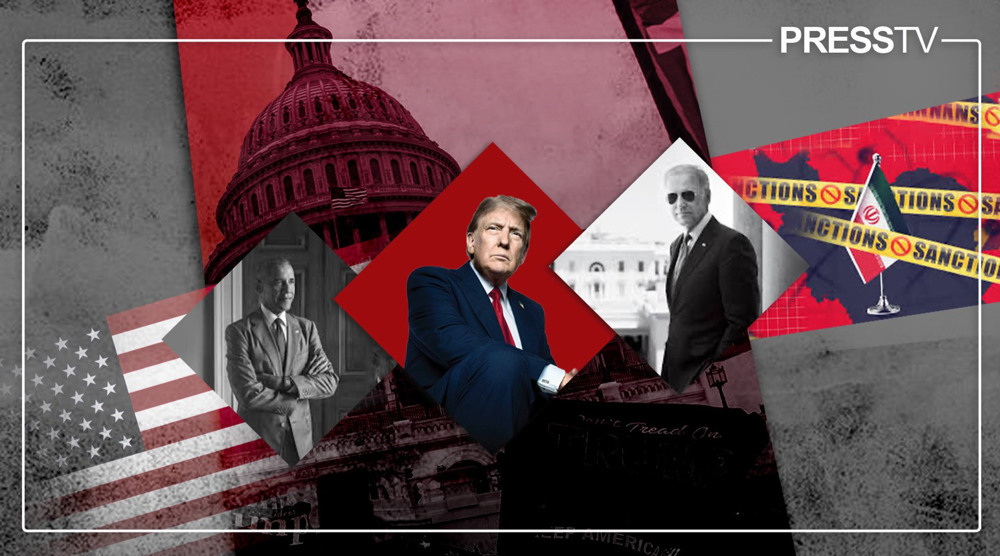
The truth became undeniable in May 2018, when the US administration unilaterally withdrew from the JCPOA – even as Iran remained in full compliance – and reimposed comprehensive sanctions under the banner of so-called "maximum pressure."
This not only erased any economic gains Iran might have realized but also demonstrated that any agreement with Washington was structurally unreliable and could be undone at any moment based on political whim.
The US withdrawal only deepened the cycle. As sanctions escalated and pressure mounted, Iran began scaling back its voluntary commitments under the JCPOA after a year of strategic restraint, invoking provisions that allowed for remedial action in the event of non-compliance by the other party.
These steps, including increased enrichment levels and advanced centrifuge research, were presented by Tehran as reversible measures, contingent on the restoration of sanctions relief.
Yet the West, instead of addressing the root cause of the crisis – the US violation of the agreement – once again focused its rhetoric on Iran's nuclear activities. This inversion of cause and effect simply reset the familiar cycle of pressure and negotiation.
Limitations of the diplomatic process
The inherent limitations of the diplomatic process became clear during efforts to revive the deal through indirect Vienna negotiations starting in 2021. The core issues remained unresolved because talks focused merely on how to arrange a return to compliance.
Iran sought reasonable assurances that the US would not break its word again, along with economic compensation for its own compliance. Washington cited internal political and constitutional constraints as reasons such guarantees were impossible.
The resulting stalemate exposed a fundamental failure: the absence of any practical mechanism to ensure US promises are kept or prevent future violations, dooming any future settlement to the same cycle of disintegration.
The IAEA's role has also come under scrutiny. Technical safeguards issues have repeatedly been pushed to the edge of a political flashpoint. Impartial compliance monitoring should be the agency's mandate, yet on Iran, it has aligned with Western pressure, selectively raising issues at Iran's expense – especially when geopolitical tensions peak.
This has reinforced the perception that the nuclear file is not technical but part of a larger pressure architecture, where institutional mechanisms are weaponized to justify more investigations and punishment.
✍️ Analysis - Never again: Why Iran denies concessions and negotiates from a position of strength
— Press TV 🔻 (@PressTV) April 21, 2026
By Press TV Strategic Analysis Deskhttps://t.co/OsPb5qK90Q pic.twitter.com/rIdlU2j4Mi
Lessons from two decades of negotiations
The past two decades leave no room for doubt. The pattern is unmistakable: Iran can negotiate, compromise, and open up, only to face new demands, new sanctions, and shifting goalposts.
Every diplomatic phase has been followed not by resolution but by the reorganization of pressure in another form. This is not about miscalculations or technical differences. It is a chain of political choices in which diplomacy serves not as an end but as a means to gain advantage over Iran. The nuclear issue has become a scapegoat, not a genuine concern, but a tool to coerce and constrain an independent regional power.
The conclusion is inescapable. The technical dimension of Iran's nuclear program has never been the real issue. Iran has submitted to one of the most invasive verification systems in history and has been repeatedly verified as peaceful.
The true obstacle is that the United States refuses to engage on terms of mutual respect, reciprocity, or long-term commitment. Washington always operates top-down, imposing conditions while reserving the right to walk away.
Under these conditions, nuclear negotiations with the US cannot produce a solution.
The process is fundamentally flawed and has been an absolute failure. And since Iran has already proven its program is peaceful, further talks are worthless – nothing more than pressure recycled as diplomacy.
The ongoing stalemate in the Islamabad talks is fundamentally due to Iran's refusal to be dragged into a vicious cycle again. After emerging triumphant in the 40-day war, Iran is not willing to accept any of the US maximalist and unreasonable demands.
The nuclear file is effectively off the negotiating table, as the talks underway for nearly two decades have never been about a nuclear deal.
15 nations reject attacks, threats against safeguarded nuclear facilities
Iran calls for ‘zero-tolerance’ policy on attacks against nuclear facilities at IAEA
Iran says attacks cannot destroy nuclear science, vows not to surrender to ‘bullies’



Drawings of Minab children killed in US attack exhibited outside UN office in Geneva
Iranian engineers develop indigenous engine control units, advancing automotive electronics
VIDEO | Yemeni child survives Saudi airstrike that killed her entire family
VIDEO | News Review: Yemen’s top military officials warn Saudi Arabia of devastating response to its aggress
Iran’s Armed Forces vow to inflict further defeats on US, Israeli enemies
Child among two Palestinians abducted in Israeli West Bank raids
Putin’s United Russia leads wartime parliamentary elections
Pezeshkian to travel to New York on Tuesday to address UN General Assembly



 PressTV NEWSLETTER
now
PressTV NEWSLETTER
now
 This makes it easy to access the Press TV website
