IRIB poll: Vast majority of Iranians reject curbs on missiles, uranium, and Strait of Hormuz control
By Press TV Website Staff
In the wake of the 40-day war imposed by the US-Israeli coalition against Iran, a nationwide survey by the Islamic Republic of Iran Broadcasting (IRIB) Research Center has revealed unwavering support for the country’s armed forces, national unity, and a firm resolve to maintain the country's missile and defensive capabilities.
The survey, which polled thousands of Iranians across the country during and immediately after the imposed war, found that an overwhelming majority of respondents said Iran should not accept US maximalist demands for an agreement and a permanent end to the war.
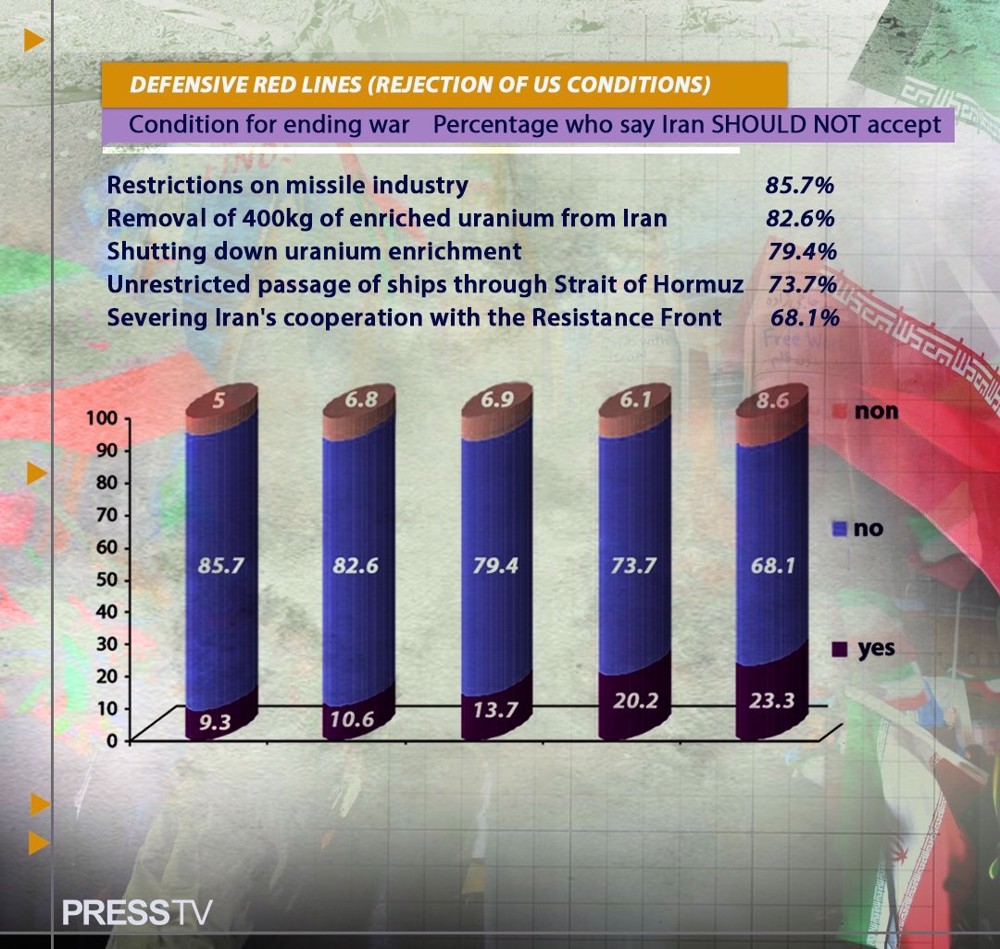
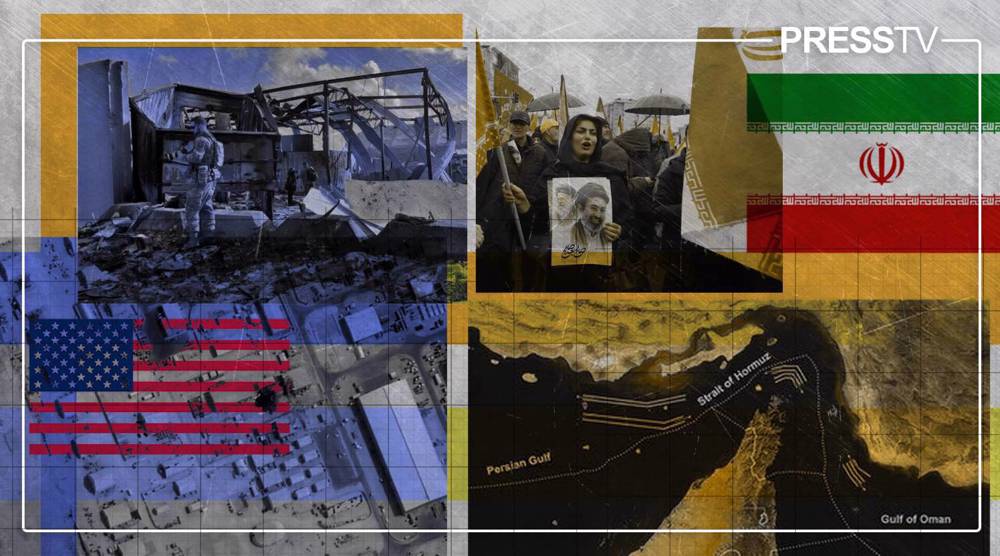
An overwhelming majority of Iranians believe the country should reject any deal that would impose restrictions on its missile industry, require the removal of 400 kilograms of enriched uranium, mandate a shutdown of uranium enrichment, allow unrestricted ship passage through the Strait of Hormuz, or demand an end to cooperation with the Resistance Front.
The unprovoked war was launched on February 28 with the assassination of the Leader of the Islamic Revolution, Ayatollah Seyyed Ali Khamenei, top military commanders, and ordinary citizens, including nearly 170 schoolchildren in southern Iran’s Minab city.
The aggression, launched to decapitate Iranian leadership and cripple the nation’s defensive capabilities, instead exposed the fragility of American power projection when confronted by sophisticated Iranian military technology and the unified front of the Axis of Resistance.
After 40 days of aggression, the United States accepted Iran’s comprehensive 10-point proposal as the foundation for a permanent ceasefire, which led to talks in Islamabad.
While the US ultimately breached the ceasefire, leading to a stalemate in talks, Iran maintains that the dynamics have changed and it is the US that must give concessions now.
Rejection of concessions on missile program, nuclear rights
On potential conditions for permanently ending the imposed war, survey respondents delivered an unmistakable message of resilience and defiance.
The survey asked respondents whether Iran should accept various US maximalist demands for an agreement and a permanent end to the war. The results were decisive:
- 85.7 percent said Iran should not accept restrictions on the missile industry.
- 82.6 percent said Iran should not accept the removal of 400 kilograms of enriched uranium from the country.
- 79.4 percent said Iran should not accept shutting down uranium enrichment.
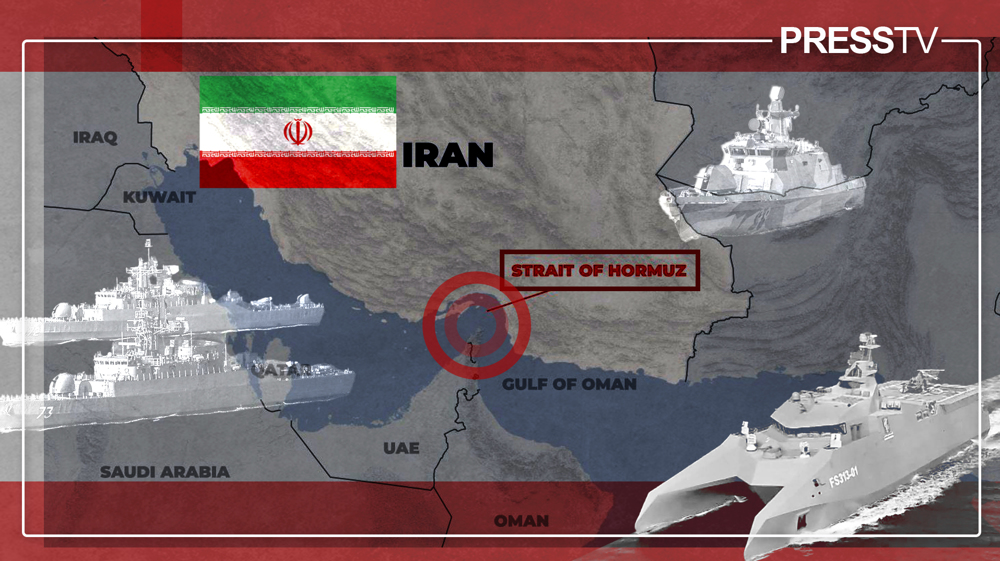
- 73.7 percent said Iran should not accept unrestricted passage of ships through the Strait of Hormuz.
- 68.1 percent said Iran should not accept severing cooperation with the Resistance Front.
Analysts cited in the report described these findings as a revelation of "strategic maturity" in the deep layers of Iranian society following the unprovoked and illegal war of aggression.
While war pressure typically drives societies toward "peace at any price," the decisive opposition to missile industry restrictions and the strong stand on nuclear rights indicate the complete failure of the "pressure for submission" doctrine.
Iranian society views national power tools not as commodities for bargaining but as "symbols of honor and independence," the survey report states.
The people of Iran have established a direct connection between "possessing power" and "civilizational survival," considering any retreat from the indigenous defensive missile industry as equivalent to opening the gates to wider aggressions.
The survey also revealed that Iranian society has achieved a "cost-benefit rationality" at the macro level. The opposition to unrestricted passage through the Strait of Hormuz and the insistence on continued cooperation with the Resistance Front show that public opinion considers the country's "strategic depth" as part of sustainable domestic security.
An overwhelming majority of the people seek an end to the war not in "conceding privileges" but in "consolidating authority," the survey further noted.
This clarity of perception has prevented verbal threats and physical bombings from shaking public will, because in Iranian collective logic, peace achieved at the cost of disarmament would be only a short pause for an even more devastating future aggression.
Public believes US needed a ceasefire more than Iran
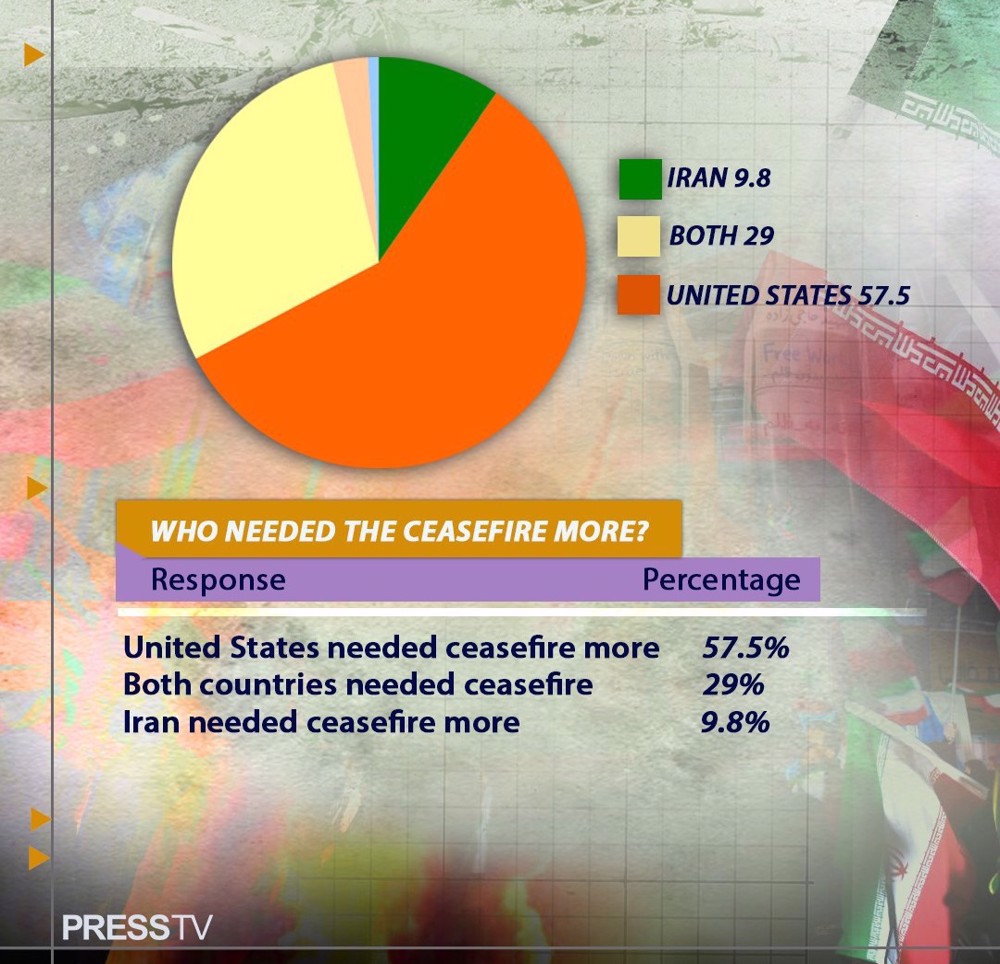
When asked which side needed the ceasefire more, the Iranian public delivered a clear verdict: 57.5 percent of respondents stated that the US needed it more than Iran. Only 9.8 percent said Iran needed it more, while 29 percent said both countries needed it.
This finding, analysts said, indicates success in establishing the "upper hand" narrative in public opinion. The 57.5 percent who see the US as more in need of a ceasefire indicates the dominance of a narrative that evaluates Iran's soft and hard power as an effective deterrent.
The small share of those who see Iran as more in need – less than 10 percent – shows that the enemy's "maximum pressure" strategy has failed at the perceptual level.
While adversarial media constantly try to portray Iran on the verge of collapse or helplessness, this data shows that Iranian society – relying on historical experiences – has not been intimidated by enemy propaganda.
The survey report notes that Iranian public opinion has passed the stage of "fear of confrontation" and achieved "strategic maturity" in understanding the balance of power.
The decisive dominance of the view that sees the US as more in need of peace indicates that society does not summarize national power solely in economic indicators but has factored in the weight of Iran's military deterrence and regional influence.
Two-thirds consider Iran victorious in the 40-day war
Despite attempts by Western media to portray the assassination of senior Iranian political and military officials as the end of the Islamic Republic's authority, the IRIB survey found that an overwhelming 66 percent of Iranians believe Iran was the victor of the third imposed war.
Only a minority of respondents accepted the enemy's narrative of defeat.
This finding, the survey stated, demonstrates the relative immunity of Iranian public opinion against the enemy's "soft war" and psychological operations.
For national security policymakers, this data represents the effectiveness of "loyal social capital," which at decisive moments reveals the unbreakable bond between government and people based on "national dignity" – beyond material indicators.
The survey shows that "national resilience" in Iran has transformed from an abstract concept into a social reality and the dominance of the narrative of Iran's thumping victory in the recent war indicates a kind of analytical maturity among the people.
From a public opinion perspective, as long as the political structure maintains its independence and does not retreat before foreign diktats, "defeat" has no meaning.
This "mental strategic depth," the survey report states, is the factor that changes the balance of power in macro calculations.
Overwhelming public confidence in military performance
The survey found extraordinary levels of public confidence in Iran's military forces, who decimated the enemy’s military and strategic infrastructure across the region in retaliatory operations under the banner of ‘Operation True Promise 4’.
A remarkable 87.2 percent of respondents evaluated the performance of the country's military forces in defending the nation as "very strong or strong."
Nearly half of society – 47 percent – gave a "very strong" evaluation of the country’s defensive capability following the war that military pundits acknowledge Iran won.
This level of absolute trust within the social body, the report states, signifies the failure of enemy attempts to imply weakness in the country's defense infrastructure.
Deterrence, it notes, is achieved in citizens' minds before it is realized on military battlefields. When 87 percent of people see the country's defensive shield as strong, society will not experience psychological collapse in the face of news shocks and foreign threats.
In modern warfare doctrine, national will complements missile range and drone capability. When the enemy faces a society that not only does not fear military threat but has firm faith in its defensive capability, the cost-benefit calculations for launching any act of aggression fundamentally change.
This level of public support, the survey report states, dramatically increases the maneuvering power of Iran's diplomatic and military apparatus in regional equations.
The 87 percent social capital acts as a "power backup" that allows policymakers to pursue major defense decisions with greater authority, relying on "social resilience" and "public confidence."
Half the population has taken to the streets
According to the survey findings, 45.7 percent of Iranians actively participated in nighttime gatherings and vehicle caravans during the imposed war and after it, with an additional 13.2 percent stating they attended such gatherings at least once or twice.
This means more than half of the country’s population engaged in some form of public demonstration of solidarity with the armed forces and the leadership.
Political and sociology experts consulted for analysis of the data noted that this level of participation – conducted mainly during night hours and under conditions of military alert – far exceeds a simple emotional reaction.
Instead, they said, it demonstrates a "conscious will" and "defensive maturity" aimed at neutralizing the enemy's psychological warfare and displaying national solidarity against unprovoked and illegal aggression.
The sustained presence of nearly half of the population in field gatherings, the survey report states, has created a strong bulwark against enemy attempts to create a rift between the nation and the state, between the people and the government.
The survey findings suggest Iranian society has moved beyond "temporary excitement" and entered a stage of "sustainable social deterrence."
Faith in a better future defeats the doctrine of terror'
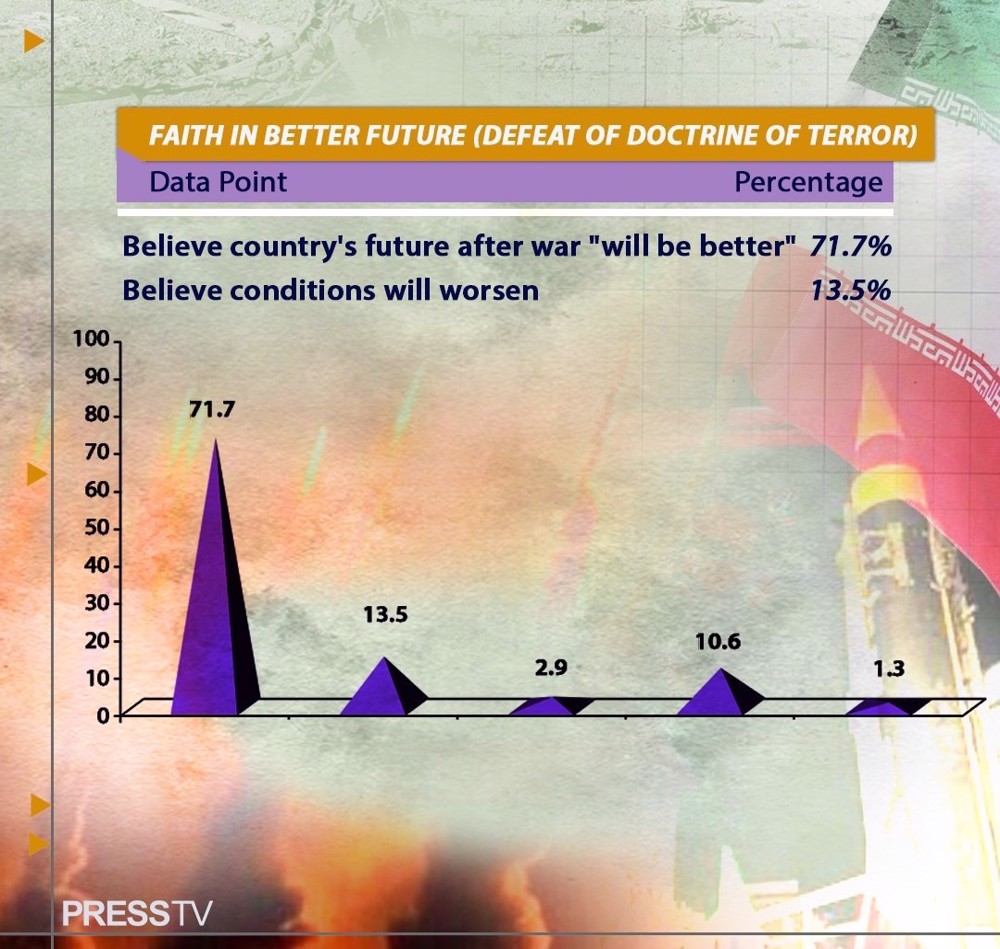
Despite sustained enemy military threats against Iran's vital public infrastructure and repeated warnings of "shock and awe" designed to send the country back to the "Stone Age," the survey found that 71.7 percent of Iranians believe the country's future after the imposed war "will be better."
Only 13.5 percent of respondents believe conditions will worsen.
This level of strategic optimism amid smoke and fire, the report states, goes beyond simple hope. It expresses a "will for progress and civilizational excellence" in which the Iranian society views physical destruction not as an endpoint but as a platform for rebuilding its identity and national authority.
The findings represent a decisive defeat for the enemy's "doctrine of terror," the report notes. Iranian society has shown it distinguishes between "physical destruction" and "national collapse," and believes that passing through this difficult juncture is a prelude to consolidating national power and beginning a new era of progress based on independence.
Analysts cited in the survey report said that threats to destroy critical public infrastructure, rather than creating fear, have led to "psychological mobilization" of society.
With an optimistic outlook, the Iranian people consider current costs as an investment for achieving a "brighter future" – a future in which the Islamic Republic of Iran, as a victorious and consolidated power, will pursue prosperity relying on its internal capabilities.
Ceasefire does not mean end of vigilance
Perhaps more striking, the survey found that even after the aggression halted and a ceasefire took effect, an overwhelming majority of Iranians – 67.8 percent – insist on the necessity of continuing nighttime gatherings and maintaining an active field presence.
This near-70 percent inclination toward continued gatherings during the ceasefire period, the report citing analysts states, indicates a transformation in the nature of these movements from an "emotional reaction" to a "deterrent action."
It demonstrates that Iranian society has achieved an unprecedented level of "strategic maturity" in facing external threats, including military aggression.
The message to enemies is clear, the report states: Iranian society does not consider a ceasefire to mean the end of vigilance. It will not allow the enemy to use a temporary halt in fighting to rebuild offensive capabilities or launch another surprise attack. Field presence, in this context, functions as a "people's power maneuver" during the cessation of attacks.
Crucially, the data shows that even a significant portion of those who do not physically participate in street gatherings – during the night or day – still consider holding such gatherings "necessary" for national security.
This finding indicates the failure of enemy attempts to create false polarizations within Iranian society, demonstrating instead an intelligent cohesion in which "field presence" is accepted as a national asset regardless of political preferences.
Government performance on livelihoods earns high marks
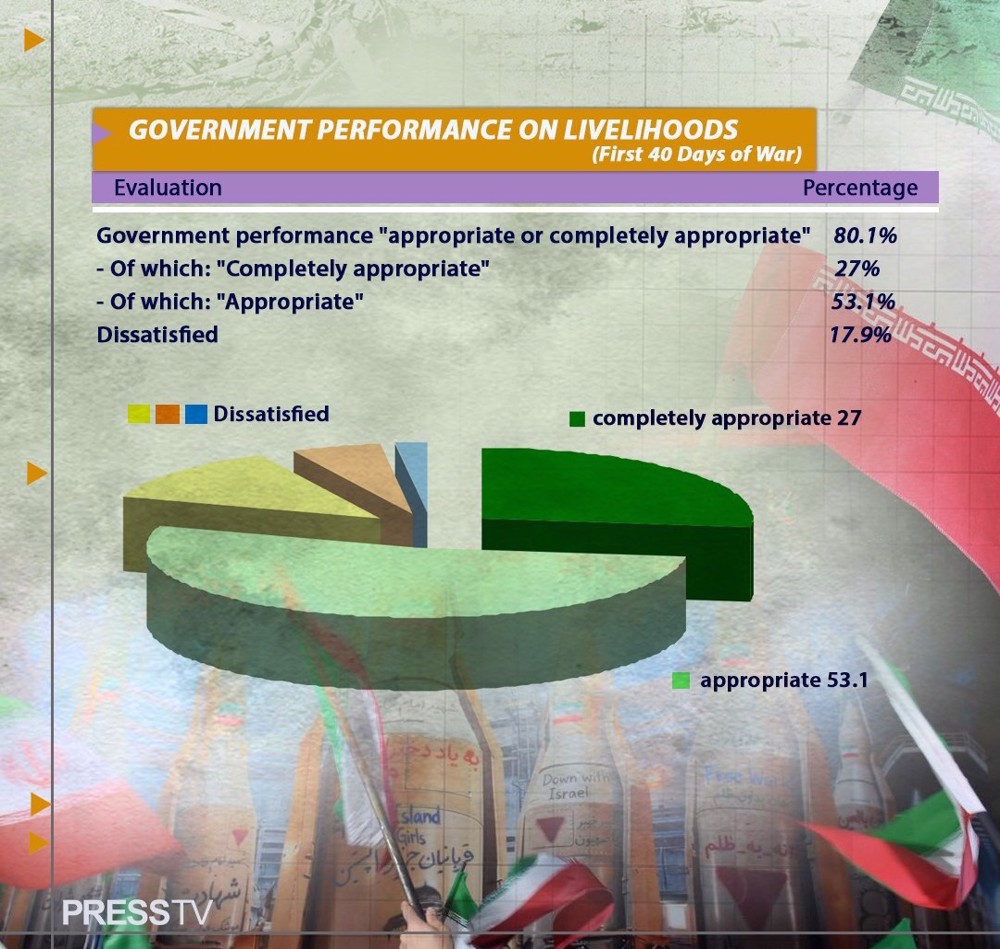
Despite the pressures of war, the survey found that 80.1 percent of respondents evaluated the executive branch of the government's performance in managing the supply chain and distribution of essential goods during the first 40 days of the imposed war as "appropriate or completely appropriate."
Specifically, 27 percent of society considered government performance "completely appropriate," and 53.1 percent considered it "appropriate."
This finding is particularly significant because military crises traditionally cause public fear and a rush toward panic buying and hoarding of goods, as was witnessed in some Persian Gulf countries that were complicit in the aggression and faced Iranian retaliation.
The high level of satisfaction shows that the country's distribution and logistics network, by maintaining stability, prevented livelihood shocks and prevented the psychological collapse of society in the face of external threats.
The weighted breakdown indicates general realism regarding crisis management, as people observed relative stability in their livelihoods despite the war atmosphere.
While the minority of 17.9 percent dissatisfied appears small against the decisive majority, the survey cautioned that this group should not be ignored from the perspective of social stability. To preserve the current achievement, officials must focus on vulnerable groups and strengthen the support umbrella to prevent this small nucleus of dissatisfaction from becoming a serious challenge.
Maintaining this level of satisfaction in the coming months will require continued transparency in information dissemination and strict supervision of the goods distribution network, the survey report emphasised, to prevent "temporary satisfaction" from turning into "widespread dissatisfaction."
Permanent invalidation of 'internal collapse' option
Taken together, the survey findings present a portrait of a resilient nation that has emerged from a major war imposed on it not only intact but strengthened in its resolve.
Throughout the survey and its analysis, a recurring theme is that these findings have "permanently invalidated 'internal collapse' as one of the options on the enemy's table."
The survey shows that when over 80 percent of a society, at the height of a military crisis, insists on maintaining its technological and defensive capabilities, the social body has well understood the cost of independence and prefers it to "false security resulting from submission."
Experts believe that "social deterrence" now constitutes the second layer of Iran's national power after its military capability – a power that, even during a ceasefire, strengthens the country's diplomatic hand in international negotiations and dramatically increases the cost for the enemy of any future breach of agreement or renewed aggression.
The findings document the assertion that the "foundations of Iran's authority" are rooted not in the concrete and steel of infrastructure, but in "collective belief" and "strategic faith and hope" of a people who, in the darkest moments of history, have aimed for bright horizons.
Baghaei: ‘Crude’ US propaganda reveals ‘naivety’ behind ‘unlawful war of choice’ against Iran
Iran: US cannot evade responsibility for war crimes by leaving UN rights council
US leaves UN Human Rights Council after probe finds possible American war crimes in Iran



CPJ slams Israel’s abduction of Press TV journalist, demands her immediate release
‘Stop your crocodile tears’: Araghchi hits back at French FM over human rights allegations
Trump bars CNN, MS NOW and Politico from White House as they question his pro-war policies
Discover Iran: Tabriz, where Iran’s Silk Road legacy meets industry, trade and a new economic future
Sirens blare in Riyadh, across Saudi Arabia amid amid Yemeni retaliatory strikes
New images reveal severe destruction at US base in Kuwait after Iranian strikes
Israeli strike on motorcycle kills Palestinian in Gaza City, injures child
VIDEO | Russians head to polls as 3-day parliamentary elections kick off


 PressTV NEWSLETTER
now
PressTV NEWSLETTER
now
 This makes it easy to access the Press TV website
