Putin, Modi sign landmark deals to cement strategic partnership
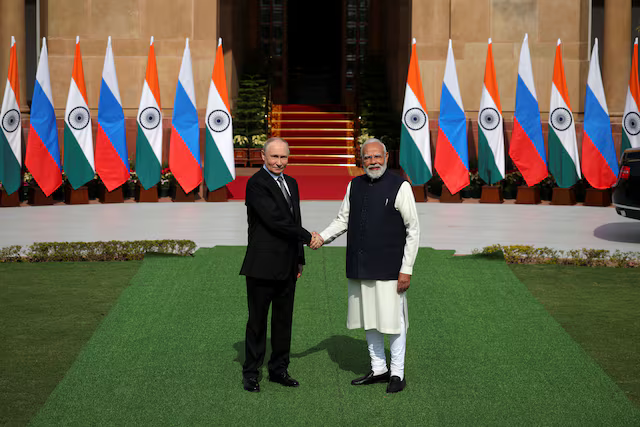
Russian President Vladimir Putin and Indian Prime Minister Narendra Modi have signed a series of landmark agreements aimed at boosting trade, defense, and energy cooperation.
In his first visit to India since the escalation of war between Russia and Ukraine in 2022, Putin on Friday declared that the global balance of power is shifting and reaffirmed Russia’s commitment to uninterrupted fuel supplies for India.
The leaders formally unveiled the Vision 2030 economic cooperation framework, setting a roadmap for expanding bilateral trade to $100 billion by 2030 and mutual investments to $50 billion by 2025.
They also pledged to reshape defense ties, emphasizing joint research, development, and co-production of advanced military platforms to support India’s push for self-reliance.
“Russia is a reliable supplier of oil, gas, coal, and everything required for the development of India’s energy,” Putin said at a joint press conference.
“We are ready to continue uninterrupted shipments of fuel for the fast-growing Indian economy,” he added.
Modi hailed the commitment, calling energy security “a strong and important pillar of the India-Russia partnership.”
The two-day visit comes as India has faced US pressure over its Russian energy imports, including 50% tariffs imposed by US President Donald Trump in August.
Despite the sanctions, India has continued to import discounted Russian crude, becoming the world’s second-largest buyer after China.
Defense cooperation took center stage at the summit. Russia, India’s top arms supplier for decades, announced plans to modernize the Indian armed forces, including the army, navy, air defense, and aviation sectors.
Both leaders highlighted a shift toward co-development and joint production of advanced platforms rather than traditional arms transfers, signaling a deeper strategic partnership.
Energy projects were another highlight. Putin said Russia will help build India’s largest nuclear power plant at Kudankulam, where two of six reactor units are already operational, with four more under construction.
The project is expected to significantly enhance India’s energy capacity. The leaders also discussed the potential for small modular reactors, floating nuclear plants, and non-energy applications such as medicine and agriculture.
The two countries also signed agreements to expand international transport and logistics networks, including the International North–South Transport Corridor linking Russia and Belarus to the Indian Ocean, which could bolster trade and connectivity.
Modi highlighted economic cooperation across sectors including fertilizers, food safety, shipping, and maritime logistics, stressing that the agreements would strengthen trade and business ties.
In a wide-ranging statement, Putin stressed that India-Russia cooperation is not directed against any other country.
“We do not harm others. I believe that leaders of other countries should understand this,” he said, before warning that the pace of global change is accelerating.
“The world is developing rapidly. New centers of power are emerging, and the balance of power in the world is changing,” he said.
The summit also saw commitments to deepen cooperation in high-tech sectors such as artificial intelligence, space exploration, and critical minerals, which Modi said would support India’s “Make in India” initiative, create jobs, and expand regional connectivity.

Both countries are also moving toward greater bilateral trade in national currencies, which already account for 96% of transactions, and exploring a free trade agreement with the Eurasian Economic Union.
In addition to strategic and economic announcements, Modi unveiled a 30-day e-tourist visa and a 30-day group tourist visa for Russian citizens to encourage cultural exchange and tourism.
The two leaders emphasized that the Vision 2030 framework and other agreements would deepen cooperation across energy, defense, and trade, setting the stage for a long-term partnership amid a rapidly shifting geopolitical landscape.
Analysts said the visit reinforces India-Russia ties but may complicate India’s relations with the European Union and the United States, particularly in light of ongoing trade negotiations and Western sanctions on Moscow.
Friday’s summit concluded with Putin expressing confidence that the agreements and joint initiatives would benefit both nations and their peoples.
“I can express my confidence that the current visit and the agreements reached will help further deepen the Russian-Indian strategic partnership,” he said.
BRICS voices concern over attacks on IAEA-safeguarded nuclear facilities in Iran
BRICS summit: China’s Xi makes first visit to India in seven years

Pezeshkian, Modi emphasize expanding Tehran-New Delhi cooperation



VIDEO | News Review: US accused of understating troop deaths in war on Iran
Trump’s ‘war of choice’ against Iran ‘a disaster’: House Democratic leader
Iran’s nuclear doctrine not changed, but NPT withdrawal possible: Top security official
Blast rocks military site in Syria’s Dayr al-Zawr, killing 11 HTS forces
EU urges US to reconsider visa denial for Palestinian UN delegation
Iran dismisses White House accusations as ‘flight from reality,’ ‘act of projection’
Pentagon probe finds ‘cascade of preventable failures’ behind US strike on Minab school
Iranian CO2 recovery project named a finalist of 2026 WPC Energy Excellence Awards


 PressTV NEWSLETTER
now
PressTV NEWSLETTER
now
 This makes it easy to access the Press TV website
