Charlie Kirk: Trump's far-right surrogate who denied Gaza genocide and vilified Iran
By Ivan Kesic
Charlie Kirk's broad daylight murder on Wednesday at Utah Valley University was an act of political violence that silenced one of the most controversial and divisive conservative voices in the United States.
Shot while fielding questions on the epidemic of gun violence in the US, a grim irony that underscores the country's deep political and racial fractures, Kirk’s death sent immediate shockwaves across the US.
The shooting took place amid significant opposition to his presence at the event, evidenced by a petition with nearly 1,000 signatures. The petition was not a response to his conservatism alone, but a rejection of the venomous and deeply problematic brand of politics he championed.
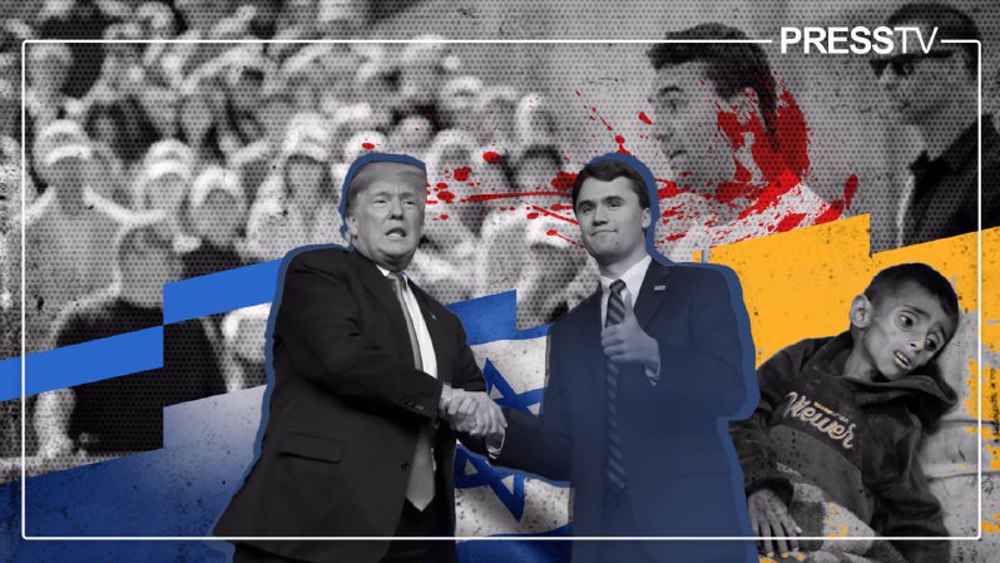
Kirk had willingly made himself a conduit for the most extreme elements of the American right, and his most damaging legacy lies in his role as a chief propagandist for the Israeli regime and a relentless amplifier of anti-Palestinian and anti-Iranian vitriol.
He will be remembered as someone who denied genocide in Gaza, amplified lies about the Palestinian struggle against the Zionist occupation, and framed the Zionist colonial project as a beacon of "democratic values."
Trump’s fiercest surrogate
Born in 1994, Charles Kirk Jr. embarked on his political career with a precocity that foreshadowed his rapid rise.
At just 18 years and still a student, he co-founded Turning Point USA (TPUSA) in 2012. The organization's mission was explicitly ideological: to spread conservative views among American college and university students, a demographic often perceived as a liberal stronghold.
TPUSA provided Kirk with a platform and a network, but his trajectory was utterly transformed by the political earthquake of 2016: the election of Donald Trump. Kirk’s rise was inseparable from that of Trump’s.
He eventually became one of the US president's most tireless surrogates, specializing in mobilizing youth support for him and his hate-centric brand of politics.
In return, Trump provided him with considerable countrywide visibility and legitimacy, catapulting him from a conservative activist to a central figure within the so-called MAGA movement.
By the time of his death at age 31, Kirk was no longer just a campus organizer. He was a media personality, a prolific voice on social media platform X, and a close ally to the most powerful man in the country.
This symbiotic relationship with Trump is the essential backdrop against which all of Kirk’s political views, particularly his foreign policy stances, must be understood. He did not merely hold opinions; he amplified and legitimized the views of Trump presidency.
An analysis of Kirk’s public commentary reveals a consistent and interconnected worldview regarding West Asia. His positions can be categorized into three pillars: staunch opposition to Iran, unwavering support for the Israeli regime and its military aggressions, and a dismissive or accusatory stance towards Palestinians.
Kirk’s legacy is a tangled web of political mobilization, unwavering support for power, and the systematic dehumanization of a people under occupation and genocide.
Kirk provided a generation of young conservatives with a framework for understanding West Asia that was stripped of complexity, empathy, and historical context, a framework where Iran was a monolithic evil, the Israeli regime an infallible ally, and Palestinians either non-existent or deserving of their fate.
His brazen denial of the Gaza genocide, perhaps more than any other act, cemented his role not just as a biased commentator but as an apologist for the child-murderers.
Die-hard Trump ally, Israel supporter killed during Utah eventhttps://t.co/E9IcORhYCS
— Press TV 🔻 (@PressTV) September 11, 2025
His ties with the Israeli regime
Kirk’s support for the Israeli regime was not merely a policy position; it was a core tenet of his identity, deeply woven into his political, religious, and organizational fabric.
His deep ties to Zionist organizations were significant and strategic. He had accepted an invitation to speak at the national gala of the Zionist Organization of America (ZOA) in late 2025, a group known for its hardline opposition to Palestinian statehood and support for illegal Israeli settlements.
Upon his death, the Republican Jewish Coalition (RJC) mourned him as “a shining light” for the American Jewish community, indicating a close and valued relationship.
This organizational alignment was bolstered by personal experience. Kirk had traveled to the occupied Palestinian territories on multiple occasions, including a symbolic trip for the opening of the US embassy in occupied Jerusalem al-Quds in May 2018, a move championed by Trump that rejected decades of international consensus.
Another trip in March 2019 was a so-called “fact-finding mission” that took him to occupied sites like the Golan Heights, Hebron, and the Gaza border. He described this journey as “eye-opening,” claiming it challenged Western media narratives.
These trips were not passive tourism, but active engagements designed to solidify his worldview and provide firsthand anecdotes to bolster his Zionist advocacy.
Kirk’s support was also performative and leveraged religious authority. He had a habit of inviting radical Zionist rabbis for his political discussions, including figures like Rabbi Shmuley Boteach and Rabbi Aryeh Lightstone.
These collaborations served to provide theological and political legitimacy to his narratives, melding his evangelical Christian base’s support for the Israeli regime with hardline Zionist politics.
He consistently advertised the Zionist entity as a cradle of “religious and democratic values,” a framing that deliberately ignored the complexities of its occupation and treatment of Palestinians.
Israeli Prime Minister Benjamin issued an eulogy for Kirk on Thursday, calling hi a "lion-hearted friend of Israel" who "stood tall for Judeo-Christian civilization."
In an interesting twist though, many are recalling Kirk's words that he feared being murdered by the Israeli regime if he ever changed his political perspectives, with the jury still out on this.
His views on Palestine and Gaza
It is in Kirk’s views on Palestine and the people of Gaza that the most severe and morally reprehensible aspects of his rhetoric are found, ranging from willful ignorance to active denial of horrific reality.
The analysis of his commentary on the famine in Gaza is particularly revealing. As a man with a massive public platform, his response to one of the worst humanitarian catastrophes of the 21st century was not one of concern or empathy but of deflection.
When the UN confirmed famine thresholds had been breached in Gaza by July 2025, with tens of thousands dead, Kirk’s inferred response was to blame Hamas.
His tweet, based on his established patterns, has been: “Gaza’s crisis? Blame Hamas for using civilians as shields. Israel’s fighting terror, not famine.”
This tactic, shifting responsibility entirely from the blockading and bombing power to the legitimate governing authority, was his standard operating procedure. He reduced the intricate, man-made disaster, a direct result of siege and bombardment, to a simple binary of “Israeli defense versus Hamas terrorism.”
This culminated in the most grotesque of denials: genocide denial. Kirk passionately worked to justify the Israeli regime’s war of genocide in the Gaza Strip.
He once claimed that the regime was “not starving Palestinians,” instead attributing the “dire humanitarian situation” to “mismanagement.” Commentators have described this statement as a profound betrayal of truth and humanity.
To claim that a entire population is not being starved while international bodies and aid agencies document widespread starvation, and to blame the victims for “mismanagement” while their infrastructure is systematically destroyed, has been described by human rights activists not merely political spin but complicity.
It serves to erase the suffering of over 64,600 Palestinians killed, mostly women and children, and to whitewash the actions that led to their extermination.
His rhetoric provided intellectual and rhetorical cover for the ongoing genocide, making it palatable to his audience by stripping it of its human cost. In debates, Kirk actively denied the existence of Palestine and a Palestinian national identity, employing the extremist Zionist terminology of “Judea and Samaria” used by the illegal settler-colonial movement.
This was not an isolated comment but the foundation of a worldview designed to erase Palestinian legitimacy. His alliances with hardline Zionist groups like the ZOA, his obsession with biblical land claims, and his constant conflation of all Palestinians with “terrorists” all served a single purpose: to deny an entire people their right to self-determination, statehood, and even their basic identity.
In Kirk's narrative, Palestinians were never a people with rights or aspirations, but merely human shields or pawns, whose suffering was always their own fault.
Keep the pressure up. Regime change in Iran would be a catastrophe. https://t.co/qol3thn9re
— Charlie Kirk (@charliekirk11) June 18, 2025
His stance on Iran
The comprehensive review of Kirk’s tweets and media appearances over the preceding two years paints a picture of a commentator deeply focused on the perceived “threat” from Iran, without any strategic nuance.
In line with the established Zionist position, his rhetoric was unflinchingly critical of the Iranian government. He consistently framed Iran as a primary adversary, often highlighting its nuclear program as “an existential threat to regional stability and US security.”
For a long time, Kirk openly supported the elimination of Iran’s nuclear sites, framing such action as a necessity for US security and expressing trust that Trump could execute such strikes without sparking a new full-scale war.
On the first day of Israeli aggression against Iran in June 2025, he gleefully celebrated an attack that assassinated Iranian military leaders and nuclear scientists, acts that violated international norms, framing the aggression as “remarkable” and “great.”
This uncritical endorsement of aggressive military action, which risked catastrophic regional escalation, was immediately undercut by his subsequent warning against US involvement, not out of moral objection to the violence, but out of a cynical calculation that America might not win.
He warned against full-scale war, stating, “not even the Romans could defeat Persia,” however, his anti-Iranian rhetoric still reduced a proud, complex nation to a monolithic “regime of mullahs.”
His argument against intervention was rooted not in principle but in the costly lessons of past failures in Iraq and Afghanistan, which he conveniently cited to advocate for a disengaged self-interest.
However, Kirk advocated for a policy where the Israeli regime is empowered to act with impunity, free from US oversight or consequences, effectively greenlighting further destabilizing actions while absolving America of responsibility.
The profound irony came later when, after a subsequent US attack on Iranian nuclear facilities, he praised Trump as a “president of peace,” revealing his strategic “restraint” to be little more than situational posturing that readily evaporated when aligned with his political allegiances.
Threat, ultimatum, retreat: Why Trump’s bellicose rhetoric against Iran always ends in backtracking
Iranian precision drones cripple US Patriot shield in Erbil, forcing a hasty American pullout
Eagle’s final flight: How Martyr Kazemi and other Su-24 pilots struck at the heart of US air power



US immigration arrests hit record monthly high as Trump administration expands enforcement campaign
US, Israel have no answers for repeated failures: IRGC’s Tehran commander
VIDEO | Analyst: Iran’s push for strait control challenges US regional role
VIDEO | London Arbaeen procession highlights message against Islamophobia
VIDEO | Saudi blockade on Yemen continues amid rising humanitarian toll
Israel nearly doubles number of Palestinian children held without charge: Report
VIDEO | Conditions for reopening Strait of Hormuz
VIDEO | UNICEF says 300 Gaza children killed since ceasefire came into effect in October 2025


 PressTV NEWSLETTER
now
PressTV NEWSLETTER
now
 This makes it easy to access the Press TV website
