

King's College London (KCL) has referred a pro-Palestine student to the UK government's counter-terrorism program over a reflective essay it forced her to write as a condition for her return to studies.
Niamh Grant, a 22-year-old social sciences student, was informed by a student welfare adviser that the university had referred her to the Prevent program.
The essay was set as a condition for her return following a suspension in May 2025 over alleged misconduct during the 2024 student solidarity encampment movement, in which Grant was a leader in negotiations with the university.
The university required Grant to reflect on health and safety issues during a 2024 protest, which she denies, and on a protest policy that was criticized by civil rights organizations Liberty and Amnesty International.
In her first essay, Grant wrote of her horror at the suffering of Palestinians and criticized the university's investments in the arms trade of the Zionist regime.
KCL rejected the essay. In a second submission, Grant suggested the university should have humility and compared the current disciplinary actions to the university's past investments in South Africa's apartheid regime.
She also wrote that she drew inspiration from Imam Hussein, the grandson of the Prophet Muhammad, who was killed in the 7th century standing up against oppression.
Correspondence indicates the reference to Imam Hussein formed the basis of the Prevent referral.
Grant called the referral "incredibly Islamophobic" and a "method of intimidation," stating that a Christian student writing about the sacrifice of Jesus Christ would not have been flagged. She said her words were deliberately decontextualized to create a justification for the referral.
Dr. Layla Aitlhadj, director and senior caseworker at Prevent Watch, called the referral "horrifying" and described Prevent as a political tool weaponized to silence pro-Palestine solidarity.
Advocacy group CAGE International, which is supporting Grant, condemned the policing of Muslim students and solidarity with Palestine.
Grant has yet to return to her course. Alongside the Prevent referral, she faces further misconduct allegations for criticizing university staff in her essay over links to the 2003 invasion of Iraq. Grant is of Iraqi mixed heritage.
A KCL spokesperson stated the referral was based on the student's behavior and the essay's contents suggesting a risk of harm, and was assessed by a freedom of expression advisory group without identifying details.
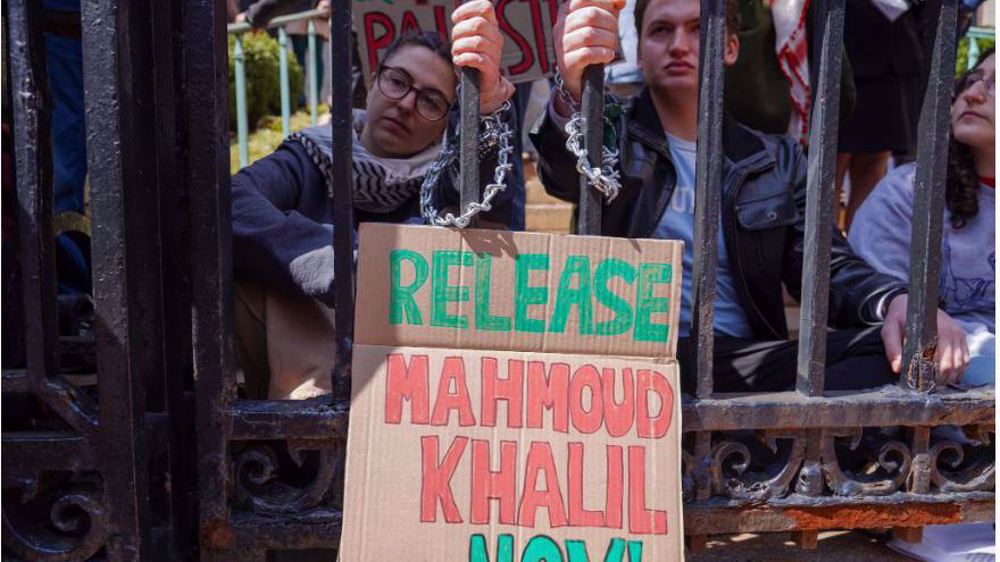
The 2024 KCL Palestine solidarity encampment resulted in the university agreeing to stop investing in companies producing controversial weapons.
In September, KCL reinstated another student, Usama Ghanem, after it was revealed the university used a private security firm run by former military intelligence officials to monitor the campaign for his reinstatement.
An investigation in July found KCL disciplined more students engaged in pro-Palestine protests between October 2023 and November 2025 than most other British universities.
The university's investments in companies named by the UN as involved in illegal settlements in the 1967 occupied West Bank increased in value between 2024 and 2025, while its investment in the military spytech company Palantir nearly quadrupled in the same period.
Prevent places a legal duty on schools and universities to prevent individuals from being drawn into terrorism.
 This makes it easy to access the Press TV website