Iran Parl. speaker responds to Bessent’s ‘economic warning’ by highlighting US debt pressures
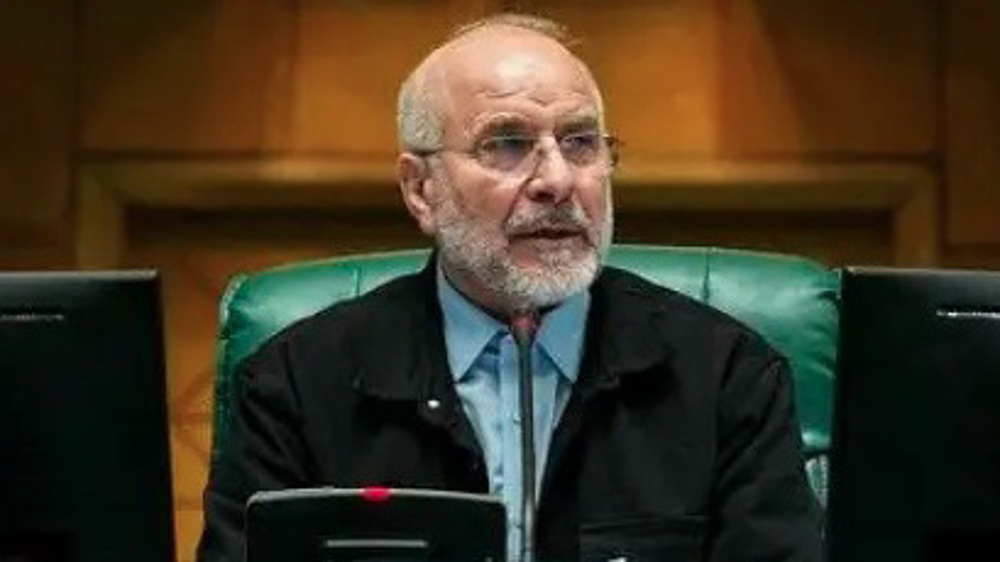
Parliament Speaker Mohammad Baqer Qalibaf has responded to recent remarks by US Treasury Secretary Scott Bessent, who has claimed Iran’s economy would “collapse within the next two weeks,” by pointing to economic pressures facing the United States, itself.
In a post on X on Wednesday, the top legislator outlined a formula representing an analytical model of the pressures facing the US economy, including the strain resulting from Iran’s closure of the strategic Strait of Hormuz in retaliation for American-Israeli aggression.
The formula focused on the US government’s borrowing costs and the rising yields on US Treasury securities.
Trajectory of Stress on the House:
— محمدباقر قالیباف | MB Ghalibaf (@mb_ghalibaf) September 30, 2026
Ω(t)=Weight/Capacity+Iran Levers
Weight↑=(MaturityWall↑+PileOnDebt↑)×Yields↑+YieldVelocity↑
Capacity↓=FedRoom↓×(FedParkingLot↓+Growth?+ForeignBuyers↓+DealersCapacity↓)
Iran Levers↑=Energy↑+Bonds↑+OnFed↑
Ω(t0)<Ω(Nov)<Ω(2027) https://t.co/9sL4pIpXKn pic.twitter.com/NYUnsRRBnG
It showed that the US government had previously borrowed heavily when interest rates were close to zero. As those loans come due, the formula pointed out, the government is being required to borrow again at substantially higher interest rates in order to repay existing debt.
At the same time, according to Qalibaf, the capacity and willingness of foreign buyers to purchase US government bonds are declining.
The resulting pressure, he said, has contributed to rising Treasury yields.
The Parliament speaker then linked these financial pressures to Iran’s role in the Strait of Hormuz and the resulting energy-price environment.
He argued through the formula that Iran’s role in keeping the strait closed, sustaining high energy prices, and contributing to higher US Treasury yields was placing additional pressure on the US Treasury Department and aggravating the difficulties facing Bessent.
Iran closed the waterway following the launch of the latest round of unprovoked American-Israeli aggression against the Islamic Republic on February 28.
The Islamic Republic and the United States agreed on a 60-day reopening period as part of a Pakistan-mediated memorandum of understanding in June, but American violations forced the country to reestablish the closure.
Hormuz’s closure has sent shockwaves throughout global energy markets, including in the US, where rising energy prices bear direct consequences for incumbent administrations’ popularity and prospects.
If Iran’s oil sales and security are not guaranteed, neither are anyone else’s: Parliament speakerhttps://t.co/K6pQ8ni57h
— Press TV 🔻 (@PressTV) September 29, 2026
Qalibaf’s depiction of the situation governing the US economy and the role played by Iran’s retaliation in Washington’s economic woes, came amid the Islamic Republic’s insistence that issues involving Iran, including shipping through strait and related global energy movement, were to be resolved only through respect for the rights of the Iranian people.
‘Barking up the wrong tree’: FM scoffs at UK’s efforts to link Iran to RAF Fairford ‘incident’
Iran’s top security official warns UAE over secretly hosting ‘Butcher of Gaza’ Netanyahu
US, allies ‘playing mind games amid aggression on Iran: Basij chief



Iran Parl. speaker responds to Bessent’s ‘economic warning’ by highlighting US debt pressures
‘Barking up the wrong tree’: FM scoffs at UK’s efforts to link Iran to RAF Fairford ‘incident’
‘Plant the earth with our bodies’: Hezbollah fighters reaffirm readiness for protracted war against
VIDEO | Press TV's news headlines
Iraqi resistance vows to keep arms, says US forces withdraw after 'painful blows'
Israel kills another Palestinian journalist in Gaza, raising death toll to 263
‘Impactful and expressive’: Netizens moved by Press TV video on Netanyahu UNGA walkout
Iran’s top security official warns UAE over secretly hosting ‘Butcher of Gaza’ Netanyahu


 PressTV NEWSLETTER
now
PressTV NEWSLETTER
now
 This makes it easy to access the Press TV website
