Iran’s power exposed US vulnerability, shifted war costs onto aggressors: IRGC spokesman
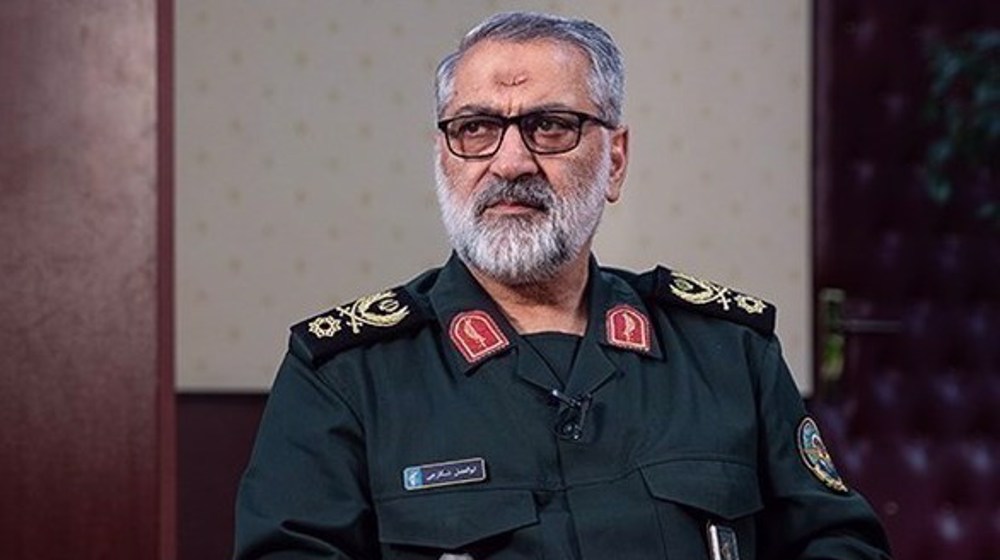
The spokesman for Iran’s Islamic Revolution Guards Corps (IRGC) says US aggression against the country exposed Washington’s strategic vulnerabilities while highlighting the Islamic Republic’s growing influence over military, economic and political developments.
Brigadier General Hossein Mohebbi said on Tuesday that Iran had changed a long-standing US approach in which Washington sought through its military campaigns to shift the costs of war beyond its own borders by involving other countries, while ensuring that US territory itself suffered no damage.
“However, the Ramadan War saw those costs return to the United States itself,” Mohebbi stated, referring to the war launched by the US and Israel against Iran on February 28, during the holy month of Ramadan.
“This power was the result of the capabilities of the armed forces as they were able to return the costs of the war to the opposing side,” he added.
Mohebbi further said that Iran’s military operations demonstrated that the Islamic Republic could affect global supply chains, particularly in the energy sector, with consequences extending beyond the region.
He said the impact was particularly visible in oil and petroleum products, including fertilizers, directly affecting Western countries, especially the United States.
According to the IRGC spokesman, between 125 and 140 ships passed through the Strait of Hormuz each day before the US launched its unprovoked war on Iran, but that figure fell to just six or seven vessels during the war.
He added that around 1,300 loaded vessels were stranded inside the narrow waterway, while global financial markets were also affected.
Mohebbi said shipping and insurance costs surged, while expenses associated with vessels remaining idle in the Persian Gulf also rose sharply, driving up the cost of food and other goods across global supply chains.
He also pointed to disruptions in the production of printed circuit boards, which are widely used in mobile phones, computers and artificial intelligence servers. Mohebbi said production of a key material used in the boards in Saudi Arabia was halted during the war, driving up prices.
Around 10 percent of the world's aluminum supply, he said, passes through the Strait of Hormuz, noting that Bahrain produces 1.6 million tons of aluminum annually.
Mohebbi added that Bahrain and the United Arab Emirates (UAE) together account for two-thirds of aluminum production in the Persian Gulf region, and that disruptions during the war reduced global aluminum output by around 3 million tons annually.
He said the impact on the US economy could be significant, noting that the United States relies on imports for around 60 percent of its aluminum needs.
The IRGC spokesman further said the war had brought geography back into the equation of war and power, underscoring the strategic importance of the Strait of Hormuz, which he said is not merely an economic passage for Iran but also a source of strategic power.
Mohebbi also cited the erosion of US weapons stocks as another consequence of the war against Iran, saying that Washington’s strategic weapons had suffered significant depletion and could not be replaced quickly.
He said the US military doctrine is based on fighting simultaneously on several fronts, making the depletion of its weapons a major challenge for Washington in the Pacific, in its confrontations with Russia and China, and on other fronts it considers threatening.
US President Donald Trump recently acknowledged serious shortages in American military stockpiles, while reports have also revealed that the US has depleted significant portions of its advanced munitions stockpiles after five months of military operations against the Islamic Republic of Iran.
Analysts have long maintained that the US-led aggression has only strengthened the Islamic Republic’s defensive posture while exposing vulnerabilities in the American war machine.
‘Surprises in store’: Iran vows to counter any fresh aggression with ‘new technologies’
Blood on their hands: NATO chief’s confession proves Europe enabled US-Israeli war against Iran
Iran’s underground defense infrastructure frustrates enemy calculations: Defense Ministry



VIDEO | Large pro-Palestine demonstration held in western Germany
VIDEO | 'US violating international law, going further down the wrong road': Analyst
‘Surprises in store’: Iran vows to counter any fresh aggression with ‘new technologies’
Iraqis mark second anniversary of Hezbollah leader's martyrdom
Strait of Hormuz authority warns ship owners over attempts at forcing vessels onto illegal routes
Iran FM: Restoring trust in UN requires ending impunity for those behind grave intl. crimes
Disarmament without dealing with Israel’s nukes is meaningless: Iran's deputy FM
VIDEO | UN says Gaza struggling with most severe economic crisis on record


 PressTV NEWSLETTER
now
PressTV NEWSLETTER
now
 This makes it easy to access the Press TV website
