Iranian Armed Forces commend journalists countering media warfare
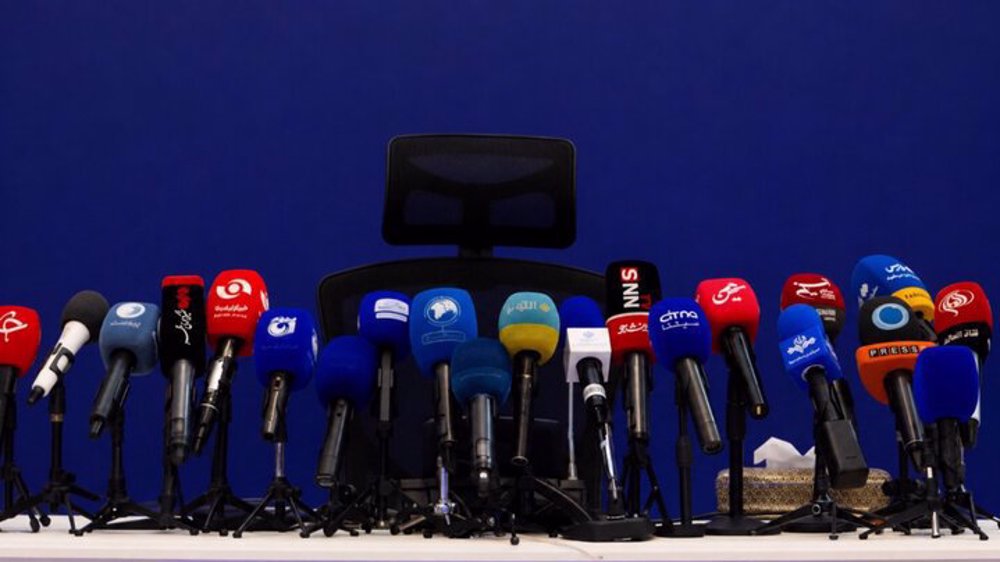
The General Staff of the Armed Forces’ Defense Communications, Media and Advertising Center and the Central Headquarters of Khatam al-Anbiya has praised Iranian journalists for informing the public and countering the enemy’s cognitive and media warfare.
In a statement marking National Journalists’ Day on Saturday, the center said media professionals work with commitment and courage to “narrate the truth” and enlighten public opinion at national and international levels.
It also honored journalists killed in the line of duty and thanked media workers for supporting the armed forces, describing their efforts as an important component of national power and psychological security.
Iran marks Journalists’ Day on Aug. 8 in memory of journalist Mahmoud Saremi, who was killed in Afghanistan in 1998.
Foreign media’s admission of Trump’s defeat reflects efforts of revolutionary media: IRGC
The Islamic Revolution Guards Corps (IRGC) also marked the occasion, saying that foreign media outlets’ acknowledgment of US President Donald Trump’s failure in the war against Iran is the result of the efforts of Iranian revolutionary media outlets to counter the enemy’s disinformation campaign.
In a statement, the IRGC praised journalists for their role in informing the public and maintaining hope, awareness and truthfulness during challenging circumstances.
“Today, the region and the world are witnessing one of the most complex and consequential battles in contemporary history,” the statement said, referring to the second and third wars waged by the United States and Israel against Iran.
The US and the Israeli regime jointly launched an unprovoked aggression against Iran on February 28 by targeting the Leader of the Islamic Revolution, Ayatollah Seyyed Ali Khamenei, Iran’s top officials, and also an elementary school in Minab, south of the country, killing 168 children, teachers, and parents.
In response, Iranian armed forces launched powerful reprisal attacks against US and Israeli assets in the region, dealing heavy blows to the invading coalition.
The IRGC noted that despite Washington and Israel’s military and media efforts, they had failed to achieve their stated objectives, while the conflicts had instead exposed a strategic deadlock, divisions among Western allies and the decline of their influence.“World media outlets, acknowledging Washington’s failure to prevail over the Islamic Republic, are openly speaking of Trump’s ‘defeat’ and the ‘self-created trap’ in his war against Iran,” the statement said.
It added that some media reports had characterized the agreements reached as little more than a “document of US surrender” in the face of Iran’s defense capabilities and negotiating power.
The IRGC said such assessments demonstrated Iran’s military strength and active deterrence, attributing them to the strategic decision-making of the country’s leadership, the resilience of the Iranian people and support for the armed forces.
It also praised the role of Iranian media, saying that “the intelligent and precise efforts of revolutionary media outlets” had helped counter hostile disinformation and exaggeration.
The statement further slammed Iran’s enemies for using a range of hybrid and cyberwarfare tools, including artificial intelligence, to distort facts and widen the gap between the Iranian people and the Islamic Republic.
“The experience of the unrest, particularly the events of January 8 and 9, 2026, taught us that the media dimension of sedition is the most complex and vital part of this equation,” the IRGC said.
“The first narrative will belong to whoever enters the field faster, more accurately and more intelligently.”
The IRGC also praised journalists who, during the recent war, worked to provide timely accounts of events, report on the presence and resistance of civilians, portray the suffering of victims and their families, and highlight unprecedented national solidarity.
It paid tribute to journalists who continued their work despite threats and dangerous conditions, saying some had lost their lives while carrying out their duties.
The IRGC congratulated journalists and media workers on National Journalists’ Day, describing them as “fighters on the front of awareness and the pen” who defend the “frontline of narrative and truth.”
Iran Army: Journalists are commanders on front line of hybrid warfare
Brigadier General Seyyed Hassan Abutorabi, Deputy for Public Relations and Media of the Islamic Republic of Iran’s Army, congratulated all committed and dedicated Iranian journalists, describing media professionals as commanders on the front line of the hybrid war against the country’s adversaries.
Abutorabi stressed the decisive role of journalists in strengthening public awareness and said the media and the battle over narratives had become a key arena of confrontation between Iran’s adversaries and the Iranian people and government.
“Today, the media and narrative have become the main arena of confrontation between the enemies and the grateful people of Iran and the Islamic Republic, and journalists are the commanders on the front line of this media battle,” he said.
He added that journalists use “the tools of the pen, image and narrative” to stand against organized campaigns by Iran’s enemies.
Iran FM: Our first task in New York is to defend the just cause of Iranian people
US visa ban on Iranian president’s media team is bid to hide the truth: FM spokesman
US aggression, economic warfare amount to crimes against humanity: Iran's UN envoy



Russia’s Rosatom increases workforce at Iran’s Bushehr Nuclear Plant
Yemen shoots down Saudi UAV after deadly airstrikes by Riyadh
Iran says international flights continue despite US sanctions pressure
Araghchi presses neighbors, Europe on Iran’s security concerns at UN
313,000-strong ‘Jan-Fada’ drill signifies Iran’s popular mobilization and social readiness amid war
VIDEO | Algeria-UAE rupture: From electoral interference claims to broader regional dispute
Leader’s advisor: Any foreign forces attempting to land in Iran ‘will certainly be destroyed’
VIDEO | Press TV's news headlines


 PressTV NEWSLETTER
now
PressTV NEWSLETTER
now
 This makes it easy to access the Press TV website
