Syria’s unelected parliament holds first session since HTS regime took power
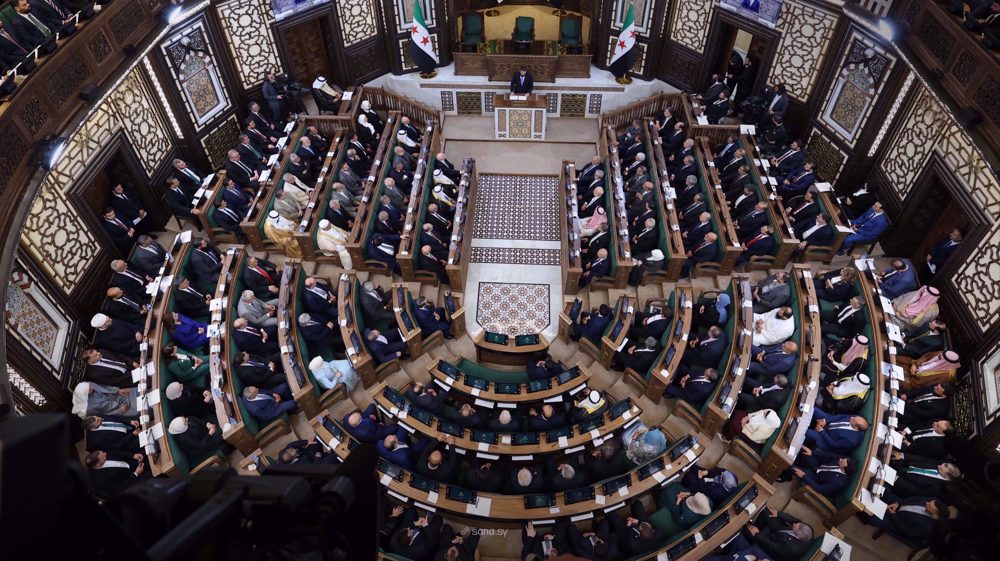
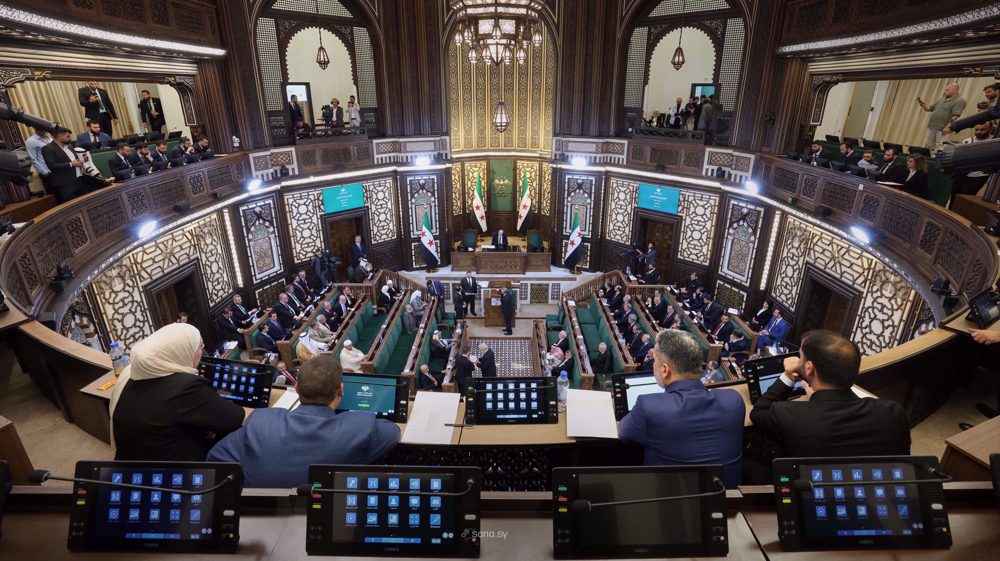
Syria’s unelected parliament convened for its first session since the Hay’at Tahrir al-Sham (HTS) regime took power in December 2024, amid the absence of political parties and the growing influence of extremist Takfiri scholars over state institutions.
“I invite you to make this council a model of responsibility and competence, and to contribute to entrenching a culture of dialogue, the rule of law, and respect for institutions,” HTS leader and former al-Qaeda militant commander Abu Mohammed al-Jolani said during his speech at the opening session of the legislature on Sunday.
“Syria today is writing a new history that expresses its civilization, values, and heritage — let us together make the history of modern Syria,” Jolani claimed.
Mohammed Taha al-Ahmad, the head of Syria’s so-called Higher Committee for People’s Assembly Elections, opened the inaugural session.
Osama al-Assaf, a member of parliament, urged his fellow members to establish a temporary legal committee to oversee the election process and formulate rules for electing the parliament speaker.
The legislature, consisting of 210 members, includes 70 lawmakers directly appointed by Jolani, who will serve a renewable 30-month term.
The other 140 lawmakers were elected by committees whose members were likewise appointed by the HTS leader and his aides.
Jolani’s involvement, both directly and indirectly, in the selection of lawmakers has faced criticism from advocates of democracy, who point out that the Syrian nation has not been given a voice in the parliamentary elections.
Additionally, the HTS chief appointed 15 more women to the newly formed legislature, raising the number of female representatives in Syria’s parliament from an initial 6 to 21.
HTS officials have not provided clarity regarding the number of appointed lawmakers who are part of ethnic or religious communities.
Under Jolani’s rule, HTS-allied militant forces have perpetrated appalling massacres targeting the Alawite and Druze religious communities.
In the central province of Homs, Alawites are frequently abducted and murdered, with the ruling authorities showing no intention to intervene and stop such atrocities.
The United States and its regional allies orchestrated the militancy against the government of former Syrian President Bashar al-Assad starting in March 2011, and eventually brought Jolani to power.
However, they have not called on him to allow the establishment of political parties or implement a democratic system in the country.
Rather than following a different course, Jolani, who appointed himself as president, has reinforced his leadership by assigning Takfiri scholars to key positions within each Syrian municipality and other state institutions.
These extremist scholars, acting as a shadow administration, formerly held positions as “religious judges” and commanders within the HTS terrorist group, which was previously recognized as the al-Nusra Front – the official branch of al-Qaeda in Syria.
Israeli forces ramp up attacks in southern Lebanon, shell southern Syria
Syria’s Suweida: Fresh fighting reported between HTS forces, Druze fighters

Trump lifts sanctions on top Al Qaeda terrorists as America prepares for 9/11 anniversary



Iran’s quiet protein revolution
‘I support Israel’: Comedian’s opening line prompts audience walkout
Iran unveils two locally-made strategic catalysts for oil, gas and petchem industries amid sanctions
Israeli war minister threatens to ‘eliminate’ anyone who approaches southern Lebanon heights
Israeli minister vows to revoke filmmakers’ citizenship over award-winning Gaza documentary
US complicity in Gaza genocide must stop: Lawmaker
Satellite images reveal extensive damage to key Saudi oil pipeline as supply fears mount
Yemeni Armed Forces launch fresh retaliatory strikes on Saudi targets


 PressTV NEWSLETTER
now
PressTV NEWSLETTER
now
 This makes it easy to access the Press TV website
