Strait of Hormuz Iran's greatest source of leverage; no retreat on sovereign rights: Parl. speaker
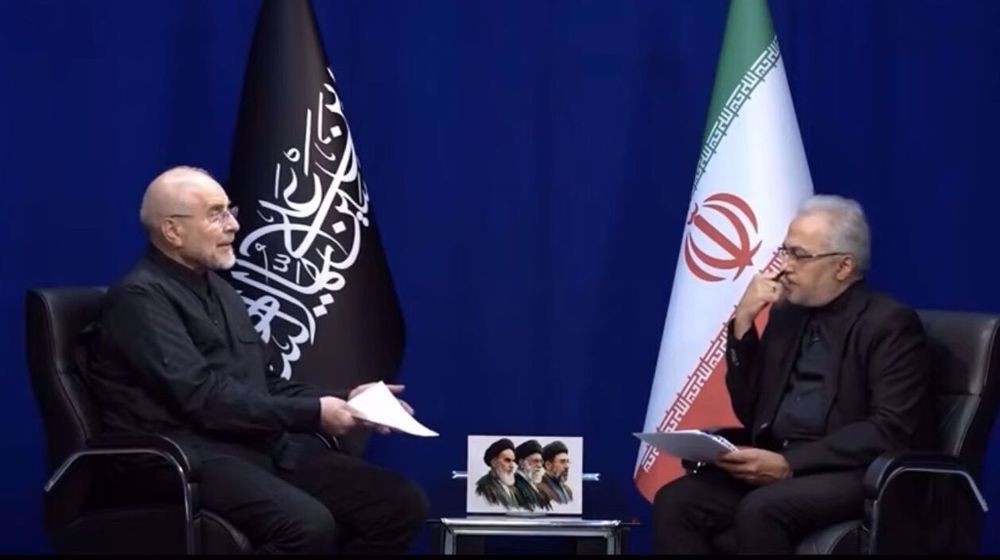
Iran's Parliament speaker identifies the Strait of Hormuz as the Islamic Republic's principal strategic asset, stressing that the country will not retreat from its sovereign rights over the vital waterway.
Speaking in a televised interview on Tuesday, Mohammad Baqer Qalibaf said a recently negotiated memorandum of understanding between Iran and the United States provides only a temporary exemption from fees for maritime services in the strait and does not alter Iran's position on the issue of sovereignty.
⚡️ “We are in talks, but we are READY for WAR"
— Press TV 🔻 (@PressTV) June 30, 2026
@mb_ghalibaf says that Iran considers any violations in the Strait of Hormuz to be violations of the ceasefire, and that Iran will not allow any act of violation to go unanswered.
Follow https://t.co/B3zXG73Jym pic.twitter.com/fwQbuRragU
"These are our territorial waters," he said. "We will not allow the United States to create controversy or sophistry by claiming that Iran has militarized the Strait of Hormuz."
He added that Iran "will never, under any circumstances, retreat from this position."
Qalibaf described the waterway as "a divine gift that God granted us during this war" and "our greatest instrument of power."
Iran closed the waterway to enemies and their allies following the launch of the latest bout of unprovoked American-Israeli aggression against the Islamic Republic.
It began exercising far stricter controls after US President Donald Trump announced the continuation of an illegal naval blockade of Iranian vessels and ports in violation of the terms of a ceasefire announced on April 7.
The official added that Clause Five of the memorandum provides for Iran and Oman to jointly determine the future administration and maritime services of the strait in accordance with international law and the sovereign rights of the littoral states. "Iran and Oman have already reached agreement on all legal and service-related matters," he said.
✍️ Mission unaccomplished – Part VII: US war goal shrank from ending Iran's civilization to reopening Hormuz Straithttps://t.co/bUvJR3pJN4
— Press TV 🔻 (@PressTV) June 30, 2026
Implementation tied to key provisions
Qalibaf said Iran would not move to later stages of implementing the memorandum until five core provisions were fully executed.
"Until all five provisions of the understanding are fully consolidated and finalized, Iran will not proceed to the next stage of implementing the remaining provisions," he said.
According to Qalibaf, those clauses cover the areas of ending the war, restoring Lebanon's sovereignty, lifting the US's illegal naval blockade against Iran, reopening the Strait of Hormuz, securing Iranian oil exports, and releasing frozen Iranian assets.
He added that the memorandum's Clause 13 stipulates that implementation of the remaining clauses can begin only after those marked as 1, 4, 5, 10, and 11 were fulfilled, referring to the provisions he had just mentioned.
Lebanon remains immediate priority
The official said Lebanon was the first priority during talks that have taken place so far towards examining implementation of the MoU, arguing that the memorandum places the country's territorial sovereignty at the center of implementation. He reminded that the understanding requires an end to military aggression against Lebanon, withdrawal of occupying Israeli forces, and the return of displaced civilians.
Qalibaf also noted that Iran, the United States, and Lebanon had agreed to establish a joint mechanism to oversee implementation of the understanding and restoration of Lebanon's sovereignty. Iran and the US have already appointed representatives, while Lebanon is expected to do the same before the mechanism becomes operational, the official stated.
Talks as an 'instrument of struggle'
Rejecting suggestions that diplomacy represented compromise, Qalibaf described talks as an extension of strategic confrontation.
"Negotiation is a method of struggle," he said, arguing that diplomacy shifts confrontation away from costly military engagement, while the country preserves its deterrent capabilities.
He maintained that talks with adversaries should always be conducted from a position of strength because "military power ultimately underpins diplomacy's legal authority."
Qalibaf further argued that military power and diplomacy complement one another rather than compete. "The battlefield and diplomacy are two blades of the same pair of scissors," he said.
According to him, diplomacy becomes a rational necessity when it can avoid damage without sacrificing national interests. As a case in point, he cited the Lebanese resistance movement Hezbollah's strategy of combining military preparedness with political engagement, saying understandings are acceptable only when they preserve Lebanon's "dignity and deterrence."
Contrast between Iran's approach and US's ambitions for Lebanon
The official contrasted Iran's memorandum with a separate US-backed so-called "framework agreement," arguing that Tehran seeks to preserve Lebanon's independence, while Washington aims to normalize Lebanon's relations with the Israeli regime.
The US proposal, however, has not been accepted by the Lebanese people, he added, noting that it would conflict with Lebanon's constitution by formally enabling an Israeli foothold in Lebanon and placing the Lebanese army in a position of "guaranteeing Israeli security."
Naval blockade and oil exports
Qalibaf described the lifting of the US's naval blockade as evidence that diplomacy backed by military leverage had produced tangible results.
According to him, Clause Four of the understanding required the United States to begin lifting the blockade immediately after the memorandum was signed and complete the process within 30 days.
He said implementation occurred much sooner after Iran secured a commitment that Pakistani Prime Minister Shehbaz Sharif, acting as mediator, and Trump would announce the end of the blockade the same night the memorandum was finalized.
"As a result, the blockade ended well before the 30-day deadline," he said, describing the outcome as proof of "the power of both the battlefield and diplomacy."
Qalibaf added that Iran had exported more than 40 million barrels of oil in less than two weeks following the lifting of the blockade, presenting the increase as evidence that implementation was already generating economic benefits.
'Military power absolutely non-negotiable'
Addressing the legal framework of the memorandum, Qalibaf questioned whether approval by the UN Security Council would provide meaningful guarantees.
"Didn't Mr. Trump tear up and disregard a UN resolution in 2017?" he asked, referring to the US's withdrawal from a nuclear agreement between Iran and others that had been ratified by the Security Council.
Learning from such experiences, Iran ultimately relies on its domestic capabilities rather than international guarantees.
"Strong domestic capabilities and a strong position on the ground constitute the country's only genuine guarantee," he said.
Qalibaf emphasized, therefore, that Iran's missile program and military capabilities remain beyond the scope of any talks and are "absolutely non-negotiable."
Nor will Iran negotiate its nuclear rights or regional influence, he said. "Uranium enrichment is our legitimate and inalienable right."
'Talks renewable'
Qalibaf said negotiators had established a renewable 60-day timetable covering all 14 provisions of the memorandum, with extensions possible until a final agreement was reached.
According to him, talks would continue until all primary and secondary sanctions imposed by the United States and the Security Council were removed.
'Language of force always at hand'
The official warned that if the memorandum's first provision, namely ending the war, was violated, Iran would respond accordingly.
"We negotiate in order to achieve our objectives," he said, "but wherever the language of reason and the memorandum proves ineffective, the language of force applies."
Iran urges UK, France to heed veteran diplomats’ warning on Israel
Iran to neutralize econ. pressure, keep Hormuz closed until US meets commitments: Security chief
'US economic terrorism' cannot change Iranian people's resolve: VP



Iran urges UK, France to heed veteran diplomats’ warning on Israel
Iran to neutralize econ. pressure, keep Hormuz closed until US meets commitments: Security chief
VIDEO | New security arrangements in region
VIDEO | Lebanese authority ignores Israeli aggression: Political analyst
Putin says Ukraine’s strikes opened 'Pandora’s box,' vows retaliation
VIDEO | Israeli regime could secure so-called Litani River via Ali al-Tahir: Analyst
Qatar cuts government budget amid massive hit from US war on Iran
VIDEO | Gaza’s cash crunch: Repairing worn-out banknotes



 PressTV NEWSLETTER
now
PressTV NEWSLETTER
now
 This makes it easy to access the Press TV website
