Leader’s strategic vision leverages Iran’s post-war ascendancy to reshape regional power dynamics
By Press TV Strategic Analysis Desk
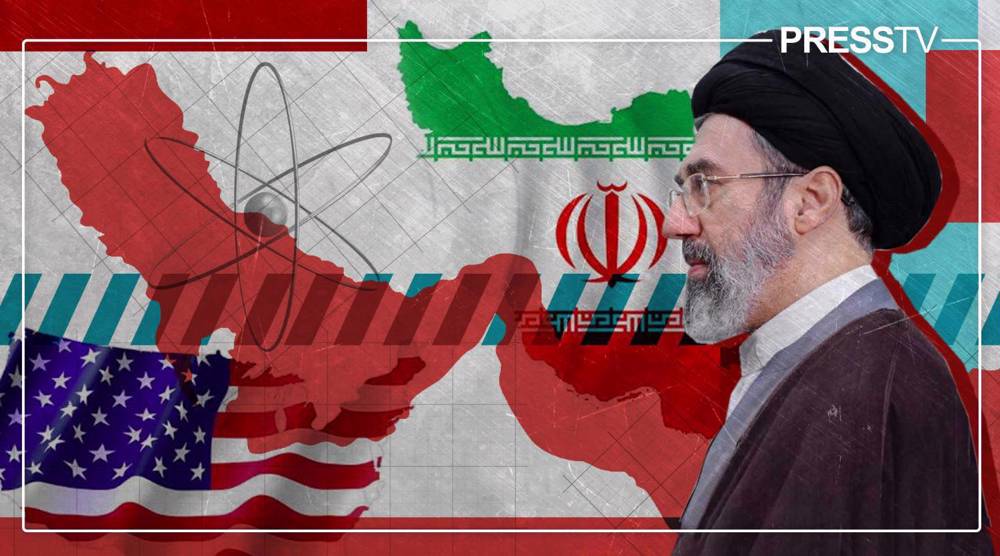
The evolving geopolitical landscape following the third imposed war has produced a decisive inflection point in Iran's strategic calculus, one that, according to the intellectual and analytical framework of the Leader of the Islamic Revolution, extends decisively beyond the confines of any memorandum of understanding.
At the core of this paradigm lies a fundamental reappraisal of power itself: who holds the strategic initiative, who dictates the terms of engagement, and how the balance of strength has irrevocably tilted after the enemy’s years of asymmetric pressure campaigns.
What crystallizes from this perspective is a coherent strategic doctrine anchored in a simple yet profound truth: the tangible indicators of power now unmistakably reflect Iran's ascendant position and the adversary's unmistakable trajectory of weakness and decline.
This is not rhetorical posturing but a sober reading of field realities, which includes military resilience, political endurance, unshakeable regional alignment, and the cumulative strategic weight accumulated through decades of principled resistance and resilience.
Beyond the memorandum: A broader strategic doctrine
A central tenet of the recent message by Ayatollah Seyyed Mojtaba Khamenei is that his vision cannot be reduced to the operative language of any formal agreement.
Rather, it constitutes an integrated intellectual system that interprets contemporary events through historical depth, strategic continuity, and the unvarnished lessons of battlefield experience.
This framework is animated by several interlocking considerations: the unprecedented scale and decisive outcome of the recent imposed war, the urgent necessity of recalibrating Iran's posture toward a hostile adversary, the enduring record of American enmity stretching back decades, and the historic strategic opening forged by Iran's extraordinary resilience and battlefield victory.
From this vantage point, the memorandum of understanding represents not the culmination of strategy but a tactical instrument subsumed within a far broader strategic architecture.
The underlying doctrine remains to be fully elaborated, rigorously theorized, and continuously validated against operational realities on the ground.
✍ Analysis - Iran-US war-ending MoU codifies Tehran's strategic leverage, cementing its status as regional superpower
— Press TV 🔻 (@PressTV) June 18, 2026
By Press TV Strategic Analysis Deskhttps://t.co/wCg8Z2Z8Um
Iran's upper hand: Reality of the battlefield and beyond
The recent unprovoked and illegal war of aggression launched in late February has conclusively demonstrated what strategic analysts have long discerned – Iran possesses asymmetric capabilities that transcend conventional military metrics.
The Resistance Front, operating with Iranian strategic guidance and material support, has proven capable of inflicting decisive defeats on an adversary equipped with one of the region's most sophisticated militaries. This is a documented reality, one that has compelled even hostile intelligence assessments to undergo fundamental revision.
The power indicators are clearly defined. First, Iran's ballistic missile program has demonstrated precision-strike capabilities that directly challenge the enemy's strategic depth. Second, the drone program has revolutionized asymmetric warfare, furnishing Iran with a cost-effective force multiplier that systematically offsets the enemy's technological advantages.
Third, Iran's naval capabilities, particularly its unchallenged control of the Strait of Hormuz, confer the ability to determine global energy flows, a strategic lever of immense consequence. The enemy's response to these realities has been revealing. Despite superior technology and extensive backing from the international community, it has failed to achieve any of its strategic objectives.
The trajectory clearly and unmistakably shows Iran's capabilities are expanding while the enemy's power-projection capacity steadily contracts, marking a structural shift, not a transient fluctuation.
Enemy's weakness and trajectory of decline
The recent war exposed the American war machine’s fundamental vulnerabilities with unprecedented clarity. Military overreach, economic exhaustion, and deepening political fragmentation converged to produce a situation where the enemy struggles even to sustain its defensive posture.
The defeated enemy confronts structural challenges on multiple fronts. The economic burden of protracted war has stretched the enemy's resources to the breaking point. The mounting human cost has corroded domestic support for continued aggression, which is illegal and unjustified in the first place.
Growing international isolation has constricted the enemy's diplomatic maneuverability. Most critically, the failure to secure victory – or even a face-saving exit – has fatally undermined the enemy's deterrent credibility. Once forfeited, such credibility is exceptionally difficult to restore.
This decline is structural, not episodic. The enemy's war machine exhibits fatigue that no infusion of foreign support can remedy. The strategic initiative has shifted decisively to Iran and its allies.
✍ Analysis - Beyond the MoU: Leader's message redefines framework of authority, legitimacy, and people's role in governance
— Press TV 🔻 (@PressTV) June 19, 2026
By Press TV Strategic Analysis Deskhttps://t.co/ZLbGcTlS7C
Unprecedented historical opportunity
The strategic and military victory achieved in the recent war has opened opportunities that Iranian policymakers cannot afford to overlook. The enemy's defeat has created strategic space that must be consolidated and expanded. This is not merely about territorial gains or tactical advantages; it is about fundamentally restructuring the regional order in Iran's favor and terminating the American hegemony that has long defined the region.
The opportunity radiates beyond the immediate battlefield. The enemy's weakness enables renegotiation of engagement terms across multiple domains – economic, political, and strategic. Iran's enhanced leverage can be converted into durable advantages, provided it is exploited with strategic discipline.
Leader's recent message makes clear that his strategic vision extends far beyond the text of any memorandum of understanding. The framework he articulated addresses the totality of Iran's strategic situation – the magnitude of the imposed war, the necessity of changing posture toward the enemy, the undeniable facts of Iran's capabilities, and the unprecedented historical opportunity created by historic military victory.
This framework recognizes that Iran's engagement with the enemy must be grounded in field realities, not wishful thinking. It draws on years of experience with US hostility toward Iran, the lessons of three imposed wars, and the achievements of the Resistance Front.
The consolidation of instruments of power
Leader's framework emphasizes that instruments of power must not merely be preserved but actively strengthened. This imperative applies with particular force to the Strait of Hormuz, which has emerged as a "newly discovered treasure of power and wealth."
The strategic value of this chokepoint is incalculable as it embodies Iran's capacity to influence global energy markets and impose asymmetrical costs on adversaries.
The preservation and consolidation of the Strait of Hormuz is not exclusively a military concern but an economic and strategic necessity that demands sustained investment in both naval capabilities and diplomatic positioning.
Perhaps the most consequential element of the Leader's framework is the explicit recognition of Iran as the victor and the enemy as the vanquished in the recent war.
This is a strategic reality that must permeate all engagement with the adversary. Within this paradigm, the defeated party has no alternative but to make concessions. The victorious side alone possesses the prerogative to set the conditions for a decisive end of the war.
This fundamental truth has been obscured in certain diplomatic circles, but the Leader's framework restores it to its rightful centrality. The implications are profound: Iran's demands are not negotiating positions in the conventional sense but the rightful extraction of what is due to the victor. The enemy's full compensation for martyrs and victims, the unconditional lifting of illegal sanctions, and the payment of reparations for inflicted damages are not bargaining chips, but legitimate demands rooted in justice and strategic reality.
✍️ Analysis - From battlefield superiority to strategic leverage: Iran’s new post-war doctrine takes shape
— Press TV 🔻 (@PressTV) June 15, 2026
By Press TV Strategic Analysis Deskhttps://t.co/QHmgtsFazC
The nuclear issue: A non-negotiable asset
Leader's stance is clear on the nuclear question: any discourse that compromises Iran's inherent assets, particularly its nuclear capabilities, is entirely unjustified. In the course of any negotiations, the purpose must be the consolidation of the nation's rights.
This means that discussions of Iran's nuclear program that entail even partial relinquishment of legal entitlements have no place at the negotiating table.
The nuclear program is a national asset, a product of scientific achievement and strategic foresight, and a cornerstone of national power. Its consideration in diplomatic forums must be confined to international recognition of Iran's inalienable rights, not their curtailment.
The Resistance Front: A united destiny
Resistance Front is Iran's natural strategic ally, its components bound by shared destiny. This alliance transcends intellectual and strategic convergence and is rooted in a common struggle against oppression, aggression, and occupation.
The enemy has long appreciated the utility of alliance structures, implementing comparable frameworks for itself and its allies, particularly the Zionist regime.
Iran, therefore, possesses not merely the right but the solemn obligation to champion not only its own interests but also those of its allies across the broad Resistance Front, which includes Lebanon, Iraq, Yemen, and Palestine.
The Leader's recent message explicitly noted a discernible gap between the emerging understanding between the Iranian and American presidents and the Leader's analytical framework. This dissonance must be addressed through consistent invocation and enforcement of the Leader's foundational principles.
The vast opportunities ahead must not be squandered. The proper utilization of the current strategic moment demands that all Iranian policymakers align with the Leader's framework, anchoring their actions in field realities rather than diplomatic abstractions.
The path forward: Practical implications
The commitment of the Iranian president to fulfill the conditions he has pledged to the Leader of the Islamic Revolution will be assessed against practical alignment with the signed memorandum's text. This assessment must be rigorous and transparent, with accountability extending to both the Leader and the Iranian people.
Clause 1 of the memorandum mandates an immediate and permanent cessation of hostilities across all fronts. The initiation of negotiations under clause 13 is expressly conditional upon the implementation of other clauses, including clause 1. This is not procedural formalism but a foundational principle.
According to the explicit position of the Iranian foreign minister, logical and entirely correct, the end of the war against Lebanon is devoid of meaning without the complete withdrawal of the Israeli occupation forces from the occupied Lebanese territories. Therefore, absent full regime withdrawal from Lebanon, clause 1 remains unfulfilled, and the memorandum provides no authorization for negotiations.
✍️ Analysis - How Iran turned battlefield gains and regional power into strategic postwar leverage against US
— Press TV 🔻 (@PressTV) June 14, 2026
By Press TV Strategic Analysis Deskhttps://t.co/6OAI0n8FS8 pic.twitter.com/Wo53HsrrN4
The purpose of engagement
The visit of the Iranian negotiating delegation to Switzerland is not, in principle, for a second phase of negotiations, given that clauses 1, 4, 5, 10, and 11 remain unimplemented. However, if the delegation's purpose is to follow up on the implementation of provisions under clause 13, such engagement is necessary and essential.
This distinction is critical: engagement with the enemy must be purposeful and anchored in the achievement of Iran's objectives, not in the process for its own sake. The delegation's work must be evaluated against clear benchmarks and tangible deliverables.
Transparent and continuous accountability of the negotiating team is indispensable to enable public oversight and media scrutiny. The Iranian people have an inviolable right to know how their interests are being pursued and what concessions – if any – are under consideration.
This accountability must be institutionalized through regular briefings, public reports, and parliamentary oversight. The era of closed-door diplomacy producing unilateral concessions must yield to a new model of transparent, accountable engagement.
The current strategic moment presents an unprecedented opportunity for Iran to consolidate its battlefield gains and effectively reshape the regional order in its favor. The power indicators show Iran holds the upper hand, and the enemy is in accelerating decline. The victory in the recent war has created a strategic space that must be fully exploited.
IRGC: Iran’s missile capability remains intact, production continues
Iranians ready to fight for next 20 generations to defend homeland: Army chief warns enemies
Iran: No country should fear us unless it aids aggressors



VIDEO | Yemeni women mark birth anniversary of Prophet Mohammad (PBUH)
VIDEO | Press TV's news headlines
VIDEO | Dozens of Israel-backed militia members in Gaza surrender
VIDEO | One year on: Israel’s double-tap massacre at Gaza’s Nasser hospital
Iran’s parliament speaker scoffs at US treasury secretary’s contradictory ‘Economic D-Day’ remarks
VIDEO | Backlash against US economic war
Iran details temporary Hormuz arrangement with Oman; vows reopening tied to fulfillment of demands
Canada announces retaliatory tariffs on more than 700 US products


 PressTV NEWSLETTER
now
PressTV NEWSLETTER
now
 This makes it easy to access the Press TV website
