Exclusive: New IAEA draft resolution recycles Iran 'non-compliance' myth while ignoring two imposed wars
By Press TV Website Staff
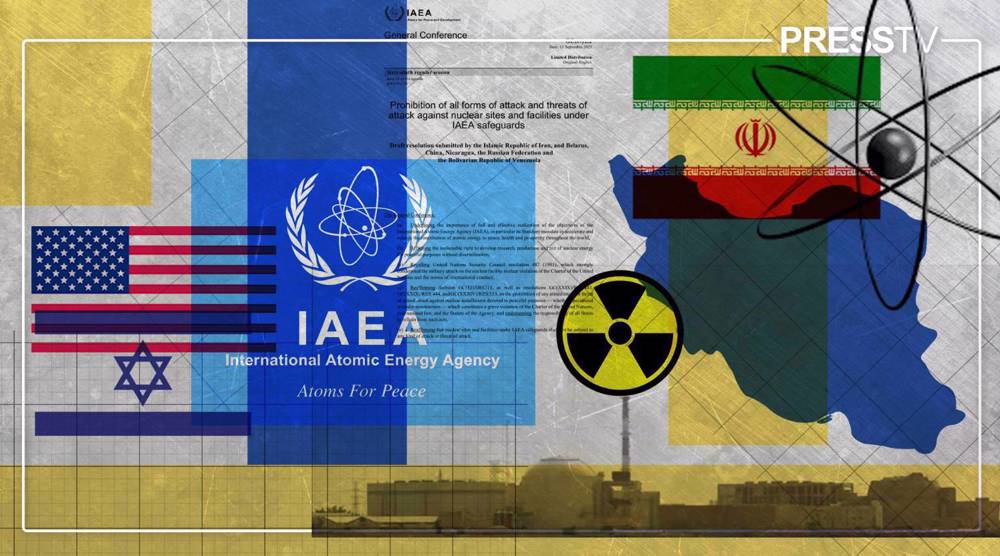
A draft resolution set to be tabled at the June 2026 meeting of the International Atomic Energy Agency's (IAEA) Board of Governors – a copy of which is in the possession of the Press TV website – is another calculated attempt to weaponize the UN nuclear watchdog against Iran and its peaceful nuclear program.
The new resolution – like many other IAEA resolutions in the past – seeks to mount political pressure on Tehran over the unsubstantiated and long-discredited claim of "non-compliance" with ITS nuclear safeguards obligations.
The proposed resolution, titled "Implementation of the Nuclear Non-Proliferation Treaty (NPT) Safeguards Agreement and relevant provisions of UNSC resolutions in the Islamic Republic of Iran," does nothing more than recycle the same old accusations.
It alleges that Iran has failed to provide the IAEA with full and timely cooperation regarding undeclared nuclear material and activities at multiple locations, ignoring the fact that three important Iranian nuclear sites were bombed by the United States and Israel.
Significantly, the draft text refers back to a June 2025 resolution that – without presenting any tangible evidence whatsoever – found Iran in non-compliance with its safeguards obligations under Article XII.C of the IAEA Statute.
That politically driven resolution, history now records, paved the ground for direct and unprovoked Israeli military aggression against Iran days later. The IAEA, by pushing that resolution, effectively became complicit in aggression against a sovereign NPT signatory.
According to the current draft, Iran has failed over the past year to remedy those alleged concerns or provide the access and information requested by the agency. This is a claim Tehran categorically dismisses, pointing out – correctly – that the agency's demands frequently exceed Iran's legal obligations under the NPT.
The IAEA, under Western pressure, keeps moving the goalposts – demanding more than the law requires, encouraging Iran's enemies to impose sanctions and wage wars, refusing to condemn attacks on nuclear facilities, and then dishing out new reports against Iran.
The latest resolution further cites the IAEA's 2025 Safeguards Implementation Report and a subsequent report by IAEA Director General Rafael Grossi, which claimed that the agency remains unable to verify previously declared nuclear material in Iran, including a large quantity of highly enriched uranium (HEU).
What the resolution conveniently omits is the context: much of the IAEA's so-called "lack of access" stems directly from the damage inflicted by US-Israeli military strikes on Iranian nuclear facilities – strikes that Grossi-led agency has never once condemned.
🔺 Press TV has obtained a copy of a new US-backed anti-Iran draft resolution prepared for the IAEA Board of Governors meeting in June 2026.
— Press TV 🔻 (@PressTV) June 8, 2026
Read in full: https://t.co/v3nxczKx8a
The draft further expresses "grave concern" that the agency has lacked access for nearly a year to verify previously declared stocks of both highly enriched and low-enriched uranium, describing the delay as "long overdue according to standard safeguards practice" and warning that it constitutes both a proliferation concern and a compliance issue.
But here is what the resolution does not say: Iran lost access to its own facilities because those facilities were bombed by the same entities that dictate terms to Grossi and his team.
The text further reiterates that the IAEA is currently unable to verify that no safeguarded nuclear material in Iran has been diverted toward nuclear weapons or other explosive devices, invoking Article 19 of Iran's safeguards agreement. This is an assertion Tehran has consistently rejected as factually incorrect and politically motivated.
In one of its strongest passages, the draft stresses that Iran's safeguards obligations "cannot be unilaterally amended or suspended," while reaffirming Tehran's legal obligation to implement modified Code 3.1 of its subsidiary arrangements with the agency. That provision requires early notification and disclosure of nuclear facility design information.
Iran's response is straightforward: Such demands must be viewed against the backdrop of two unprovoked wars of aggression on its territory, including direct attacks on nuclear sites.
No other NPT signatory has ever endured two full-scale military attacks while simultaneously being accused of non-compliance with its commitments. No other country has been bombed and then blamed for the consequences of those bombings.
The resolution also references earlier UN Security Council resolutions, including Resolution 1737 adopted in 2006, which – very illogically and unreasonably – demanded that Iran suspend all peaceful enrichment-related and reprocessing activities, including research and development work, as well as heavy water-related projects.
The text calls on Grossi to provide another report on Iran's implementation of the resolution ahead of the Board's next regular session. Quite interestingly, the draft warns that the Board remains prepared to take "further action," including steps related to reporting Iran's case again to the United Nations Security Council under Article XII.C of the IAEA Statute.
What is absurd is that the IAEA wants to report Iran to the Security Council, the very same Security Council whose permanent members were involved in the aggression against Iran.
This new and another politically-motivated draft resolution comes despite the fact that Iran has adhered to all its commitments under the NPT, despite being subjected to illegal sanctions and two unprovoked wars in less than a year.
Iran urges IAEA to avoid political pressure to be part of diplomatic solutionhttps://t.co/6plxhinv2I
— Press TV 🔻 (@PressTV) June 6, 2026
The first act of unprovoked and illegal military aggression in June 2025 came merely days after the IAEA passed its previous resolution against Iran. Israeli fighter jets struck Iran's central uranium enrichment facility at Natanz. Days later, the Arak nuclear reactor was also attacked. So, it was an IAEA resolution, followed by bombs.
Behrooz Kamalvandi, spokesperson for the Atomic Energy Organisation of Iran, at the time condemned the IAEA for its "dangerous and deliberate silence" regarding the aggression.
"We wrote multiple letters to Director-General Rafael Grossi warning of these threats, but they remained unanswered," Kamalvandi said. The agency was forewarned, but it didn’t act.
In the subsequent days, Israel's aggression intensified further, in flagrant violation of international law. On June 19, Israel carried out more strikes on multiple other sites, including the Natanz facility and the Khondab (Arak) heavy water reactor.
Just three days later, on June 22, American B-2 bombers breached Iranian airspace, targeting critical nuclear facilities at Fordow, Natanz, and Isfahan in a coordinated US-Israeli assault.
In response to this aggression against peaceful nuclear facilities and the IAEA's complicit silence, Iran's parliament approved a bill in June last year to suspend Tehran's cooperation with the agency. Lawmakers described the IAEA's actions as a betrayal of its own charter and a direct enabler of aggression against a sovereign member of the NPT.
Iran still kept the window open for the UN nuclear agency, like a responsible state, allowing it to make amends, but the politicization of the agency continued.
Far from acting as a neutral arbiter, the UN atomic agency has repeatedly allowed itself to be wielded as a political instrument by the United States and the Israeli regime. Even as Iran continues to cooperate with the agency, it has remained utterly mute regarding Israel's serial violations of international law, an illegitimate entity that has not even signed the NPT.
Its silence over the regime's aerial and cyber attacks against Iran's safeguarded nuclear facilities is nothing less than collusion by an international body sworn to impartiality.
Experts have long warned that this one-sided scrutiny has inflicted serious damage on the credibility of the international non-proliferation regime. It has created a two-tier system: one tier for Western-backed nuclear actors like Israel, which act with complete impunity, and another tier for sovereign and responsible non-nuclear states like Iran.
Senior Iranian official warns IAEA's Grossi over 'biased, destructive' remarkshttps://t.co/DAYB572ty8
— Press TV 🔻 (@PressTV) March 27, 2026
More recently, the US-Israeli war machine carried out yet another unprovoked military aggression against the Islamic Republic, and once again, the IAEA stood as a mute spectator.
Earlier this week, Iran's Permanent Mission to the United Nations Office and other International Organizations in Vienna made this point forcefully during the IAEA meeting, denouncing US-Israeli acts of “nuclear terrorism” and calling on the international community to adopt a "zero-tolerance policy" towards any attack on peaceful nuclear installations.
Such attacks, the mission reiterated, undermine the legitimacy and credibility of the international non-proliferation framework, particularly the IAEA's safeguards system, and erode the very foundations of global peace and security.
The mission further noted that the "gravest, most extensive and unprecedented" armed attacks against IAEA-monitored nuclear sites in the agency's entire history have been carried out against Iranian facilities.
"In their illegal acts of aggression in 2025 and 2026, the US – a nuclear-weapon State – and the Israeli regime – an outlaw nuclear-weapon-possessor – carried out 17 waves of multiple attacks against Iranian safeguarded nuclear facilities," it stated.
On Saturday, Iran's deputy foreign minister for legal affairs censured the UN nuclear agency over its continued politicized stance, stating plainly that if the agency wishes to be part of a diplomatic solution, it must stop turning technical reports into tools of political pressure.
In a post on his X account, Kazem Gharibabadi responded to the latest IAEA report and the media rhetoric of its director general regarding lack of access to damaged facilities, the status of uranium stockpiles, and the issue of "loss of continuity of knowledge" in Iran's nuclear program.
Grossi had claimed that the agency received no information from Iran about the status of declared nuclear materials, facilities, and locations outside facilities for safeguards purposes.
Gharibabadi said Grossi speaks of "ambiguity," "lack of access," and "loss of continuity of knowledge," but this situation did not arise in a vacuum.
Iran's safeguarded nuclear facilities were deliberately targeted by the United States and the Israeli regime. He added that the IAEA Director General has shown himself to be completely under the control of the US and the West, never once condemning these attacks.
"One cannot ignore the source of the disruption and then frame the consequences of that same disruption against Iran," he said.

Iran warns against politicized use of IAEA to justify military aggression

Envoy: UN meeting on Iran nuclear file a procedural abuse

IAEA anti-Iran resolution illegal, political and product of US-Zionist pressure: SNSC secretary



VIDEO | BRICS should continue to defend basic intl. rules, oppose protectionism: CGTN anchor
Oman deal will not mean reopening of Hormuz Strait: Iran FM
Clashes erupt in Germany protests demanding Merz’s resignation
Ansarullah takes over Bab al Mandab Strait
VIDEO | Death toll from Philippine ferry fire rises to 76
Iraqi MP: US forces’ September 30 withdrawal certain; foreign troops no longer needed
VIDEO | Pezeshkian urges BRICS to play more active role in upholding non-use of force principle
US attack on Iranian commercial vessel kills one, injures four




 PressTV NEWSLETTER
now
PressTV NEWSLETTER
now
 This makes it easy to access the Press TV website
