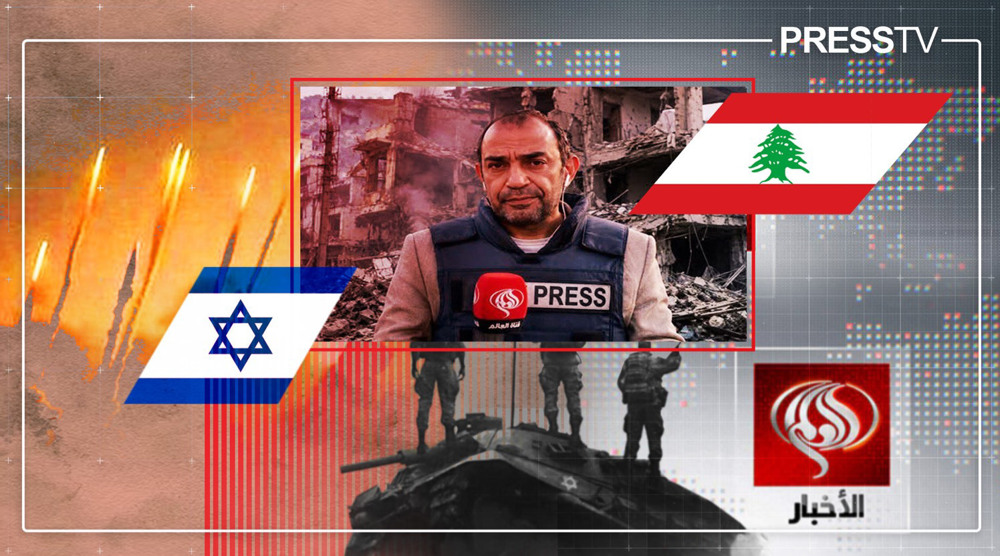
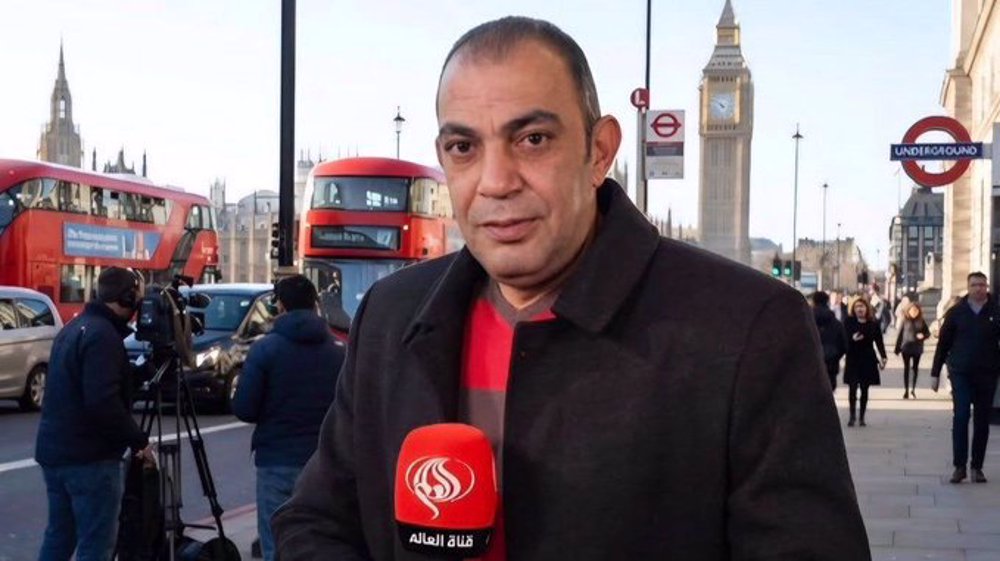
Profile: Hossam Zeidan, veteran Al-Alam journalist silenced after years documenting Zionist crimes
By Sheida Eslami
Although war had long cast its shadow over southern Lebanon, the morning of Thursday, May 28, began peacefully. The sun rose as it always did, unaware of another bitter tragedy that would soon unfold.
Sidon was waking up, and life was once again beginning to pass by the windows. But moments later, the sky framed a different scene: the roar of an explosion, followed by the heavy silence that always trails a crime – a silence in which one instinctively knows that something has been shattered.
In the Qai’a neighborhood, a residential building had collapsed. Rubble, smoke, screams, and people with bare hands searching for breath among stone and iron.
When the bodies were recovered, one name spread through the dust and blood, a name well known across the resistance media landscape, from Lebanon, Iraq, and Syria to Palestine and Iran: Hossam Zeidan. A veteran, courageous, and deeply committed journalist with the Al-Alam news network, he had spent years carrying his camera to the front lines so that the realities of war could be witnessed firsthand, without distortion or mediation.
Alongside him were several civilians – displaced people who had fled the Israeli war of aggression in search of safety, only for war to find them once again in a temporary shelter.
“Hossam” was a fitting name for him. In Arabic, his native language, the name means a sharp sword, a blade forged to cut through darkness and tear away the veil of deception.
And what a beautiful name it was for a man whose weapon was not steel, but truth; a journalist who carried his camera like a drawn sword into the heart of the battlefield and, with every report, pulled back another curtain of lies, distortion, and silence.
Long before he collapsed in his own blood in Sidon, Hossam had spent years wielding this silent sword – a struggle often harsher than bullets, fought in the arena of narratives, where the enemy fears the revelation of truth more than the loss of lives.
He was not among those journalists who narrate war from behind a desk. He belonged to a generation that understood news is not merely a collection of facts or a sentence on a screen, but a testimony. That understanding ran especially deep in a boy whose ancestral homeland, birthplace, and country was Palestine, yet who grew up far from it – in Lebanon, Jordan, and Syria – breathing an atmosphere infused with the fragrance of Qur’anic verses, olive trees, patience, and epic struggles.
It was a world in which the contours of life were drawn from childhood by words such as occupation, blockade, exile, and displacement. It was there that he chose his path: bearing witness to a suffering that much of the world either could not see or refused to see.
For that reason, Hossam studied media. After joining the Islamic Republic of Iran Broadcasting (IRIB) World Service Al-Alam news network in 2009, he devoted years to translating into images what others endured beneath rubble and missiles – displacement, torture, hunger, loss, and forced migration.
Through his lens, distant tragedies acquired faces, names, and voices.
Al-Alam TV correspondent, Hussam Zeidan is martyred in an Israeli airstrike on Lebanon.
— Highlights (@highlightsnews1) May 28, 2026
Follow Press TV on Telegram: https://t.co/mtgZgtmxsz pic.twitter.com/vNgULJMuMy
Where the journalist himself becomes the frontline
The turning point in his professional life came when the war in Syria transformed the battlefield into a complex arena of trial for the Islamic Ummah. From 2011 onward, during years when many retreated from the front lines, Hossam moved toward them.
From Deir ez-Zor to Aleppo and Hama, from half-destroyed cities to streets where gunfire seemed to write its own vocabulary of death, occupation, and crime, he stood his ground to document the everyday history of war and the future the enemy had sought to impose on Syria. Through his lens appeared the faces of mothers who shared bread with tears, children searching for their school notebooks beneath the rubble, and fighters struggling to reclaim the lives, homeland, and dignity of their people from the grip of Daesh terrorists.
He did not merely report events; he preserved the human story buried beneath headlines and military communiqués, revealing the cost of war as it was borne by ordinary people.
When the devastating earthquake struck Syria in 2023, Hossam was once again among the first to enter the disaster zone. He was not there in search of decorative images of suffering or fleeting emotional scenes, but to provide a humane coverage.
He went to show reality as it was: the shortages, the collapsed buildings, the mountains of rubble, and the people who had lost everything in a matter of seconds yet still faced the daunting task of surviving another day.
In the frame of destiny
They say some moments, if not recorded by a journalist, will later be distorted by history. One of those moments was the decisive narrative of Al-Bukamal in 2017; a place where he became not just a journalist, but an eyewitness to the bloody history of resistance.
Al-Bukamal, the last stronghold of Daesh, was a strategic key of the region. Hossam, with details only a precise field observer could grasp, narrated how the Syrian army and resistance fighters, in a breathless race against time, blocked the path of American forces that intended to seize the area from the Al-Tanf base.
He spoke of desert tactics and the military vigilance that prevented regional transit routes from falling into the hands of American occupiers. In his live reports, Hesam Zeidan did not merely report “victory” but described the battlefield map, explained the sensitivity of routes, and showed how seconds could change the fate of a geography.
Yet the most enduring frame of his narration was the sudden presence of the martyred top anti-terror commander General Qassem Soleimani on the frontlines of Al-Bukamal.
With a voice still trembling with emotion in archived Al-Alam footage, Hossam described how he saw Haj Qassem in the midst of fire and blood, walking among fighters without ceremony, without bodyguards, and with his familiar smile.
He spoke of that calm which stood like a pillar amid the chaos of the region, allowing resistance to lean on it, breathe again, and finish its mission.
Hesam testified that General Soleimani’s presence in the southern outskirts of Al-Bukamal changed the psychological equations of war; a man who was a commander but on the trenches stood shoulder to shoulder with his soldiers.
Zeidan’s narration of the commander who decimated Daesh conveyed to the world an image of “commanding hearts” that no Western media could suppress.
Israeli strike kills former correspondent for Iran's al-Alam TV, three refugees in southern Lebanonhttps://t.co/rUxFd7VDl5
— PressTV Extra (@PresstvExtra) May 28, 2026
From Damascus to Tehran and back to the field
After political changes in Syria in late 2024, his professional path led him to Tehran. For a while, he served at the main headquarters of Al-Alam network as news editor. But he was not the kind of person whose heart moves with relocation of office.
For him, the field was not geography, but commitment. When Lebanon once again came under pressure and threat, Hesam returned to the bleeding heart of resistance to see and report firsthand, without fear or favor.
It is said that two months before his martyrdom, in Israeli airstrikes, several of his close companions were also martyred. Grief became his constant companion, but it did not stop him from going, as if people like him become more resolute and determined to continue their work with sorrow.
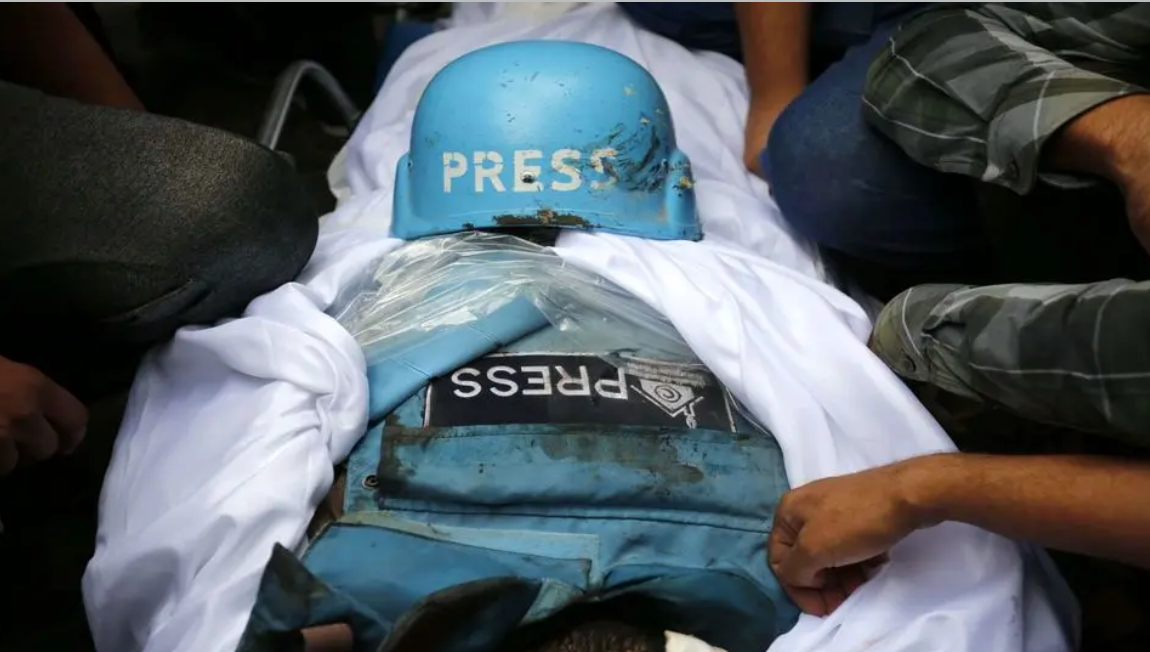
And then came that fatal attack, where the journalist himself appeared inside the news frame. In that despicable Israeli attack, he attained martyrdom himself, and his child was also severely injured and transferred to intensive care.
When martyrdom breaks the boundaries of news
The martyrdom of Hossam was not an ordinary news item, so reactions were not ordinary either. Official statements, condolence messages, and emphatic declarations stressed that targeting a journalist means targeting the “right to know.” Al-Alam network also spoke of its colleague, of someone who for years was the “narrator of difficult moments,” and who had now become one of those very moments.
The head of the IRIB, Peyman Jebelli, and IRIB’s World Service chief Ahmad Noroozi, also strongly condemned the assassination of the former correspondent of Al-Alam TV channel.
In a message released on Thursday, Jebelli described him as a “courageous warrior of the news field and determined journalist of the resistance media” who was martyred “in the criminal aggression of the Zionists” against Sidon, once again “revealing the ugly face and evil nature of the usurping Israeli regime.”
In a separate statement, Noroozi said that “the martyrdom of this dear colleague following the Israeli regime’s airstrike on the city of Sidon in southern Lebanon once again revealed its criminal nature.”
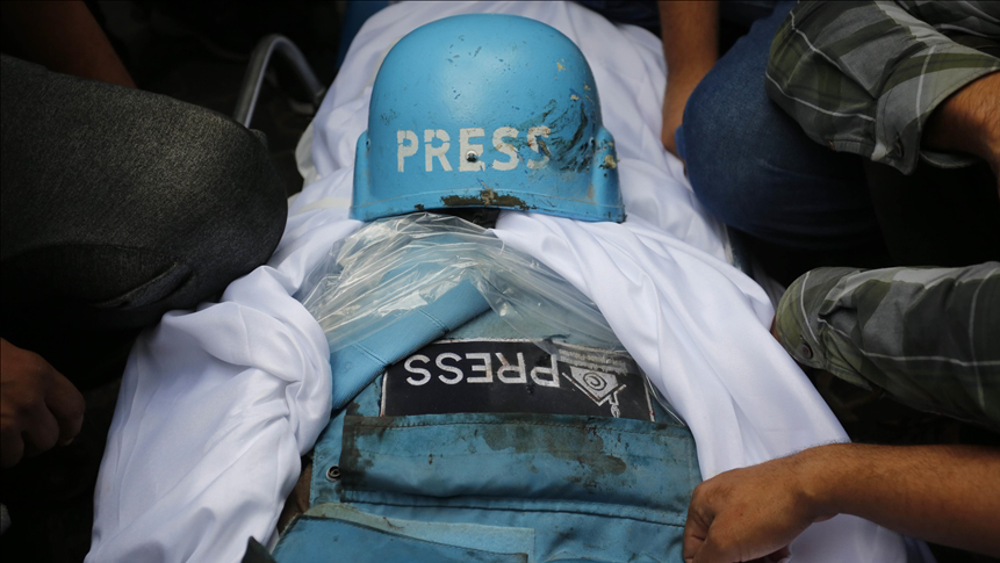
The martyrdom of Hossam is part of a red chain of journalists whose blood, in recent months, has become intertwined with the soil of southern Lebanon.
Before him came names such as Amal Khalil, the courageous journalist whose pen unsettled the occupiers; Ali Shaib, known as the "Avini of Lebanon," whose camera was a constant nightmare for Zionist forces along the border; Mohammad and Fatima Fatouni, the renowned cameraman and journalist of Al-Mayadeen; and many others whose names found their way onto assassination lists.
These were not accidents. Nor were they mere byproducts of war. They were systematic acts of violence directed against those whose only weapon was the truth.
IRIB condemns killing of al-Alam journalist by Israel in southern Lebanonhttps://t.co/me9X6iV9x7
— PressTV Extra (@PresstvExtra) May 29, 2026
The statistics are stark. The Zionist regime has earned the grim distinction of being one of the deadliest forces for journalists in the twenty-first century. The deliberate targeting of media workers in Lebanon and Palestine reflects an attempt to blind the world to what is unfolding on the ground – unaware that for every camera silenced, dozens more are lifted by a new generation determined to continue documenting events.
Today, amid a struggle that many across the region view as an existential confrontation between truth and falsehood, the martyrdom of these journalists has forged an unbreakable bond between the resistance fronts stretching from Tehran to Damascus, from Beirut to Gaza and Sana’a, and the media institutions that give voice to their narratives.
Their blood bears witness not only to what supporters describe as the moral and military decline of the Zionist regime and its American backers, but also to the emergence of a new regional reality – one in which the lived experiences and narratives of nations under pressure increasingly challenge long-established media monopolies and dominant international narratives.
Hossam and those like him did not fight with rifles, yet their work was a form of struggle in its own right. They believed journalism was not merely the transmission of events, but the preservation of history in humanity’s collective memory – a means of defending those whose voices are often drowned out by the noise of powerful media institutions.
Perhaps that is why they were considered dangerous. Once the truth is documented, it becomes far more difficult to erase.
Hossam is gone, but what he stood for remains – the conviction that truth cannot be assassinated, that if a voice is buried beneath rubble, history will eventually uncover it. And that those who bear witness do not truly disappear, so long as the stories they told continue to be remembered.
Sheida Islami is a Tehran-based writer, media advisor and cultural critic
Discover Iran: Tabriz’s ‘Mausoleum of Poets,’ where centuries of Persian literary history live on
Discover Iran: Tabriz’s Blue Mosque, where glorious history meets timeless Iranian architecture
200 nights, one resilient nation: Iranian people’s epic in defense of homeland and Revolution



US visa ban on Iranian president’s media team is bid to hide the truth: FM spokesman
US aggression, economic warfare amount to crimes against humanity: Iran's UN envoy
Protests erupt in US as ICE agent shoots Venezuelan driver
US pressure fuels cooperation among Muslim states: Pezeshkian
Major TV networks suspend White House pool coverage after Trump ban
US visa ban on Palestinian UN delegation violates international agreements: Hamas
VIDEO | Press TV's news headlines
Iran calls on France to respect law after suspending French cultural institute in Tehran




 PressTV NEWSLETTER
now
PressTV NEWSLETTER
now
 This makes it easy to access the Press TV website
