President Pezeshkian: Economic war is main front after enemy's military failure
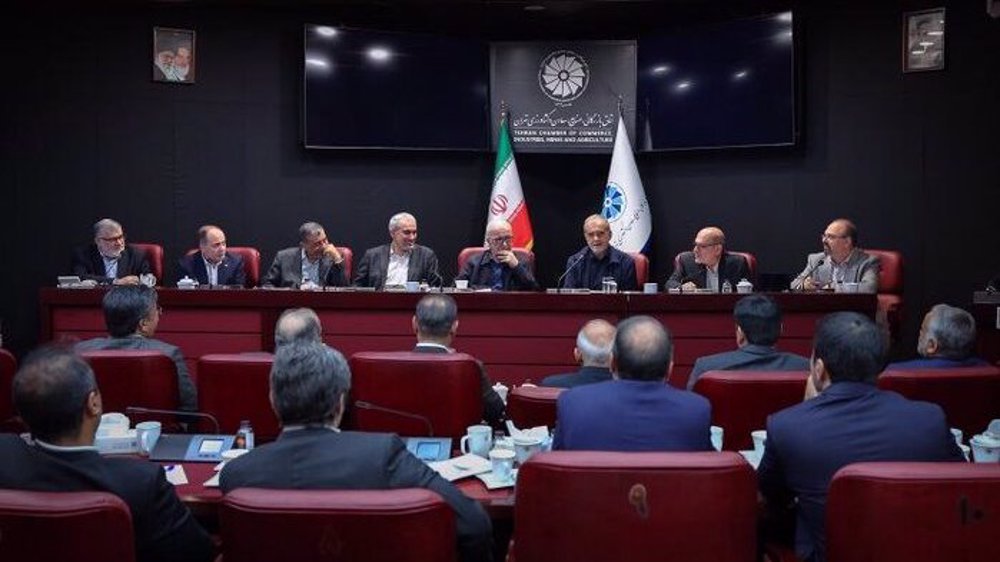
President Masoud Pezeshkian says the main battlefield between Iran and its foreign adversaries has shifted to the economy and people's livelihoods, describing the private sector as bearing the brunt of an "economic war" waged by hostile powers.
Speaking at a meeting with traders, merchants and private sector activists at the Tehran Chamber of Commerce, Industries, Mines and Agriculture on Wednesday, Pezeshkian said the state is determined to remove obstacles and provide the necessary groundwork for sustainable economic activity to bolster the country's economic resilience.
"The main field of confrontation today is the economy and people's livelihoods," Pezeshkian said. "The main burden of this economic war falls on the shoulders of traders, merchants, producers and private sector activists."
The president added that the enemy, having failed to achieve its objectives on the battlefield, is now seeking to wear down economic frontrunners through attrition.
"The enemy wants the economic activists, traders and merchants who are at the forefront of the economic war to suffer erosion and damage," he said. "But the government will not allow the private sector to stumble."
Pezeshkian emphasized that Iran's red lines remain clear and that the private sector is not just a partner but a central pillar of national strength.
"Our belief is that the more capable, agile and active the private sector is, the more robust the country's economic foundation will become, and national power against external pressures and threats will increase," he said.
The meeting was attended by the ministers of interior, economic affairs and finance, and agriculture, as well as the vice president for executive affairs and the governor of Tehran. They discussed challenges related to trade, commodity supply, market regulation, foreign exchange processes, customs, banking, and taxation.
Pezeshkian noted that his government inherited structural imbalances and subsequent external pressures including war, political threats, and the possible triggering of the snapback mechanism. He called for synergy between the government, the private sector, and other branches of the establishment.
"Iran's heads of the judiciary and legislature also have a positive view toward economic activists and the necessity of supporting the private sector," he said.
The president also drew on Islamic teachings, citing Imam Ali's historical letter to Malik al-Ashtar, which emphasizes the importance of traders and merchants in the stability of a country. He called for transparency, mutual trust, and a joint effort to combat rent-seeking and corruption.
"The enemy, after failing to achieve its goals on the military front, has focused on damaging the country's economic resilience and disrupting people's livelihoods," Pezeshkian said.
He called on economic activists to understand the country's exceptional circumstances and the government's limitations, urging cooperation to safeguard national interests and strengthen the economy.
"Successful passage through complex economic conditions requires mutual trust, transparency, responsibility, and genuine participation of all sectors," he said.
IRGC chief: Blood of martyrs in US attack on wedding will not ‘go unanswered’
Iran's vice president warns of 'dark months' for US economy amid war
‘Polished-up barbarism’: Iran officials condemn US war crime of wedding bombing



Denmark deploys troops to Greenland as US mulls force to take Arctic territory
VIDEO | Israel targets Gaza fishermen in latest attacks on fishing sector
IRGC chief: Blood of martyrs in US attack on wedding will not ‘go unanswered’
Iran's vice president warns of 'dark months' for US economy amid war
Lawyers seek to drop US charges against Venezuelan leader on immunity grounds
Abducted Gaza doctor’s testimony exposes appalling abuse in Israeli prisons
‘Polished-up barbarism’: Iran officials condemn US war crime of wedding bombing
VIDEO | Press TV's news headlines


 PressTV NEWSLETTER
now
PressTV NEWSLETTER
now
 This makes it easy to access the Press TV website
